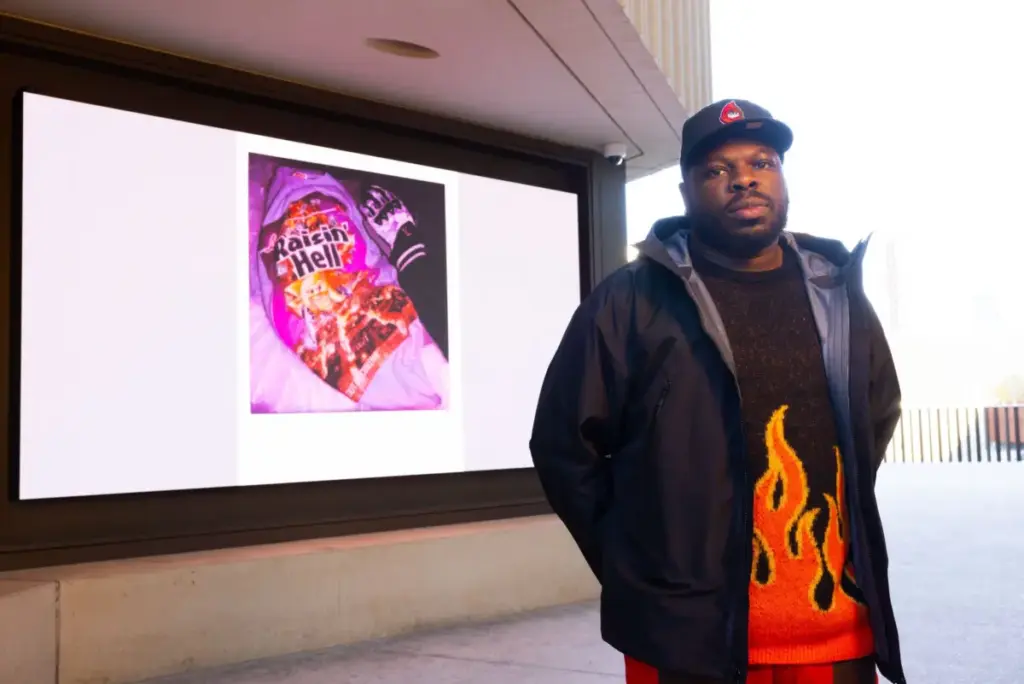
For multidisciplinary artist R.I.P. Germain, art is currently driven by what he calls “unruly fukkry”—a liberating, unfiltered mindstate that completely shrugs off whether a piece is gallery-friendly or designed to comfortably fit institutional expectations. Born in Luton and now based in Los Angeles, Germain’s broader artistic practice has long interrogated the complex intersections of the Black experience, identity, and cultural history. Now, his distinct perspective takes center stage in wheeloffortune, a striking new film commission for the V&A East Museum’s upcoming creative program, New Work: The Stories of Clothes.
Running from November 14, 2026, to June 20, 2027, the second iteration of the New Work series turns its focus toward the storytelling power of apparel. For Germain, this exploration stems directly from his own disorienting and often perilous transition from the United Kingdom to Los Angeles. Living in Southern California as a large Black man, he quickly grew acutely aware of the hyper-specific, sometimes lethal meanings attached to clothing across different neighborhoods. In a city where a particular color, brand, or style can inadvertently signal an affiliation with a local street gang, wardrobe choices carry profound weight. Clothing ceases to be a mere vehicle for personal expression and instantly transforms into a high-stakes social code—a language through which identity, territorial allegiance, and perceived threats are continuously read and misread.
The catalyst for this ambitious new commission was profound and alarming: a near-death experience. Reflecting on that pivotal moment of clarity, Germain developed wheeloffortune, which he describes bluntly as a "horror agent." The film serves as an unflinching artistic refraction of his life in Los Angeles, taking the form of a hypnotic slideshow featuring polaroids of individual garments and meticulously arranged outfits. These are clothes that have historically functioned—and continue to function—as signals of kinship or catalysts for violence depending on who wears them and where they walk, particularly for Black and Brown men navigating the urban landscape.
To construct this visual narrative, Germain weaves together disparate aesthetic languages, blending high-end luxury streetwear, the subcultural codes of African American Angeleno gangbanging, and the clinical precision of crime-scene forensics. The resulting project visualizes a long, exhausting period of personal contemplation regarding his own reality: coming to terms with walking through a city as a target, being perceived as a threat, and being treated as one—distinctions that Germain notes are entirely separate forms of danger. Rather than offering neat resolutions or comforting answers, wheeloffortune stands as a vital act of respite and a jarring, alternative lens through which to examine the absurdities of modern Americana and the persistent, low-frequency hum of terror that underscores daily life in the United States.
The research and acquisition process behind the project was exhaustive, demanding meticulous attention to historical and subcultural lore. Germain spent months scouring secondary online clothing marketplaces to track down elusive pieces. Every single item featured in the film is either something an African American gang member in Los Angeles would genuinely wear to show allegiance, or it incorporates a symbolic reference that Germain applied through artistic license.
Detailing one specific example of this methodology, Germain points to his utilization of yellow garments designed to evoke the aesthetic codes of the Main Street Mafia Crips. Because members of the set traditionally incorporate an "M" logo and colors like blue, yellow, or both into their dress, Germain tracked down a rare collaborative hoodie between Palace and McDonald’s alongside a pair of baggy Evisu Daicock Print #2000 jeans, both of which feature prominent yellow "M" motifs. This obsessive level of detail applies to every item in the film, rooted either in the grueling difficulty of its acquisition or its broader historical resonance within fashion history.

The process has also forced Germain to confront uncomfortable truths about the fashion industry itself. Over the past fifteen years, both American and Japanese high-end luxury streetwear brands have frequently marketed clothes that appear specifically targeted at gang members—or, at the very least, at consumers who recognize the dangerous connotations and find that transgressive association enticing. This implicit glamorization of gang culture presents a tangle of ethical and aesthetic problems that Germain continues to unpack, acknowledging that his maximalist instincts and lingering survivor’s guilt may subconsciously drive his fascination with these motifs.
Stepping into filmmaking for wheeloffortune also pushed Germain far outside his creative comfort zone. While sculpture remains his native, fluid language—a medium where he feels comfortable getting loose—tackling film forced him to dig into the gut of issues that feel deeply serious and emotionally volatile. Expressing the messy, shifting thoughts surrounding the reality of nearly dying violently required a medium that could capture the dizzying vertigo of his current life. Yet, he remains committed to the conversation, aiming to blend photographic and sculptural elements more fluidly in his future endeavors to bring out a more warped, experimental edge in his practice.
Guiding this uncompromising artistic evolution is a personalized set of mantras—five core questions that hang like pendants on the chain of his practice: Am I looking back at the line yet? Fun? Can I see my heart? WWLD (What would Lutz Bacher do)? Is this as weird as I feel? These inquiries keep him anchored in a state of rigid yet fluid creation, far away from institutional predictability or creative stagnation. To offer viewers a window into the cultural lineage that informs this mindset, Germain points to an eclectic sequence of references spanning grime MC sessions, dub music, classic hip-hop, spiritual traditions, and cinematic explorations of alienation.
Ultimately, Germain hopes that audiences encountering wheeloffortune will recognize that clothes carry a weight far heavier than their fabric. Depending on the neighborhood, garments can speak volumes on behalf of the wearer, often without their conscious consent. By laying bare his own proximity to systemic violence and the surreal reality of navigating Los Angeles as a young Black man, Germain delivers a work rooted in an uncompromising commitment to truth and an unyielding willingness to wade directly into the mess.
New Work: The Stories of Clothes will run from November 14, 2026, to June 20, 2027. The V&A East creative commissions program invites artists twice a year to respond to shared themes exploring the intersections of art, design, and everyday life across the V&A East Museum and V&A East Storehouse. Following its inaugural theme, Making East London, this second iteration highlights the storytelling capacity of fashion through immersive installations, film, displays, and live events.