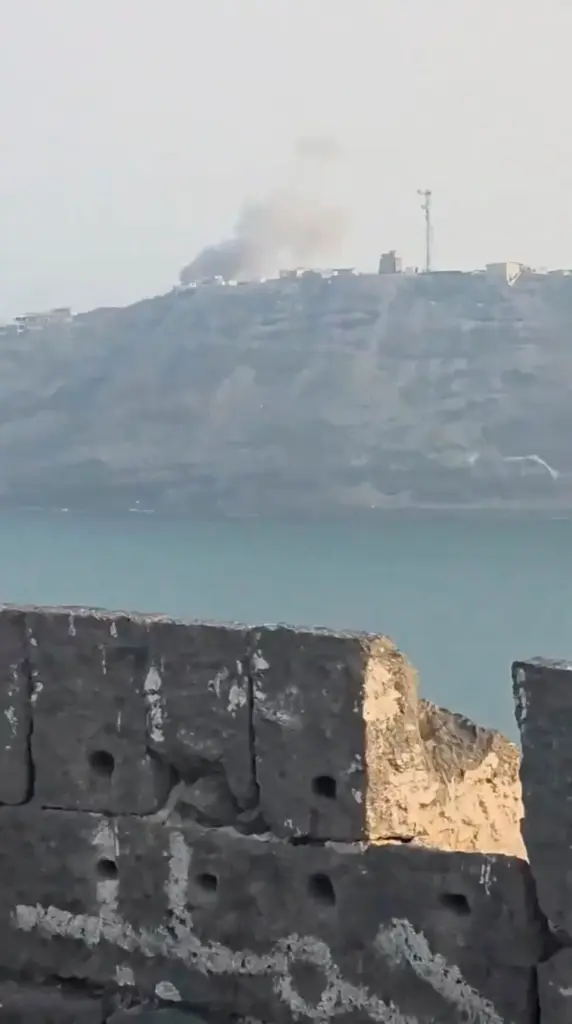
At least five people were killed and 16 others wounded on Thursday when Yemen’s Houthi forces launched a high-profile missile and drone attack targeting the presidential palace complex in the southern port city of Aden. The brazen assault on the Al-Maashiq palace—serving as the heavily guarded headquarters for Yemen’s internationally recognized, Saudi-backed government—marks the first time the vital political complex has been directly struck in the latest resurgence of fighting.
The tragic escalation highlights a sharp deterioration in the security situation as hostilities intensify on multiple fronts. Yemeni Health Minister Qasim Buhaibeh confirmed that the casualties resulting from the complex blast included both security guards tasked with protecting the compound and civilian employees working within the administrative infrastructure. Meanwhile, Information Minister Moammar al-eryani moved quickly to reassure the public and international partners, confirming that the prime minister and members of the Cabinet were unharmed during the bombardment.
Responsibility for the attack was swiftly claimed by Houthi military spokesperson Yahya Saree. In a televised statement, Saree asserted that the insurgent group had intentionally targeted what it described as a Saudi military operations headquarters embedded within Aden. Adding to these assertions, the Houthi-run SABA news agency alleged that Saudi officers operated the targeted facility and that it doubled as a strategic weapons depot. These specific claims regarding the operational nature of the compound could not, however, be independently verified by international observers or independent news agencies.
Alleged Targeting of a Saudi Fighter Jet
The strike on Aden’s presidential complex unfolded concurrently with Houthi claims that the group had successfully engaged a Royal Saudi Air Force fighter jet high above Yemen’s northern Saada province late Wednesday. In support of this claim, the Houthis released infrared video footage purportedly showing a missile detonating in close proximity to a Saudi Eurofighter Typhoon.
According to military spokesperson Yahya Saree, the aircraft had departed from Saudi Arabia’s strategically vital Taif Air Base and had sustained a direct hit, leaving it at severe risk of crashing. However, a close analysis of the released footage painted a more ambiguous picture. The infrared recording appeared to show a missile detonating near the aircraft rather than scoring a direct hit, with the pilot executing evasive maneuvers to steer the jet away from the expanding shockwave and debris field.
Furthermore, a visible trail emanating from the aircraft’s left wing immediately sparked intense speculation among defense analysts regarding possible structural or mechanical damage sustained from missile shrapnel. Despite this visual evidence, neither the precise extent of any potential damage nor the authenticity of the footage itself could be independently confirmed by military experts.
Saudi authorities maintained a strict silence on the matter, offering no official confirmation of the incident. To date, there have been no verified reports from coalition or independent sources indicating that a Saudi fighter jet was actually shot down during the engagement. Defense observers monitoring the region suggested that the weapon involved in the near-miss may have been a Barq surface-to-air missile, a platform historically associated with Houthi air defense units and widely believed by intelligence analysts to share technological roots with Iranian missile systems.
Spike in Cross-Border Attacks and Coalition Retaliation
The alleged engagement over Saada province and the subsequent attack on the Al-Maashiq palace in Aden coincide with a broader wave of intensifying violence across the Arabian Peninsula. Riyadh has increasingly accused the Houthi movement of ramping up aggressive drone and missile campaigns aimed squarely at civilian airports, maritime ports, and critical energy infrastructure distributed across the kingdom.
Addressing reporters on Thursday, Saudi-led coalition spokesperson Turki al-Maliki detailed the heavy toll exacted by these relentless cross-border strikes. According to Maliki, Houthi forces had launched a staggering 20 separate attacks targeting King Khalid International Airport in Riyadh over the course of the month alone. These sustained strikes on the Saudi capital’s primary aviation hub have resulted in the tragic deaths of 17 people and left 333 others wounded.
In addition to the attacks on Riyadh, Maliki reported that separate, targeted strikes directed against Abha airport in southwestern Saudi Arabia had claimed three lives and injured 28 individuals. The coalition spokesperson forcefully accused the Houthi leadership of acquiring increasingly sophisticated and lethal weaponry—including advanced ballistic missiles, long-range drones, and high-speed explosive-laden boats—through illicit logistical support provided by regional actors.
In response to the mounting aerial threat, Maliki noted that coalition forces had actively retaliated by destroying 127 separate weapons storage facilities and mobile launch platforms scattered across Houthi-controlled territory in Yemen. Furthermore, the coalition announced that its air defense network had successfully intercepted and destroyed multiple explosive-laden drones over Khamis Mushait and another undisclosed location in southern Saudi Arabia.
In the wake of these rapidly developing escalations, the Houthi movement issued a blunt warning to commercial international airlines, declaring that Saudi airspace and airports were entirely unsafe for civil aviation. The directive notably carved out an exception for the airspace directly above the holy cities of Mecca and Medina, aiming to insulate the revered religious sites from the immediate fallout of the aviation threat.
A Fragile Peace Shattered
The sudden eruption of heavy fighting follows the formal collapse of a prolonged, hard-won lull in Yemen’s devastating civil war. The nationwide conflict originally erupted in late 2014 when Houthi insurgent forces swept out of the northern highlands to seize control of the Yemeni capital, Sanaa. That dramatic power grab prompted a robust, Saudi-led military intervention in early 2015 aimed at restoring the internationally recognized government to power.
Full-scale hostilities unexpectedly resumed last month, abruptly shattering the relative calm and tying directly into a broader regional conflict that flared up following sweeping U.S. and Israeli military strikes on Iran in February. Capitalizing on the shifting geopolitical dynamics, Yemeni government forces have since launched coordinated military operations intended to recapture vital Houthi-held territory. Among these strategic objectives are contested regions situated near the critical Bab el-Mandeb Strait, a narrow maritime chokepoint that serves as a vital artery for international shipping, global energy supplies, and commercial trade.
As military operations intensify on both land and air, international humanitarian organizations have issued urgent warnings. Aid agencies emphasize that the renewed round of fighting threatens to severely exacerbate Yemen’s already catastrophic humanitarian crisis, placing millions of vulnerable civilians at heightened risk of displacement, food insecurity, and a lack of essential medical care.