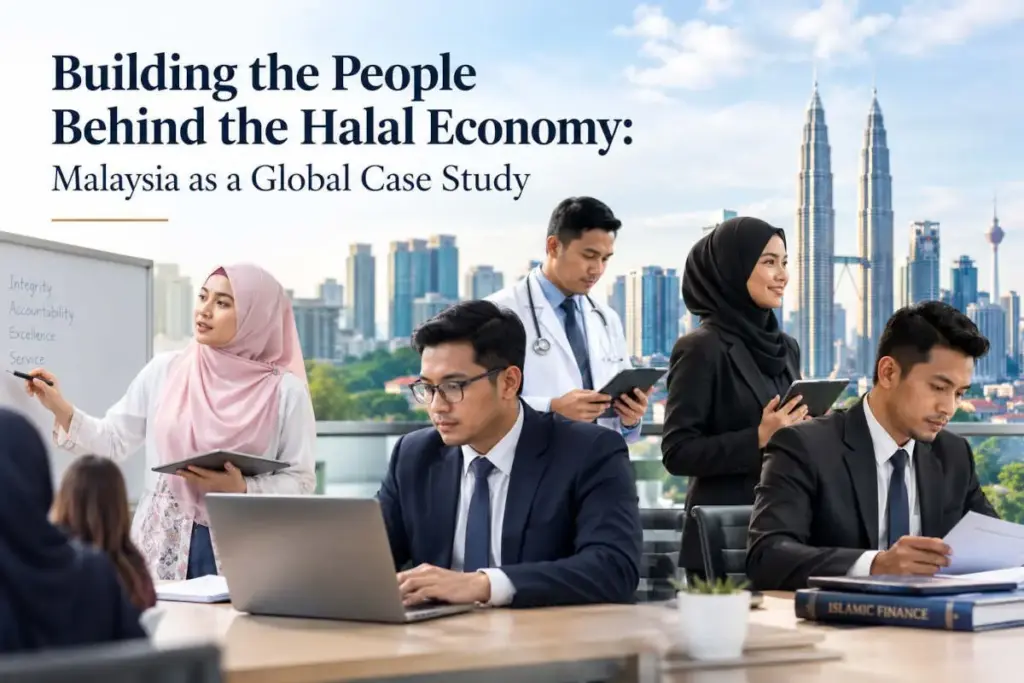
The global halal economy is entering a defining new phase. Long associated primarily with food products and basic religious compliance, this dynamic market has rapidly matured into a sophisticated, multi-trillion-dollar economic ecosystem. Today, its footprint spans pharmaceuticals, cosmetics, modest fashion, Muslim-friendly travel, media and recreation, and robust Islamic finance.
According to the State of the Global Islamic Economy Report 2025/26, Muslim consumer spending across six major consumer sectors reached an astonishing US$2.60 trillion in 2024. Projections indicate this figure will surge to US$3.56 trillion by 2029. This unprecedented expansion points to a wider, systemic transformation characterized by stronger halal value chains, digital trust infrastructure, localized production, and highly resilient economic networks. Yet, this rapid growth brings a critical challenge to the forefront: as the halal economy becomes larger and more complex, who will possess the specialized skills and institutional knowledge required to manage it?
Building a successful, competitive halal economy cannot be achieved through certification alone. Behind every accredited product lies an intricate network of professionals responsible for ethical sourcing, precision production, rigorous quality assurance, auditing, regulatory compliance, supply chain logistics, marketing, and corporate governance. As halal commodities increasingly traverse international borders and penetrate highly regulated technical sectors, the global market demands far more than just a larger workforce. It demands competent halal professionals capable of seamlessly translating abstract standards and religious principles into everyday operational practice.
Malaysia: Building More Than a Certification System
Malaysia offers a compelling case study in navigating this evolution. The country has successfully maintained its premier position at the top of the Global Islamic Economy Indicator for the 2025/26 edition, highlighting the exceptional maturity of its overall Islamic economic ecosystem. Furthermore, Malaysia’s trade data demonstrates that its halal footprint extends far beyond domestic rubber-stamping.
According to the Malaysia Halal Exports 2025 data released by the Halal Development Corporation (HDC), the nation recorded a staggering US$16.82 billion, or approximately RM68.52 billion, in halal exports for 2025. This figure represents a robust 10.9% year-on-year increase, supported by 10,638 halal-certified companies and 1,563 active halal exporters.
The composition of these exports reveals the profound diversification of the modern market. Food and beverages led the categories at US$9.05 billion (RM36.86 billion), closely followed by halal ingredients at US$5.25 billion (RM21.39 billion). Other significant contributors included palm oil derivatives at US$1.12 billion (RM4.57 billion), cosmetics and personal care at US$903.29 million (RM3.68 billion), pharmaceuticals at US$274.91 million (RM1.12 billion), and industrial chemicals at US$220.91 million (RM0.90 billion).
This wide sector distribution underscores a fundamental truth: halal is no longer solely about whether a food item contains permissible ingredients. It increasingly involves complex questions of pharmaceutical formulation, chemical processing, specialized personal care manufacturing, sophisticated supply-chain management, strict traceability systems, and large-scale industrial production. Consequently, the talent requirements across industries have shifted dramatically.
A professional working within a food manufacturing plant must master halal assurance systems, ingredient control, and internal auditing. Conversely, a counterpart in pharmaceuticals faces entirely different technical, safety, and regulatory considerations. Meanwhile, a cosmetics manufacturer requires expertise that sits precisely at the intersection of Shariah jurisprudence, advanced chemistry, manufacturing standards, and evolving consumer expectations. The sheer expansion of the halal economy is, at its core, an expansion of the specialized knowledge required to sustain it.
Over the years, Malaysia has cultivated institutional structures specifically designed to support this human dimension. The Halal Professional Board (HPB) establishes a structured professional training framework, while recognized Halal Training Providers deliver targeted programs to build industry-ready competencies. The Halal Executive Programme further empowers the personnel tasked with overseeing halal compliance within corporate organizations. Through initiatives involving entities like the Malaysian International Halal Academy (MIHA), the nation continues to bridge the gap between academic knowledge and practical industry needs.
The Institutional Architecture of Halal Talent Development
Halal talent development does not begin in the workplace; it originates within a structured regulatory ecosystem that defines compliance standards and translates them into actionable workplace practices. At the center of Malaysia’s framework is the Department of Islamic Development Malaysia, commonly known as JAKIM. The Manual Procedure for Malaysia Halal Certification provides the procedural bedrock, while JAKIM collaborates closely with State Islamic Religious Departments and State Islamic Religious Councils to administer nationwide certification.
At the strategic level, Malaysia is advancing toward a more cohesive national policy via the Dasar Halal Negara (DHN) 2025–2035 framework. This policy provides a strategic compass for building an inclusive, planned, and sustainable ecosystem while preserving the authority of religious bodies. Supported by a dedicated 2025–2030 Action Plan, the framework aims to tighten standards enforcement, streamline certification pathways, enhance international recognition arrangements, and foster systematic industry growth.
However, once an organization secures its certification, internal mechanisms must be maintained to uphold compliance. This responsibility falls squarely on trained professionals. The establishment of the HPB in 2014 marked a pivotal step in formalizing this role through the Halal Executive Programme, delivered via a network of authorized training providers.
These training providers act as crucial intermediaries, converting regulatory demands into comprehensive teaching modules and assessments. The latest JAKIM directory lists 40 recognized Halal Training Providers, spanning universities, higher education institutions, and specialized training organizations. Yet, institutional expansion alone does not guarantee alignment with evolving industry demands. Trainers must constantly interpret Shariah principles alongside technical realities, ensuring that graduates are prepared for real-world application in documentation, procurement, production control, and internal auditing.
When an Established System Meets a Changing Industry
As the global halal landscape accelerates, established frameworks face new realities. Companies operating internationally encounter diverse regulatory requirements and varied consumer expectations. What satisfies compliance in one jurisdiction may require adaptation in another, magnifying the complexity for corporate compliance officers.
For many businesses, securing certification is merely a milestone rather than a destination. Maintaining internal systems, managing documentation, and responding dynamically to shifting standards places immense pressure on organizational personnel. Consequently, a competent workforce serves as the foundational infrastructure supporting the certification process itself.
Furthermore, industry observers note that awareness among business owners remains a variable factor. Where understanding is limited, halal management risks being treated as a mere administrative checkbox rather than an integral component of corporate governance, risk management, and strategic procurement. True competency requires professionals to understand not just the rules, but the underlying rationale and practical application across complex operational settings.
Cultivating the Next Generation of Halal Talent
Looking ahead, the next generation of halal talent must be equipped for a digitalized, interconnected global marketplace. Modern professionals must navigate automated supply chains, digital traceability systems, and diverse manufacturing environments. Digital literacy and data awareness are rapidly becoming indispensable components of halal management.
To maintain momentum, training providers, regulatory bodies, and industry leaders must foster a continuous feedback loop. Industry insights regarding emerging operational challenges must inform training curriculums, ensuring that professional development evolves in tandem with global markets. By transforming isolated training initiatives into a deeply connected talent ecosystem, nations can ensure that their halal economies remain resilient, credible, and fully prepared for the future.