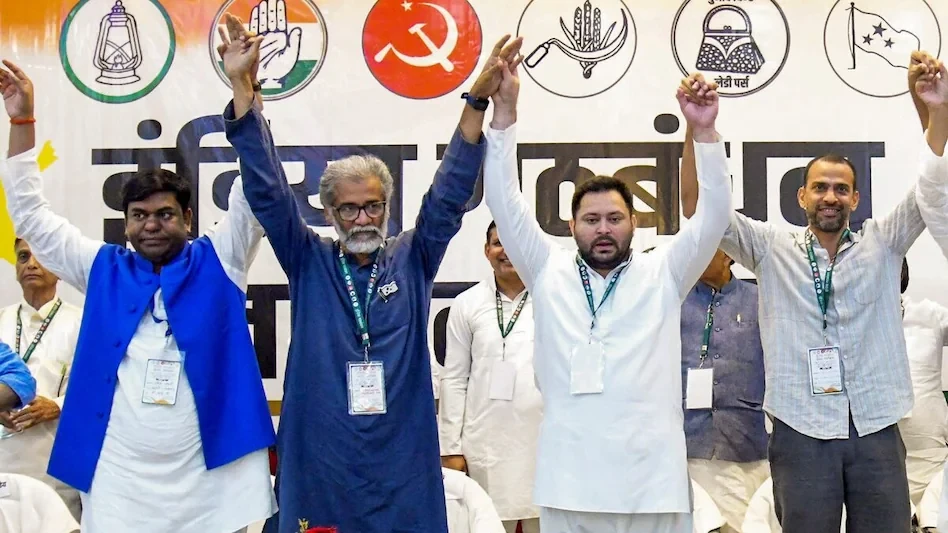
Patna: As Bihar steadily marches toward the pivotal 2025 Assembly elections, the state’s significant Muslim population, which constitutes approximately 17.7 percent of the total demographic, finds itself at a profound political crossroads. With a 243-member state Assembly up for grabs and two major competing political blocs—the opposition Grand Alliance, locally known as the Mahagathbandhan, and the ruling National Democratic Alliance (NDA)—the community is once again forced to confront a deeply familiar and agonizing dilemma. Voters must weigh the urgent imperative of resisting the steady advance of Hindutva politics against the fundamental democratic demand for fair, equitable political representation.
Despite holding a decisive demographic presence that can sway outcomes in numerous constituencies across the state, Muslims continue to experience noticeable underrepresentation in the candidate lists released by the major political formations. This persistent gap has triggered intense discussions, reverberating across street-corner political debates, academic circles, and community drawing rooms alike. The central question haunting voters is whether they should continue casting their ballots reliably for secular parties that promise security and protection from majoritarian forces yet deliver deeply disproportionate representation, or whether they should assert their political independence and agency, even if doing so risks splitting the anti-NDA vote and facilitating a ruling coalition victory.
Uneven Representation Within the Grand Alliance
Historically, the Rashtriya Janata Dal (RJD), under the leadership of veteran politician Lalu Prasad Yadav and his son Tejashwi Yadav, has served as the primary political home for the vast majority of Bihar’s Muslim electorate. Yet, when the RJD recently finalized and announced its candidate lineup for 143 constituencies, it allocated tickets to only 18 Muslim candidates, amounting to roughly 12.6 percent of its total share. Proportional representation aligned with the community’s share of the state population would dictate a figure closer to 41 seats. Political critics and community members argue that this substantial shortfall is not an oversight, but rather a deliberate underallocation that leaves Muslims with less than half of their rightful demographic share.
The prevailing dissatisfaction extends far beyond mere arithmetic. Several sitting Muslim MLAs belonging to the party were summarily denied tickets, while others found themselves unceremoniously shifted to entirely new and unfamiliar constituencies. Within the internal ranks of the RJD, whispering campaigns and open complaints suggest that the Yadav community, which accounts for roughly 14 percent of the state’s population, continues to maintain an iron grip on decision-making processes and candidate selection. A senior RJD functionary, speaking on the condition of anonymity, acknowledged the friction, noting that internal Muslim voices are frequently sidelined or treated as secondary considerations when seat-sharing pacts are finalized.
Meanwhile, the Congress party, which secured 61 seats under the broader seat-sharing arrangement within the Grand Alliance, has fielded 10 Muslim candidates, translating to about 16.7 percent of its total allotment. While this higher proportional share has earned the national party a modicum of praise from community leaders, the denial of tickets to several incumbent legislators has nevertheless sparked localized resentment and grassroots friction. Compounding these issues, Mukesh Sahni’s Vikassheel Insaan Party (VIP), another crucial constituent of the opposition coalition, completely shut out the community by failing to nominate a single Muslim candidate, further fueling widespread criticism that cold coalition arithmetic and caste calculations routinely trump genuine political inclusion.
The Left parties, which have traditionally enjoyed steady support from various sections of the Muslim working class and peasantry, offered little relief on the representation front. The Communist Party of India (Marxist-Leninist), or CPI(ML), contesting under the banner of the Grand Alliance, fielded only two Muslim candidates, while other allied communist factions fielded none at all. Altogether, the grand opposition coalition has managed to field just 30 Muslim candidates across the entire 243-seat assembly, accounting for roughly 11.9 percent of its total nominees—a figure that falls significantly short of true population parity.
“Better Than NDA, But Still Inadequate”
Reflecting on these seat-distribution dynamics, Professor Pushpendra, a former director at the prestigious Tata Institute of Social Sciences (TISS), points out that while the RJD has technically fared better than the constituents of the ruling NDA, its distribution remains glaringly deficient.
“RJD has underallocated by roughly five percentage points compared with the Muslim population,” Professor Pushpendra observes. He adds that the internal imbalance becomes glaringly apparent when roughly 37 percent of all RJD tickets are funneled to the Yadav community, illustrating a skewed power dynamic within their core electoral base.
Furthermore, Professor Pushpendra notes that the RJD finds itself politically squeezed from multiple directions. On one flank stands the formidable and ideologically entrenched NDA, while on the other flank, the party faces mounting pressure from emerging non-aligned political challengers, such as Prashant Kishor’s Jan Suraaj Party and Asaduddin Owaisi’s All India Majlis-e-Ittehadul Muslimeen (AIMIM). Notably, the Jan Suraaj Party has fielded approximately 30 Muslim candidates, surpassing the RJD in absolute numbers, while the AIMIM campaigns almost exclusively on the platform of asserting direct Muslim political representation.
“They actively accuse the RJD of exploiting Muslims’ genuine fear of the BJP’s return to power simply to justify ongoing underrepresentation,” Professor Pushpendra observes, capturing the core argument used by the opposition’s smaller rivals.
The NDA’s Calculated Distance and Tokenism
In sharp contrast to the opposition’s complex internal balancing acts, the ruling National Democratic Alliance presents a vastly different electoral approach regarding minority representation. Out of the total 243 assembly seats, the NDA has collectively fielded a mere five Muslim candidates across all its constituent parties. Chief Minister Nitish Kumar’s Janata Dal (United), or JD(U), accounts for four of these tickets, while Chirag Paswan’s Lok Janshakti Party (Ram Vilas) has fielded just one. The Bharatiya Janata Party (BJP), which is contesting 101 seats as the senior partner in the coalition, has completely shut out Muslim candidates, fielding zero members from the community.
“The BJP does not hide its Hindutva politics or its underlying hostility towards Muslims,” Professor Pushpendra states plainly. “At the same time, the tokenism displayed by its allies—allocating just four and one seat respectively—clearly demonstrates how deeply they have aligned themselves with the BJP’s core ideological position.”
For Nitish Kumar, this electoral distancing marks a steep decline in a relationship that was once far more cordial. The Bihar Chief Minister was previously credited with implementing targeted welfare measures and administrative steps that earned him considerable goodwill and substantial electoral support among ordinary Muslims. However, his credibility has plummeted in recent years. His active political support for contentious legislative measures like the Waqf (Amendment) Bill and the Citizenship Amendment Act (CAA), paired with inflammatory public remarks from a JD(U) Member of Parliament asserting that the party would not work for Muslims because they “don’t vote for us,” has severely eroded whatever trust remained. During the 2020 assembly elections, the JD(U) fielded 11 Muslim candidates, none of whom managed to secure a victory. By slashing its ticket allocation to just four this time around, the party appears to have largely written off the community’s vote bank.
A Deep Strategic Dilemma
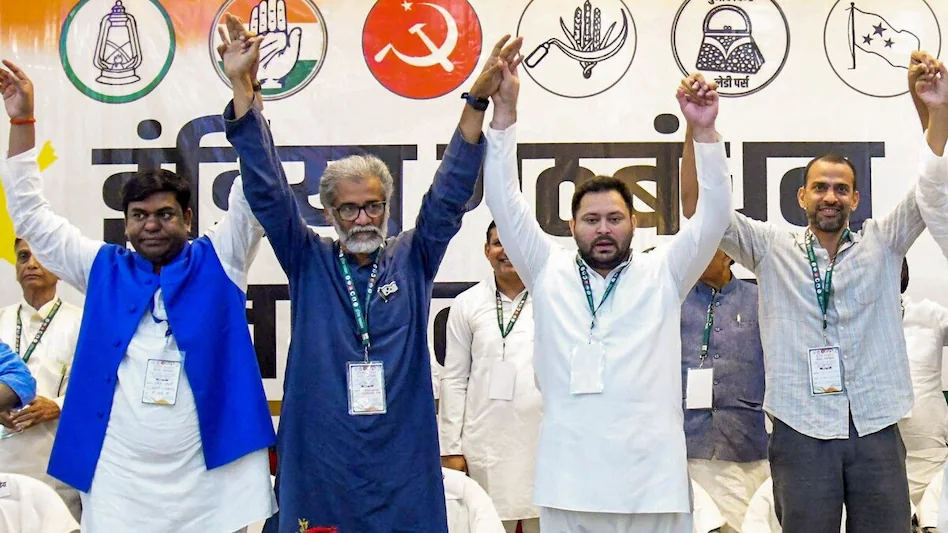
For countless Muslim voters across Bihar, the upcoming electoral contest has transcended traditional political preferences, transforming instead into a high-stakes calculation about basic survival and civic security. Voting strategically for the Grand Alliance remains a practical, albeit painful, method to help block the consolidation of Hindutva forces in the state. However, doing so requires the community to passively tolerate ongoing marginalization and political invisibility within the very secular framework they help sustain. Conversely, raising vocal demands for proportional representation and supporting alternative minority-centric platforms carries the immediate risk of splitting the anti-NDA opposition vote—an outcome that could inadvertently clear the path for a decisive NDA victory.
This persistent tension perfectly encapsulates the community’s long-standing political paradox: maintaining an overwhelming electoral loyalty to secular formations while receiving virtually no corresponding political agency or decision-making power in return.
“If proportional representation were applied strictly and fairly across the board,” notes one Patna-based political analyst who spoke on condition of anonymity, “Tejashwi Yadav, whose own community forms a smaller percentage than Muslims, would technically have no legitimate claim to the chief minister’s post.” This stark observation lays bare the glaring chasm that exists between demographic weight and actual political power within Bihar’s deeply entrenched, caste-driven political ecosystem.
Balancing Acts and Practical Calculations
Defending its ticket distribution strategy, the RJD leadership frames its candidate selection as a delicate and necessary balancing act. Party strategists and insiders argue that handing out a disproportionately high number of Muslim tickets would instantly provide the BJP with heavy ammunition to level accusations of Muslim appeasement. Such a narrative, they fear, could severely alienate key Hindu voter segments, particularly among the Extremely Backward Classes (EBCs) and various Other Backward Classes (OBCs) who form the swing vote in rural Bihar. To successfully maintain both its secular credentials and its broader, fragile caste coalitions, the RJD is forced to walk a political tightrope.
This careful balancing act, however, leaves a significant portion of the Muslim population deeply frustrated and disillusioned. While some local intellectuals and independent commentators argue that mainstream secular parties routinely weaponize the looming threat of the BJP to capture captive minority votes without offering any genuine political space in return, others maintain a more pragmatic view. They argue that in an increasingly hostile majoritarian climate, minority voters have few viable alternatives other than forming strategic alliances with imperfect, and often ungrateful, secular partners.
A Pivotal Election for Minority Politics
The 2025 Bihar assembly elections may fundamentally reshape the future trajectory of Muslim political engagement throughout the state. With the AIMIM largely excluded from mainstream opposition alliances and the Jan Suraaj Party emerging as an unpredictable wildcard, the community’s ultimate bargaining power remains precariously tethered to the Grand Alliance, despite all its recognized flaws. Whether ordinary voters choose pragmatic consolidation behind the RJD-Congress combine or decide to express their deep-seated discontent through voter abstention or alternative political options will heavily influence both the immediate election results and the long-term future of minority politics in the state.
In a political landscape where caste identities, religious affiliations, and raw power intersect sharply, this decision carries immense, existential weight. Voters must grapple with a difficult question: should they accept strategic subordination and political invisibility purely to defeat the advance of Hindutva, or should they insist on political dignity and representation, even at the high risk of fracturing the anti-fascist vote? When polling day arrives, the ballot box will once again serve as their primary voice, but the stakes have arguably never been higher.
The Identity Politics Trap
Weighing in on the structural constraints facing the community, Professor Mohammad Sajjad of the Department of History describes the current predicament as a classic identity politics trap. He explains that anti-minority rhetoric and majoritarian Hindu consolidation are simply two sides of the same coin within modern identity politics.
“Unfortunately, even a party like the RJD cannot reliably ensure that its core Yadav vote successfully transfers to Muslim candidates on the ground,” Professor Sajjad notes.
He believes that ordinary Muslim citizens, unlike aspiring political elites and ticket-seekers, are continually trapped in an impossible choice.
“They are constantly forced to choose between focusing on defeating saffron regression to avoid extreme crackdowns, regardless of their severe underrepresentation, or aggressively asserting their right to representation and risking the victory of majoritarian forces. In both scenarios, the choices available to them are deeply restrictive,” he explains.
Concluding his assessment, Professor Sajjad emphasizes that the broader spread of majoritarian politics leaves shrinking space for minority communities to maneuver.
“It is only within a genuinely non-majoritarian social and political environment that minorities can effectively negotiate their demands with other communities, various castes, and the government of the day,” he states.
Echoing these sentiments, Professor Pushpendra reiterates that political representation and community protection should never be treated as mutually exclusive concerns. Reflecting on the lessons of the previous 2020 assembly elections, he points out that when the AIMIM successfully captured five seats in the Seemanchal region, it served as a clear indicator of the community’s simmering desire for independent political agency.
“Even from a purely pragmatic standpoint,” Professor Pushpendra concludes, “the RJD could have done much more to counter these emerging political alternatives and proactively reassure its loyal Muslim base.”