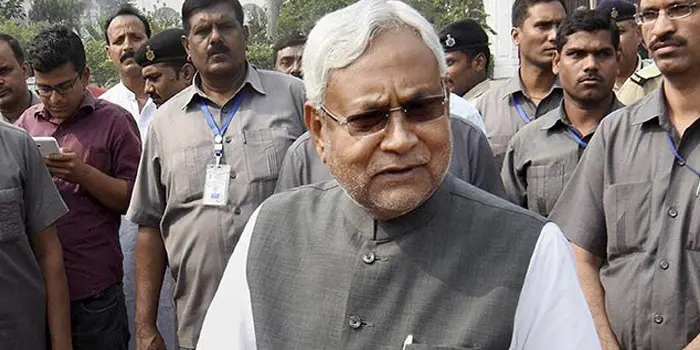
Patna: As Bihar approaches another crucial electoral battleground, Chief Minister Nitish Kumar finds himself navigating a complex and increasingly fragile political landscape. Despite serving as a key partner and political facilitator for the Bharatiya Janata Party (BJP) at the national and state levels, Kumar continues to court Muslim voters ahead of the upcoming Bihar Assembly elections. While his supporters frequently argue that the veteran leader acts as a moderating force capable of containing the BJP’s more divisive policies within the ruling coalition, a growing chorus of skepticism resounds across the minority community. For many Muslim voters, intellectuals, and community leaders, a singular, deeply felt grievance overshadows past administrative goodwill: why Nitish Kumar chose to align with the central government on contentious legislation such as the Waqf law amendments.
This friction highlights a widening chasm between the veteran leader, long celebrated as "Sushasan Babu" or the champion of good governance, and a community that once viewed him as a secular shield in an increasingly polarized political environment. As the state prepares for polls scheduled for November 6 and 11, with the counting of votes set for November 14, Kumar’s electoral strategy relies heavily on an intricate numerical balance. However, the goodwill that once secured him a notable share of minority votes appears severely strained, leaving his Janata Dal (United)—commonly known as the JD(U)—locked in a razor-thin contest against the formidable opposition Mahagathbandhan, which comprises the Rashtriya Janata Dal (RJD), the Indian National Congress, and various Left parties.
Muslim Discontent and Broken Trust
The discontent within Bihar’s Muslim community is neither sudden nor isolated. While acknowledging the tangible impact of specific welfare initiatives implemented during Kumar’s nearly two decades in office, community members harbor deep-seated frustrations regarding his repeated political realignments and his acquiescence to the core elements of the BJP’s Hindutva agenda. Over the years, these grievances have accumulated, stemming from his stance on the Triple Talaq legislation, the Citizenship Amendment Act (CAA), and his notable silence in the face of polarizing rhetoric—such as references to "infiltrators" directed at Muslims in the Seemanchal region by prominent national leaders including Prime Minister Narendra Modi and Union Home Minister Amit Shah.
The emotional toll of these political shifts was eloquently captured online by young journalist Salman Ghani, who responded directly to claims made by Kumar and his aides regarding the administration’s service to minorities. Expressing a sentiment shared by many within the state, Ghani articulated a sense of betrayal: "I feel sorry for you sometimes. Some of your wrong decisions wiped off all your work. Muslims, with heavy hearts, accepted you even while you were friends with the BJP. But the Muslim community felt let down by you on issues from CAA to Waqf."
This sentiment is echoed across various professional and social strata within the community, from traditional handloom weavers in Bhagalpur to commercial traders scattered throughout the Seemanchal districts. The breaking point in recent months arrived in March 2025, when influential and respected religious bodies, most notably the Imarat Shariah, took the unprecedented step of boycotting Kumar’s traditional Iftar gathering. This public snub was a direct protest against his tacit and active support for the BJP’s contentious Waqf (Amendment) Bill, which numerous Muslim organizations and legal bodies view as an existential threat designed to strip the community of historic religious endowments and properties.
In a strongly worded letter explaining their absence, community leaders reminded the Chief Minister of his initial rise to power on a platform of secularism and pluralism, charging that his current alignment with the National Democratic Alliance (NDA) has severely diluted his secular credentials and compromised minority rights. This friction stands in sharp contrast to Kumar’s persistent assertions that Muslims have historically voted for him—and by extension, even for the BJP—out of trust in his personal goodwill, a narrative that critics argue has lost its resonance.
The political fallout is further mirrored in candidate distribution for the upcoming polls. This election cycle, the JD(U) has fielded only four Muslim candidates, a significant drop from the eleven candidates put forward in the 2020 assembly elections. Across the broader NDA coalition, only five Muslim candidates have been announced in total, with none coming from the BJP’s ranks and just one representing Chirag Paswan’s party. While some pragmatic strategists within the JD(U) attempt to justify this reduction by pointing out that all eleven Muslim candidates fielded by the party in 2020 ultimately lost their respective contests, other party voices have made openly hostile remarks. Suggestions from within the party ranks that "since Muslims do not vote for them, they would not work for Muslims" have only deepened the alienation, effectively eroding whatever residual goodwill Kumar had cultivated over his long political career.
Between Approval and Anger
Political analysts observing the state’s dynamics note that Kumar, even amidst physical frailty and mounting anti-incumbency sentiment, remains acutely aware of the demographic reality governing Bihar’s electoral math. Muslims constitute approximately 17.7 percent of the state’s overall population, and their presence is decisive in roughly 40-odd assembly constituencies, particularly across the northern and eastern border districts. For a leader attempting to balance a delicate coalition, these seats represent a vital margin of victory or defeat.
Critics, including former loyalists and political observers, frequently accuse Kumar of trying to "hold with the hare and run with the hounds"—attempting to project a secular, inclusive image to minority voters while simultaneously enabling the dominant partner of his coalition. This tightrope walk has earned him the dismissive moniker "Paltu Ram" from political opponents due to his frequent alliance somersaults, while whispers of fatigue grow louder after nearly twenty years of uninterrupted leadership marked by periodic economic stagnation and unfulfilled developmental promises.
The Transactional Pitch and Policy Realities
Faced with this skepticism, Kumar has structured his minority outreach around an unapologetically transactional pitch, emphasizing tangible governance and economic delivery over abstract ideological alignment. Addressing a recent electoral gathering in Purnea, the Chief Minister sought to draw a sharp historical contrast, stating, "Before 2005, Muslims were just a vote bank paraded during elections, forgotten afterward. My government changed that."
In support of this narrative, Kumar and his campaign regularly highlight the multi-fold expansion of the minority welfare budget since he first assumed office—climbing from a modest allocation of roughly ₹2 crore to upwards of ₹600 crore in recent fiscal years. These funds are channeled into educational scholarships, residential minority hostels, and skill development programs aimed at empowering Muslim youth, with a specific rhetorical emphasis on Pasmanda (backward) Muslims who form the vast demographic majority of the state’s minority underclass.
Furthermore, the administration frequently points to infrastructural interventions, such as the construction of boundary walls around approximately 8,000 traditional burial grounds (Qabristans) across the state, which the government credits with significantly reducing local communal tensions. However, opponents counter these claims by arguing that the maintenance of public order and the protection of citizens’ properties are fundamental constitutional duties of the state rather than benevolent favors, noting parallel investments in crematoriums for the Hindu majority.
Similarly, while the state government highlights reforms introduced in traditional Madrasas alongside improvements in teachers’ compensation packages, community representatives maintain that these measures fall short of genuine parity. Critics note that Madrasa instructors still lag behind standard schoolteachers in terms of remuneration, and that the Urdu language continues to face administrative neglect within the state’s educational framework.
Why Nitish Still Seeks Muslim Votes
The persistent efforts by Kumar and his party to court a demographic that has expressed profound disappointment raise a fundamental question: why does the JD(U) continue its outreach despite the evident discord?
Interviews with senior party insiders shed light on the cold calculus of electoral survival. A senior JD(U) leader explained the underlying dilemma to TwoCircles.net: "The JD(U) draws its main support from Kurmis and Extremely Backward Classes (EBCs) but needs Muslims to offset the Yadav muscle vote, which stands at around 14 percent. Ditching them risks an RJD-Muslim-Yadav sweep, which would collapse our share within the 101-seat NDA quota. The BJP can afford to write off minority votes; Nitish cannot."
Senior journalist Abdul Qadir offers an additional perspective on the internal motivations driving the outreach, noting that a distinct faction of JD(U) leaders continues to canvas for Muslim support by invoking Kumar’s personal history. "Nitish has always been conscious about his image and wants to be seen as an upholder of liberal values and respect for all beliefs. More than votes, it was his image that mattered in his good old days, and his pro-Mandal aides would not like him to go down in history as a religious bigot," Qadir explained.
Compounding these electoral anxieties is an underlying wariness regarding the tactical maneuvers of coalition partners like the BJP and Chirag Paswan’s faction. While top national BJP leaders, including Amit Shah, publicly refer to Kumar as the NDA’s principal "election face" in Bihar, they have systematically avoided explicitly committing to him as the designated Chief Ministerial candidate should the coalition secure victory. Such ambiguity risks dampening the transfer of votes from the BJP’s core upper-caste base and Paswan’s supporters. In the previous assembly election, Paswan—who famously styled himself as Prime Minister Modi’s "Hanuman"—ran a campaign that actively targeted JD(U) candidates, resulting in the defeat of over three dozen of the party’s nominees through what many perceived as tacit, unacknowledged support from within the broader NDA ecosystem.
Anticipating similar vulnerabilities in the current cycle, Kumar’s outreach to minority voters functions primarily as a defensive mechanism. As a former senior government official succinctly summarized the strategy: "That is Nitish’s survival pitch. Not love. Not ideology. Just math. He needs just enough Muslim votes to stop the RJD’s M-Y sweep, while playing soft Hindutva to keep the EBCs from drifting entirely toward the BJP."