There are many ways to measure the friendship between two nations and their communities, but time is undoubtedly one of the most reliable and telling indicators. The 170 years of formal diplomatic relations between Italy and Türkiye, which are being celebrated this year, testify to the remarkable strength of a bilateral bond whose roots actually predate the birth of both modern states. This profound closeness draws its initial inspiration from ancient mythology, specifically the epic journey of Aeneas. According to classical tradition, Aeneas fled the flames of Troy and arrived on the shores of Italy after a long and arduous voyage, ultimately giving rise to the lineage from which Rome would be born several generations later.
This deep historical understanding has only grown stronger over the centuries thanks to the pivotal roles that Italian and Turkish peoples have consistently played in the Mediterranean basin—a historic crossroads of encounters and civilizations connecting three distinct continents. Nurturing this shared history and actively preserving its collective memory remains a shared priority for both governments, committing them to resolutely enhancing a vast heritage that spans both modern centuries and the very origins of human civilization. This vital mission is carried out, first and foremost, through the lens of archaeology, a field where leading Italian and Turkish scholars collaborate closely across 15 active missions spread throughout Turkish territory, including four prestigious UNESCO World Heritage sites.
It is precisely for this reason that the current diplomatic visit begins in Hierapolis, where the honor of opening the "17th Archaeology Conference"—dedicated entirely to celebrating the Italian contribution to this scientific research—is being shared alongside Türkiye’s Minister of Culture and Tourism, Mehmet Nuri Ersoy. The site of Hierapolis stands as a living symbol of enduring cooperation, having hosted the oldest continuous archaeological excavation activity by Italian teams since 1957.
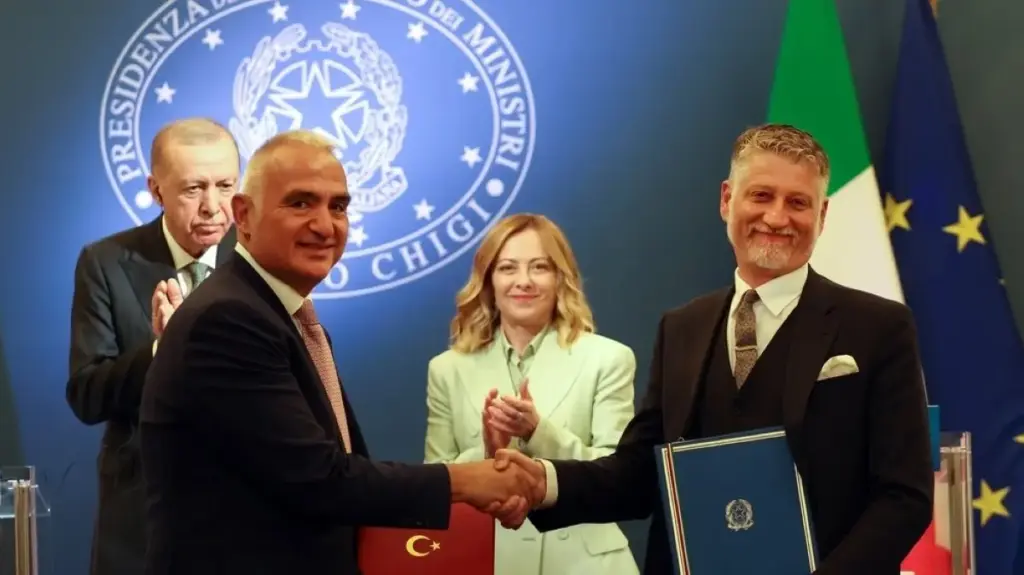
This ongoing cultural partnership reached another major milestone last June, when Minister Ersoy and visiting Italian officials inaugurated the "Troy and Rome" exhibition at the Colosseum in Rome. This splendid cultural showcase has already welcomed more than 2 million visitors, demonstrating the immense public appetite for exploring the historical intersections of the two nations. Both countries are thus continuing firmly along this shared path, which represents just one of the countless routes that culture offers to strengthen a vital partnership and build a common future defined by stability, prosperity, and mutual respect.
Throughout history, Italian architects, artists, merchants, musicians, officials, and entrepreneurs have maintained an active, vibrant presence within the great cities of the Ottoman Empire and, subsequently, of the Republic of Türkiye. Even today, this industrious community—concentrated above all in the historic centers of Istanbul and İzmir—preserves a rich heritage that unites the two nations, transcending different eras, political regimes, and institutional changes.
During the formative early years of the Republic of Türkiye, founding leader Gazi Mustafa Kemal Atatürk famously invited the accomplished Italian sculptor Pietro Canonica to place his artistic skills at the service of the newly established state. The works created by Canonica during this period helped shape the public image and visual identity of the young republic, leaving a permanent artistic footprint that is still visible today.
Current diplomatic efforts seek to renew and expand this historical dialogue. Beyond merely celebrating a shared past, the continuous and dynamic exchange between Italian and Turkish cultures has given birth to truly original experiences within this land, of which the historic Levantine community offers a fascinating and enduring testimony. In the coming days, leaders and officials will lay the concrete foundations for new agreements and initiatives designed to open up further opportunities for cooperation. In Istanbul, for example, a specially curated itinerary of emblematic locations will be presented, highlighting Italian art, architecture, and ingenuity across the metropolis.
Among friendly and allied states, culture ultimately reveals its most authentic and powerful meaning: it is a strategic resource that fosters considerably closer ties by appealing powerfully to both reason and human emotion. Deep mutual understanding unlocks the transformative potential of two great civilizations that have flourished side by side along the shores of the same sea.
Italy proudly preserves the rich Latin and Mediterranean legacy that bequeathed to the Western world the foundational law of nations, known historically as the Ius Gentium, which successfully united diverse and distant peoples within a single ideal homeland. Türkiye, meanwhile, stands as the natural heir to one of the longest-lived and most influential empires in human history, the Ottoman Empire, while also zealously safeguarding the priceless archaeological remains of the ancient Hittite civilization. Together, these parallel and intersecting histories form the enduring channel through which the purest cultural currents of world history continue to flow unobstructed today.
The views and opinions expressed in this article are solely those of the author and do not necessarily reflect the editorial stance, values, or official position of Daily Sabah. The newspaper provides space for diverse perspectives as part of its ongoing commitment to fostering open, balanced, and informed public discussion.