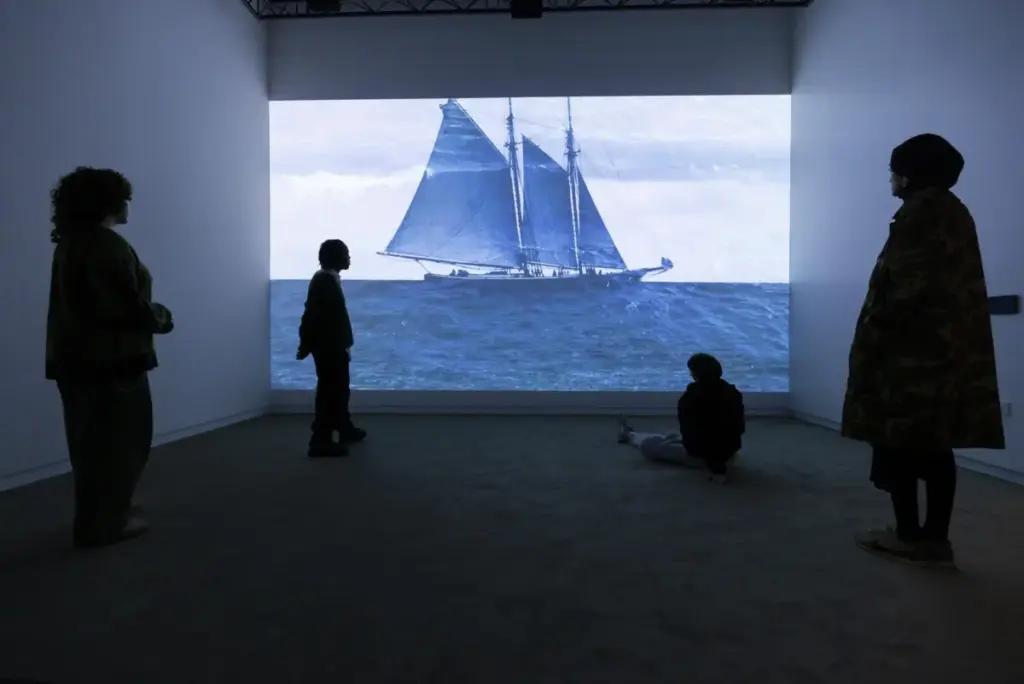
Renowned American artist Carrie Mae Weems has unveiled her latest major work, The Long Goodbye (2026), a sweeping multimedia film commissioned specifically for the opening of the V&A East Museum. Developed over nearly three years, the ambitious project explores the complex themes of migration through the lens of love stories that are frequently obscured within historical journeys. For Weems, love functions simultaneously as both the subject of the artwork and its core methodology—a powerful tool for restoring basic humanity to individuals whose courage and labor have profoundly shaped the modern world, yet whose lives are routinely reduced to mere statistics or written out of official historical accounts entirely.
The new commission invites viewers to recognize not only the profound love that people carry with them when they uproot their lives to move from one place to another, but also the deep connections and affection they leave behind. Ultimately, the film examines how these emotional and physical journeys continue to inform and shape the present day, even when they remain unacknowledged by dominant societal structures.
Migration has long been deeply rooted in Weems’s artistic practice, holding a particular resonance in east London, a region whose past and present have been entirely defined by diverse migratory waves. Celebrating and actively creating space for the many communities that call east London home stands at the very heart of the V&A East’s mission. This significant commission turns Weems’s incisive lens toward the United Kingdom and its diasporic communities for the very first time. For generations, her work has been deeply admired by and profoundly influential on British artists. Throughout the development of the commission, Weems’s initial concepts evolved organically in response to intense public debates and protests concerning migration that have dominated the contemporary political climate in both Great Britain and the United States.
The Long Goodbye continues Weems’s decades-long commitment to dismantling entrenched hierarchies of power by closely examining how images and institutional archives define and shape official historical narratives. The film dares to imagine a completely different account of post-war Britain—one that openly recognizes the buried truths regarding how and why generations of people immigrated to the UK. This serves as a pertinent and urgent lesson in the current political moment, highlighting how history has frequently become warped and rewritten to serve the self-serving agendas of those holding power.
Within the film, spoken and sung passages capture the visceral emotional landscape of displacement: "I’m trembling. I’m trembling… tell me what’s on the other side… I remember when Britain was smashed and burned and when we became a part of the Commonwealth and when the Queen called saying that she needed us… I remember the great extraction of natural resources and wealth needed at the service of empire."
These powerful words evoke the overwhelming fear of the unknown, effectively placing the viewer directly in the position of someone looking across a vast ocean toward an uncertain future, yet somehow finding the necessary resolve and courage to leave everything behind. Weems speaks eloquently on behalf of those who chose to immigrate voluntarily, while also acknowledging the absolute terror experienced by the millions of people who emigrated in chains. Her artistic voice captures the deep pain and anxiety felt by countless unnamed individuals whose collective anguish shaped the modern world, yet whose individual humanity is rarely recorded in standard history books.
Weems’s longstanding utilization of self-portraiture as a deliberate act of artistic intervention runs as a continuous thread throughout the film, complemented by direct references to her own personal archive. By inserting her own image directly into the historical narrative, Weems uses both her voice and her physical body to draw sharp, unavoidable attention to people whose life experiences have been systematically silenced or forgotten. In doing so, the traditional archive ceases to be viewed as absolute fact; instead, it becomes something that audiences must actively question, including examining the unconscious assumptions they bring to it.
This critical inquiry also extends to the mechanics of looking—how a photograph can serve as formal evidence of someone’s physical presence while simultaneously revealing almost nothing about their rich inner life. Weems carefully draws attention to this vast gap, questioning precisely what an image manages to preserve versus what it leaves for the viewer to imagine, and how society might go about filling in that historical fissure.

This meticulous attention to the making of history directly informed the development of the commission itself. During a series of collaborative workshops with the 2025 cohort of the V&A East Youth Collective, Weems shared insights into how she frames and utilizes her own archive. In response, members of the youth cohort shared powerful stories drawn from their own personal archives and family histories, answering specific questions posed by Weems regarding what they would personally want outsiders to know about their city, their community, and where they ultimately come from.
Water serves as a central, recurring motif throughout the film, functioning simultaneously as the physical route of migration, a connector between disparate geographies and cultures, and a vast vessel of historical memory. Numerous lingering shots focus intently on the open ocean and the relentless rise and fall of its waves, evoking both its terrifying rhythm and immense vastness, as well as the countless lives and untold stories trapped within its endless depths. These visual passages invoke the immeasurable number of Black bodies lost during the Middle Passage of the transatlantic slave trade, while hinting at their enduring power to rise again and challenge a present built upon their exploited labor and lives.
The film suggests that the complex histories of migration across the Atlantic remain utterly inseparable from contemporary reality. Weems’s powerful imagery explicitly invokes "tidalectics"—a theoretical concept developed by the Barbadian poet and historian Kamau Brathwaite that describes a way of understanding history, culture, and identity through the natural ebb and flow of the tides as recurring movements of departure, return, and transformation, contrasting sharply with a simple teleological progression from past to present, and emphasizing the continual presence of ancestral knowledge. The Long Goodbye offers audiences a profound way to interpret the ocean not as an empty barrier, but as a vital vessel through which the humanity, memories, and love of anonymous individuals are never truly lost, but continually return to inform the present day.
Towards its conclusion, the film shifts tone dramatically. Framed by the sound of Weems’s own laughter and imagery of a couple dancing, the final section opens toward a sense of joy and genuine possibility for the future. This optimism arises from the sheer inevitability of change—change set in motion both because of and in spite of violent historical realities, driven fundamentally by the enduring power of love. As Weems observed in a subsequent interview discussing The Long Goodbye, "the empire has to deal with the reality of what it has created," and must confront how the mass movements of people set in motion by empire will continue to fundamentally transform Great Britain, the United States, and many other major nations across the globe.
Weems reminds viewers that this very migration underpins the world’s greatest creative centers, stretching from London to New York and beyond. Her artistic vision creates an overwhelming feeling of the inevitability of change, encouraging audiences to surrender to the powerful waves of history and trust entirely in that ongoing process. The film’s repeated insistence and absolute confidence that profound social transformation is already taking place offers a much-needed source of hope in a contemporary political climate where true progress often feels frustratingly elusive, despite the tireless efforts of those fighting for justice. Change, the work insists, is not only coming; it is already occurring.
At the V&A East Museum, The Long Goodbye is exhibited alongside two foundational archival films by Weems: Before the Loss of You (2005) and Okwui (2019), both of which also serve as profound meditations on the nature of love. Before the Loss of You honors the deep love shared between Winnie and Nelson Mandela, imagining their relationship prior to their immense sacrifices in the struggle against apartheid and Mandela’s grueling 27-year imprisonment, thereby reflecting intimately on love, painful separation, and the heavy personal costs of political resistance.
Meanwhile, Okwui pays a moving homage to Okwui Enwezor, the visionary Nigerian curator, critic, and poet widely regarded as one of the most influential cultural figures of his generation, who fundamentally advanced a global perspective on art and successfully challenged the historical dominance of Western narratives. Created in commemoration following his death in 2019, the film stands as Weems’s personal tribute to Enwezor’s extraordinary life and his lasting impact on how modern and contemporary art is understood, studied, and presented today—a philosophical ethos reflected throughout the V&A East Museum’s broader displays, including Why We Make Galleries.
Seen together, these powerful films reveal love as the primary, driving catalyst behind so much of Weems’s celebrated multimedia oeuvre. Ultimately, her layered artistic practice shares enduring stories of love and challenges audiences to recognize it in the lives of strangers across vast expanses of time and place. By successfully recovering the lost humanity of people who have been marginalized within dominant cultural narratives, Weems alters how we understand and live within the modern societies that these very lives helped to build. She asks viewers not only to critically question the official stories they have inherited, but to genuinely honor the lives, the losses, and the profound loves through which our world continues to be shaped. Her entire artistic practice has consistently been dedicated to making visible those who have been rendered unseen—an endeavor that, in itself, constitutes a profound act of love.