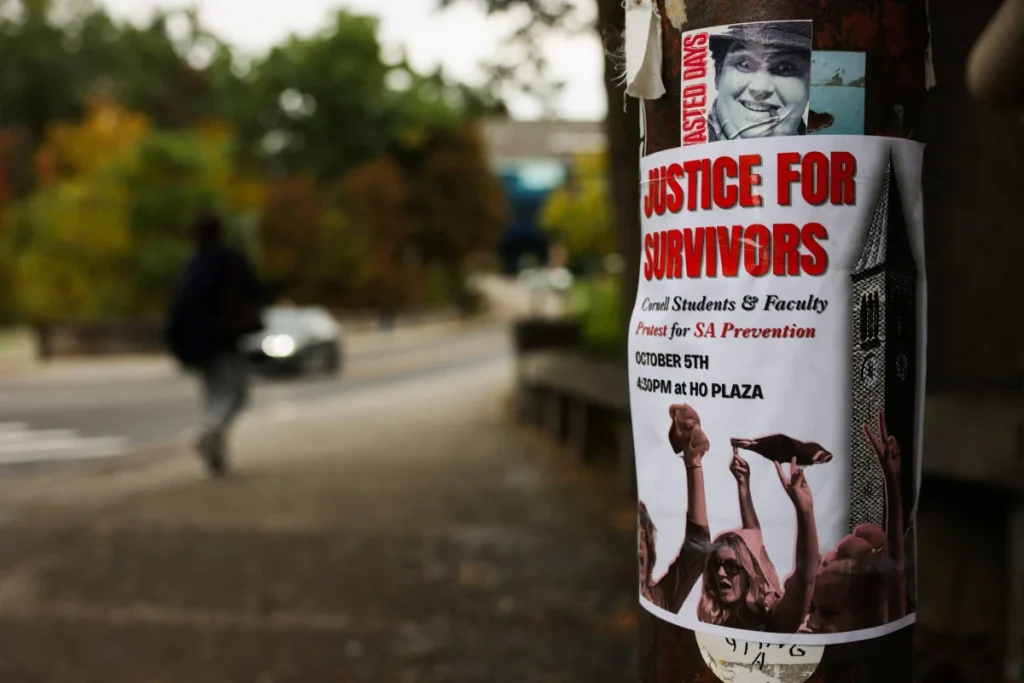
Last month, a legal filing in a New York court sent shockwaves far beyond campus boundaries, thrusting the issue of campus sexual violence back into the national spotlight. A woman identified in court documents only as Jane Doe filed a landmark lawsuit against Cornell University, the Chi Phi fraternity, and seven individual fraternity members. In her complaint, Doe accused the defendants of gang-raping her on the night of October 19, 2024, an alleged ordeal that has since triggered a profound nationwide reckoning regarding the persistent prevalence of sexual assault across American colleges and universities.
Beyond the immediate campus crisis, the high-profile case has reignited a fierce, long-standing political and social battle to reform the legal landscape within New York State. Despite its progressive reputation and its self-presentation as a national leader in women’s rights, New York continues to house legal frameworks that advocates argue place pervasive, systemic barriers in the path of sexual assault survivors seeking justice.
Erica Vladimer, an attorney and founding director of Harassment-Free New York, a survivor-led nonprofit organization, spoke to Al Jazeera about the legislative push, noting that much of the reform currently capturing public attention is the hard-earned culmination of years, and sometimes decades, of advocacy.
"These are bills that we have been fighting for for years when sexual violence is not in the news," Vladimer said.
Drawing a direct line between the contemporary wave of public outrage and the #MeToo movement—which began in 2017 as a viral online campaign to expose and denounce sexual misconduct—Vladimer emphasized that the momentum for systemic change remains robust. "It speaks to the fact that the #MeToo movement is not dead. It is a movement, not a moment," she added.
Political leaders in Albany, the state capital, have quickly signaled their intent to respond to the public outcry generated by the Cornell allegations. On Wednesday, the New York Assembly announced the formation of a dedicated working group tasked with closely examining the state’s sexual-assault laws and developing concrete legislative recommendations ahead of the 2027 session.
Yet, veteran advocates and political figures argue that institutional committees alone cannot undo the deep-seated cultural problems facing the state. Lindsey Boylan, a candidate for the New York City Council who made national headlines in 2020 as the first woman to publicly accuse then-Governor Andrew Cuomo of sexual harassment, voiced cautious skepticism about procedural delays.
"I appreciate that this work is happening," Boylan told Al Jazeera. "It doesn’t undo the fact that rape culture is pervasive in the United States and very much so alive and well in New York."
Boylan joins a chorus of activists demanding sweeping statutory changes to address the legal vulnerabilities that survivors routinely encounter in the state’s courts.
‘Voluntary Intoxication’ Statute
The unfolding Cornell University case has focused intense legislative scrutiny on New York’s "voluntary intoxication" statute, a controversial legal loophole that critics argue creates an unjust hurdle for prosecutors attempting to secure convictions when a complainant has willingly consumed alcohol or drugs.

New York Governor Kathy Hochul addressed the loophole directly, pledging during a press conference on Friday to collaborate with state lawmakers to close the legislative gap.
"It should not matter whether they chose to use drugs or alcohol. Voluntary intoxication is not a license for sexual assault or gang rape. Period," Governor Hochul stated.
Under existing New York law, an individual who has voluntarily consumed alcohol or controlled substances is not legally classified as "mentally incapacitated" during the commission of an assault, even if that substance use renders them entirely incapable of granting or withholding meaningful consent. This statutory restriction complicates the prosecutorial process, as the state’s legal code primarily recognizes incapacitation in sexual offense cases when a victim was involuntarily intoxicated, completely unconscious, or otherwise deemed "physically helpless."
This exact distinction has emerged as a central battleground in the Cornell litigation. Doe acknowledged in court filings that she consumed substances prior to the alleged assault, stating that she was pressured into drinking alcohol and taking the dissociative drug ketamine.
Initially, the Tompkins County district attorney declined to press criminal charges against the accused fraternity members, explicitly pointing to the limitations imposed by the state’s voluntary intoxication statute. However, facing mounting public pressure and intense scrutiny from state officials, the investigation into the fraternity house incident was subsequently reopened.
New York remains one of only 19 states in the United States that maintains a strict legal distinction between "voluntary" and "involuntary" intoxication when evaluating the presence of consent in sexual violence cases. Legal scholars and reform advocates have heavily criticized the provision, arguing that an act of sexual violence is no less heinous or damaging simply because a victim chose to drink or ingest substances beforehand.
"I mean, to have New York, a supposedly progressive state, penalize people who are sexually abused for drinking is disgusting," Boylan told Al Jazeera.
Vladimer further explained that the dichotomy between voluntary and involuntary intoxication fundamentally shifts the focus of the judicial system away from the actions of the perpetrator and onto the behavior of the victim.
"We essentially have codified victim-blaming by saying if you become voluntarily intoxicated and then are sexually assaulted, you essentially cannot seek justice in our court system," Vladimer said.
Efforts to rectify the statute have previously cleared legislative hurdles in one chamber. In June, the New York State Senate unanimously passed a comprehensive bill designed to permit sexual assault charges regardless of whether a victim’s intoxication was voluntary or involuntary. Despite the Senate’s unanimous vote, the legislation has stalled and has yet to be brought up for a vote in the state Assembly.

The Rape-Shield Gap
Another critical area of legal reform centers on New York’s existing rape-shield protections. While current state laws limit the introduction of evidence concerning a complainant’s prior sexual history and private conduct during criminal proceedings, these vital protections do not automatically extend to civil lawsuits.
This statutory gap carries profound implications for the Cornell case, given that Jane Doe chose to pursue accountability through a civil lawsuit rather than waiting for an elusive criminal indictment. Vladimer warned that the absence of civil rape-shield protections exposes survivors to invasive and deeply personal lines of questioning during the standard civil discovery process and inside the courtroom.
"There is the potential of her having to face questions about things like her sexual history," Vladimer noted.
Bridie Farrell, director of victim rights advocacy and legislation at the prominent law firm Weitz and Luxenberg, told Al Jazeera that her professional experience reveals a glaring double standard in how male and female complainants are treated in civil proceedings where protective shields are absent. Recalling a specific case involving a brother and sister who were both survivors of sexual assault, Farrell stated that the male survivor was spared inquiries regarding his sexual history, while the female survivor was subjected to aggressive, detailed grilling on the exact same subject.
To bridge this divide, State Senator Liz Krueger has sponsored legislation that would explicitly extend rape-shield protections to civil legal proceedings. The measure successfully passed the Senate in June and is currently pending before the Assembly Judiciary Committee.
Retaliatory Defamation Lawsuits
Advocates are additionally pressing for legislative action to shield survivors from retaliatory defamation lawsuits, a legal tactic frequently deployed by accused parties to intimidate those who speak publicly about their experiences.
Boylan shared that she has been forced to expend more than $2 million of her own financial resources defending herself against legal maneuvers stemming from her public accusations against former Governor Cuomo, who resigned from office in 2021. Cuomo has consistently denied any wrongdoing, despite the release of a damning state attorney general’s report which concluded that he had indeed "engaged in conduct constituting sexual harassment."
"Every step of the way, we have a system that penalizes people for speaking up about their own harm," Boylan reflected.
In response to these systemic intimidation tactics, Boylan and Charlotte Bennett—a former gubernatorial aide who also publicly accused Cuomo of sexual harassment—have emerged as vocal proponents of the proposed "Speak Your Truth Act." Sponsored by Assembly member Jessica Gonzalez-Rojas, the legislation would establish crucial legal protections for individuals who publicly report incidents of sexual assault, harassment, or workplace discrimination.
The proposed bill would designate certain communications concerning sexual misconduct as legally privileged, provided they are made in the absence of actual malice. Furthermore, the legislation would empower survivors who successfully defend themselves against retaliatory defamation claims to recover their incurred legal fees and court costs. Like several other key survivor-focused bills, the measure remains bottled up in an Assembly committee.

A Recent Win, a Long Way to Go
For victim rights advocate Bridie Farrell, the grueling multi-year campaign to rewrite New York’s legal code is deeply personal. In 1997, Farrell was a 15-year-old competitive speed skater when she was sexually abused by a 33-year-old teammate and mentor. She did not publicly disclose the abuse until 2013, by which point the statutory limitation period for her criminal and civil claims had expired.
The personal injustice spurred Farrell to become a tireless advocate for legislative reform in New York, playing a vital role in the successful passage of the landmark Child Victims Act in 2019. That legislation significantly expanded the window of time available for survivors of childhood sexual abuse to seek legal recourse in both criminal courts and civil forums.
The passage of the 2019 act enabled Farrell to finally file her own lawsuit in 2020. She confirmed to Al Jazeera that a trial date in her case has finally been scheduled for June 2027.
"Before we passed the Child Victims Act in 2019, New York was one of the worst in the country," Farrell said, reflecting on the historical hostility of the state’s legal apparatus toward survivors.
Viewing current legal obstacles like the voluntary intoxication statute through the lens of history, Farrell expressed little astonishment at the roadblocks facing Jane Doe. "I’m not surprised if we haven’t updated a law that is archaic," she remarked.
State lawmakers have publicly acknowledged the urgent need for evaluation. Upon announcing the Assembly’s new working group on sexual assault laws, Speaker Carl Heastie pledged that the legislature would carefully and thoughtfully examine how the state can fortify its legal protections.
"The allegations being reported out of Cornell University are truly horrifying," Heastie said. "We want to do everything we can to ensure victims of sexual assault see justice served."
Nevertheless, survivors and institutional violence experts emphasize that resolving the crisis exposed by the Cornell case requires a transformation that extends far beyond the text of any single statute. True reform, they argue, necessitates a fundamental shift in societal attitudes.
"Changing legislation is incredibly important. But legislation in a lot of cases can only go [as far as] the paper that it’s written on," Boylan concluded. "It would be amiss to orient this horrible, tragic, unacceptable, infuriating case in isolation without looking at the broader rape culture of our state and our country."