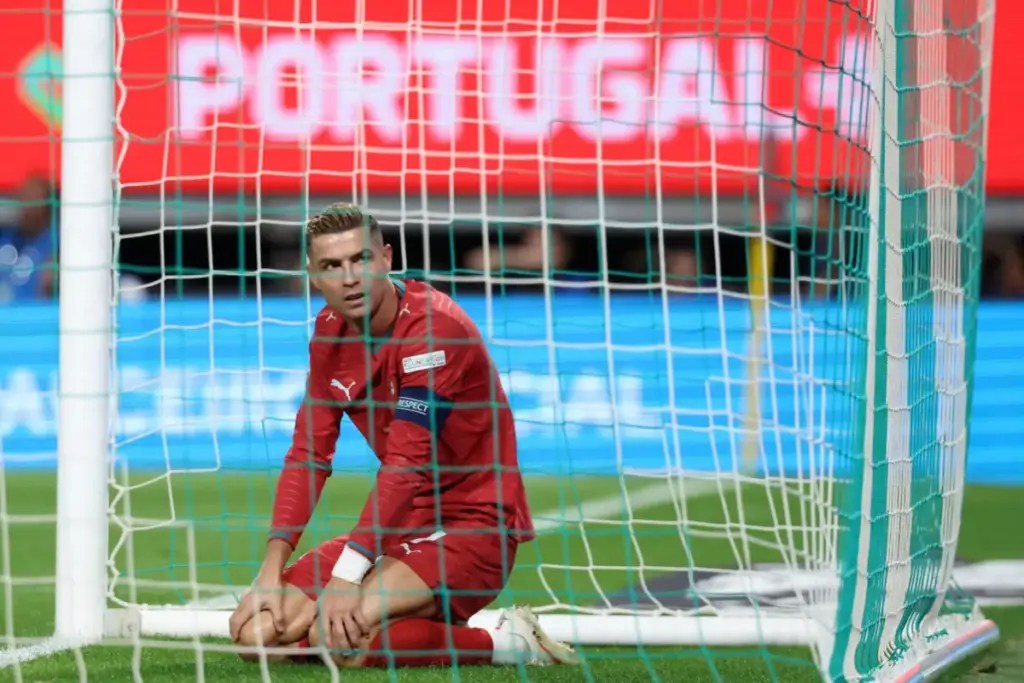
Cristiano Ronaldo’s legendary international career with Portugal has been thrust into unprecedented uncertainty after the veteran forward abruptly left the national team’s training camp. The dramatic exit came after the 41-year-old learned he would not be included in the starting lineup against Denmark for a second consecutive UEFA Nations League fixture, capping off a week of escalating tension within the squad.
The announcement of his departure arrived late Wednesday evening, unfolding shortly after newly appointed head coach Jorge Jesus confirmed during a pre-match press conference that Gonçalo Ramos would once again spearhead Portugal’s attack for the high-stakes encounter.
Ronaldo had initially been expected to participate in the final training session with his teammates at Copenhagen’s Parken Stadium ahead of Thursday night’s match. Instead, he packed his bags and departed the team bubble following an impromptu and crucial conversation with Portuguese Football Federation (FPF) President Pedro Proença.
Reflecting the sudden and stunning nature of the departure, Ronaldo took to social media to break the news to millions of supporters worldwide. Writing on Instagram, the iconic forward stated, "Following the national team coach’s press conference, and after having a conversation with the Portuguese Football Federation president, I decided to leave the national team’s training camp."
While the captain watched from afar, Portugal delivered an emphatic statement on the pitch, defeating Denmark 4-2 without their talismanic leader. The fluid, high-scoring attacking performance immediately ignited a passionate public debate across the nation regarding the future tactical identity of the Seleção and whether the team has evolved past its dependence on its most decorated player.
A Fractured Relationship Over Playing Time
The tensions had been simmering for several days. Just prior to his departure, Ronaldo had remained rooted to the bench for the entirety of Portugal’s 2-1 Nations League victory over Norway on Sunday. For a player whose competitiveness and desire to play every minute are legendary, the omission marked a startling milestone: it was the first time since November 2024 that Ronaldo had failed to make an appearance for his country when he was neither injured nor serving a suspension.
Jorge Jesus, who previously managed Ronaldo for a turbulent year at Saudi Professional League club Al-Nassr before taking the reins of the national team in July, repeatedly insisted to the media that there was no deep-seated personal feud between them. However, the manager candidly acknowledged that his captain was deeply unhappy about being left out of the action against Norway.
"There was no incident whatsoever," Jesus maintained during his post-match press conference following the win over Norway.
The coach later offered further context into the decision-making process, explaining that Ronaldo had engaged in an extensive pre-match warm-up lasting between 20 and 30 minutes, only to be told he would not be substituted onto the pitch.
"Any player, and I was a player myself, when you spend 20 or 30 minutes warming up and then don’t get on, no one is happy about that," Jesus admitted.
Jesus explained that he had informed Ronaldo prior to the opening whistle that he could potentially be utilized as a tactical substitute depending on how the match unfolded, but ultimately chose a different path as the game progressed. "Afterwards, as coach, I decided not to bring him on. It’s nothing to make a fuss about," Jesus added.
The friction reached a boiling point when Jesus doubled down during his Wednesday press conference, confirming that Ramos would retain his starting role against Denmark. Addressing reporters regarding Ronaldo’s status, the coach remarked bluntly, "If I need him, he’ll come on. If I don’t need him, he won’t."
Ronaldo’s swift decision to pack his belongings and leave the camp indicated that his grievances ran far deeper than a single tactical snub or a disagreement over substitute minutes. Signaling that a larger confrontation may have occurred behind closed doors, the veteran forward strongly hinted that the public has only heard a fraction of the story.
"In due course, I will tell the truth to all the Portuguese people about my reasons for leaving the national team, to which I have always been dedicated," Ronaldo wrote in his Instagram statement, leaving the door open for future revelations. "Now is time to wish good luck to Portugal and to all my teammates, without exception."
Airport Intervention and Family Outcry
The unfolding crisis prompted desperate behind-the-scenes efforts by Portuguese football authorities to salvage the situation. According to reports from the prominent Spanish sports newspaper Marca, coach Jorge Jesus and FPF President Pedro Proença personally pursued Ronaldo all the way to Copenhagen’s airport. The pair attempted a last-ditch intervention to persuade the forward to reverse his decision and remain with the squad, but their appeals fell on deaf ears before Ronaldo boarded his private jet.
The controversy quickly reverberated outside the sporting sphere, drawing fiery reactions from Ronaldo’s inner circle. His sister, Elma Aveiro, launched a blistering attack on the Portuguese public via social media, expressing profound anger over how her brother has been treated by critics and fans alike.
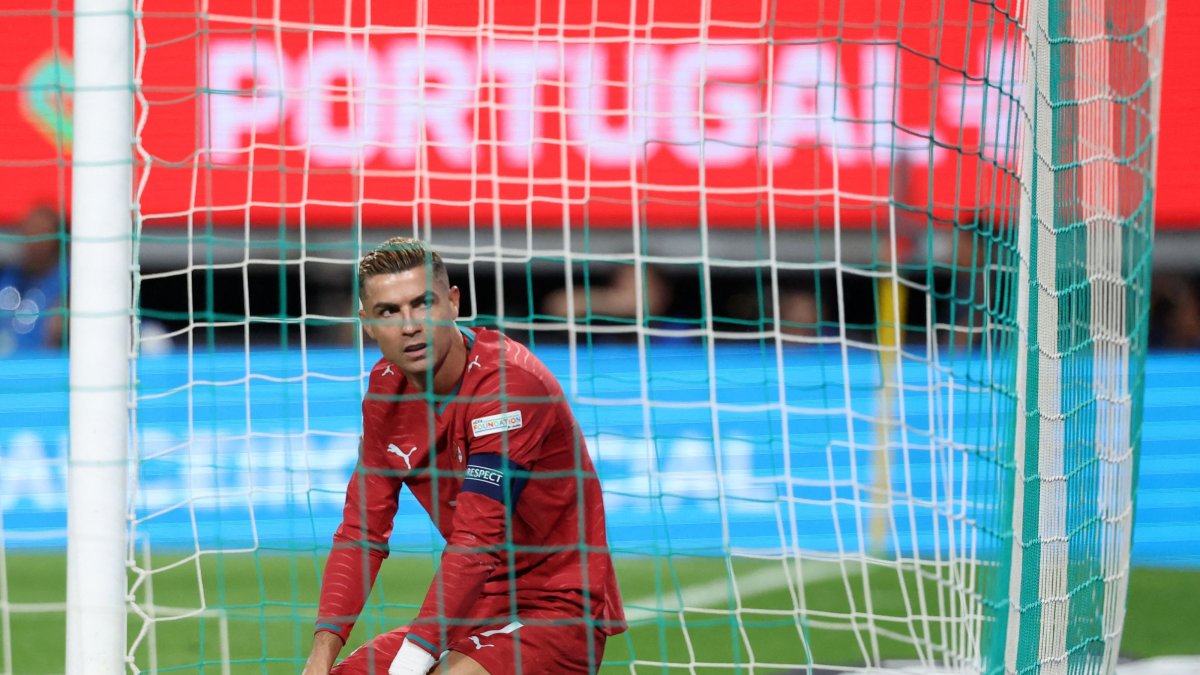
"They don’t deserve to have the best of anything," Aveiro wrote in an emotional Instagram post, claiming that the country had grown "envious, scornful, and ignorant" and arguing that the nation deserved to regress to the era before Ronaldo transformed the landscape of Portuguese football.
The dispute quickly spilled off social media and onto the physical streets of Lisbon, turning into a public spectacle.
A passionate Portugal supporter funded a large, eye-catching billboard strategically positioned near the Estádio da Luz and the Portuguese Football Federation headquarters. The display featured artificial intelligence-generated imagery of both Ronaldo and Jorge Jesus alongside pointed, contrasting messages.
"Thank you, Cristiano Ronaldo, for all that you did for Portugal. You will always be our captain," read the tribute dedicated to the forward. Directly adjacent to it, a scathing critique of the national team manager stated that Jesus "was not up to the job," accused him of a "lack of sensitivity in managing the CR7 asset," and claimed he had "mishandled a captain."
The billboard was quickly taken down by authorities, but the fan behind the financial backing, Fernando Maia, stepped forward to explain his motivations. Maia, who owns a local billboard enterprise, confirmed he has no personal ties to Ronaldo or any members of his management team.
"I don’t know Ronaldo, I don’t know anyone on Ronaldo’s entourage," Maia told local Portuguese media outlets. "I know myself, and I know something called gratitude."
Maia added his belief that the manager was merely a catalyst for a deeper institutional issue within Portuguese football. "Jorge Jesus was just the means for this to have happened, but there are more culprits," he said, vowing to reproduce the same controversial display outside the Estádio do Dragão when Portugal hosts its next upcoming Nations League fixture.
Balancing Legacy and Team Rules
Faced with mounting media scrutiny following the 4-2 victory over Denmark, Jorge Jesus sought to pivot the narrative back to the sporting achievements of his players on the pitch, emphasizing that collective success must always supersede individual drama.
"This Portugal team scored four goals and put in a performance which, in my opinion, was of a very high standard," Jesus told reporters. "Of course, this is more important than anything else that has happened."
At the same time, the manager drew a definitive line regarding squad hierarchy, making it clear that no individual player’s historical status would exempt them from his tactical framework or the disciplinary standards of the team.
"There are players with status. That much is crystal clear," Jesus acknowledged. "लेकिन [But] I’ll say it again: The rules are the same for everyone."
These remarks highlight the formidable and delicate balancing act confronting Jesus as he manages a towering figure who has been the undisputed heartbeat and cultural focal point of Portuguese international football for over two decades.
Ronaldo, who recently hinted that the current campaign could mark the final chapter of his illustrious professional career, stands as Portugal’s all-time leading goalscorer and most-capped player in history. Across an extraordinary international career, he has netted 146 goals in 234 appearances for his country.
His journey with the senior national team began back in 2003 when he made his debut as an 18-year-old prodigy. From there, he went on to star in the Euro 2004 final on home soil, lead Portugal to the semifinals of the 2006 FIFA World Cup, and ultimately captain the nation to its historic first-ever major international trophy at Euro 2016.
At the club level, his storied career has seen him break numerous records while representing elite European giants including Sporting CP, Manchester United, Real Madrid, and Juventus, solidifying his legacy as one of the most lethal and prolific goalscorers the sport has ever produced.
Now, as Ronaldo approaches the twilight of his playing days, his relationship with the national team has entered uncharted and turbulent territory. His sudden departure from the training camp, coupled with his vow to eventually reveal his side of the story, leaves a lingering cloud of uncertainty over whether his absence in Copenhagen was simply a temporary protest over squad rotation or the definitive, fractured end of an era for Portuguese football.