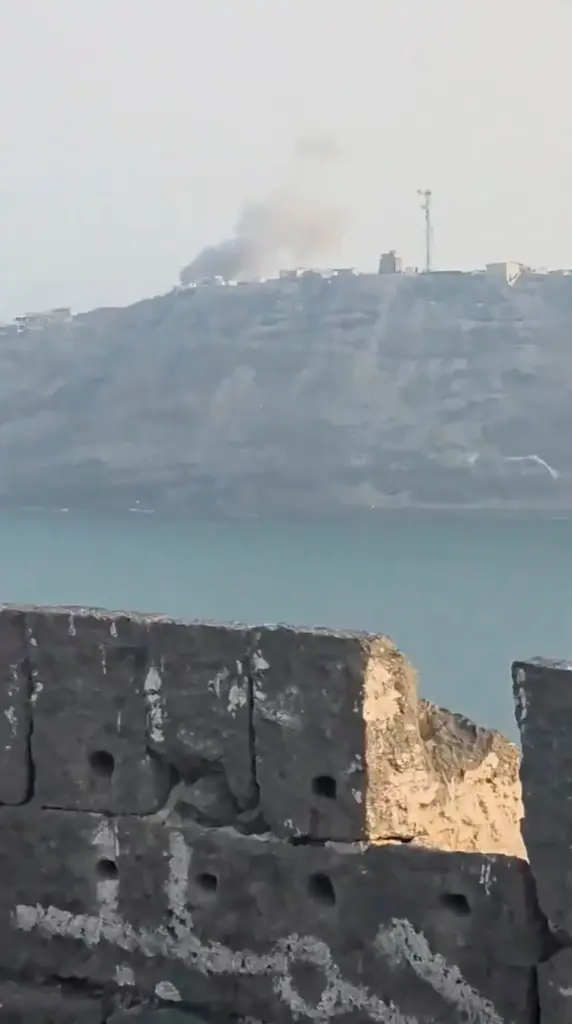
At least five people were tragically killed and 16 others sustained wounds on Thursday when Yemen’s Houthi forces launched a devastating strike targeting the presidential palace complex located in the strategic southern port city of Aden. The high-profile assault formed part of a dramatic escalation in hostilities that also saw the insurgent group claim responsibility for hitting a Saudi fighter jet high above northern Yemen, marking a sharp and dangerous deterioration in a conflict that has plagued the region for over a decade.
The coordinated missile and drone bombardment directly struck Al-Maashiq Palace, which serves as the heavily guarded headquarters for Yemen’s internationally recognized, Saudi-backed government. This violent incursion marked the very first time the sprawling complex has been directly hit during the latest renewed round of heavy fighting. The attack shattered a period of relative quiet and sent shockwaves through the southern interim capital, emphasizing the vulnerability of the central administration even in areas far removed from the primary northern frontlines.
Yemeni Health Minister Qasim Buhaibeh confirmed the grim casualty toll, noting that those killed and injured in the precision strike included dedicated security guards and civilian employees who maintain the administrative functions of the government headquarters. Meanwhile, Information Minister Moammar al-Eryani stepped forward to reassure the public and international partners, confirming that the prime minister and all members of the Cabinet were completely unharmed during the assault, having escaped serious injury or worse.
Houthi military spokesperson Yahya Saree quickly claimed full responsibility for the targeted operation against Al-Maashiq Palace. In a televised statement, Saree asserted that the insurgent forces had successfully struck what the movement described as a vital Saudi military operations headquarters located within the Aden complex.
Further compounding these claims, the Houthi-run SABA news agency alleged that Saudi military officers were actively operating the targeted facility and that the grounds concealed significant weapons depots. However, these specific allegations regarding the facility’s military use and foreign personnel could not be independently verified by international observers or independent journalists operating in the region.
Simultaneously, the escalating air war took a dramatic turn as the Houthis released dramatic infrared footage purportedly capturing a surface-to-air missile striking a Royal Saudi Air Force Eurofighter Typhoon high over Yemen’s rugged northern Saada province late Wednesday.
Spokesperson Saree claimed that the advanced fighter jet, which military tracking suggests had departed from Saudi Arabia’s strategically important Taif Air Base, sustained a direct hit during the engagement and was left in immediate danger of crashing before managing to limp away from the combat zone.
A close examination of the released infrared imagery, however, suggested a more ambiguous scenario. The footage appeared to show a missile detonating in close proximity to the aircraft rather than scoring a direct, catastrophic hit. The pilot appeared to execute quick defensive maneuvers, steering the aircraft away from the immediate blast radius of the explosion.
A clearly visible vapor or smoke trail streaming from the aircraft’s left wing immediately sparked intense speculation among defense analysts regarding potential structural or mechanical damage sustained from high-speed missile fragments. Despite the intense speculation, neither the exact extent of any physical damage to the multi-million-dollar aircraft nor the absolute authenticity of the Houthi-released footage could be independently verified by defense experts.
Official authorities in Riyadh have maintained a strict silence on the incident, offering no official confirmation or denial of the engagement, and there have been no verified reports from search-and-rescue teams or military monitors indicating that a Saudi fighter jet was actually shot down over northern territory.
Defense observers studying the engagement suggested that the weapon utilized in the attack was likely a Barq surface-to-air missile. This specific ordnance is closely associated with Houthi domestic and integrated air defense networks and has long been reported by intelligence monitors to be linked to advanced Iranian missile technology and components smuggled into the war-torn country.
This alleged mid-air engagement unfolded against a backdrop of mounting regional tension, with Riyadh aggressively accusing the Houthis of drastically intensifying a relentless campaign of cross-border missile and drone attacks directed against civilian airports, vital commercial ports, and critical energy infrastructure distributed across the kingdom.
Saudi-led coalition spokesperson Turki al-Maliki delivered a stark assessment during a press briefing on Thursday, revealing that Houthi forces had ruthlessly launched a staggering 20 separate attacks targeting King Khalid International Airport in the capital city of Riyadh over the course of the month. According to coalition figures, these specific strikes resulted in the deaths of 17 people and left 333 others wounded, causing widespread panic and significant disruption to international air travel.
In addition to the frequent attacks on the capital’s main aviation hub, separate, coordinated assaults targeting Abha international airport located in southwestern Saudi Arabia claimed three more lives and left 28 individuals nursing various injuries, underscoring the persistent and far-reaching security threat posed by the insurgent group’s growing arsenal.
Maliki leveled direct accusations against the Houthi leadership, stating unequivocally that the movement has rapidly acquired highly sophisticated military hardware. He highlighted the proliferation of advanced ballistic missiles, long-range loitering munitions, and explosive-laden remote-controlled boats, asserting that these lethal capabilities were acquired through the direct assistance and logistical backing of regional actors hostile to the coalition.
Demonstrating the coalition’s ongoing military response, Maliki reported that coalition warplanes and ground-based air defense systems had successfully destroyed 127 separate weapons storage facilities, underground bunkers, and mobile launch platforms hidden across various provinces of Yemen.
In a related operational update, the coalition separately announced that its integrated air defense network had successfully intercepted and destroyed multiple explosive-laden drones over the southern Saudi cities of Khamis Mushait and another unspecified area in the southern region of the kingdom, preventing further civilian casualties and property damage.
In the wake of these fast-moving developments, the Houthi movement issued a sweeping and ominous warning to international commercial aviation. The group formally declared that Saudi airspace and all airports operating within the kingdom were entirely unsafe for civilian travel, pointedly carving out a single exemption for the airspace directly above the holy cities of Mecca and Medina to avoid direct provocation regarding religious sites.
This sudden and dramatic resurgence of large-scale violence directly follows the complete collapse of a prolonged and fragile lull in Yemen’s devastating civil war. The nationwide conflict originally erupted back in 2014, when Houthi rebels swept down from their northern strongholds and forcefully seized the capital city of Sanaa. That power grab prompted a massive, internationally backed Saudi-led military intervention the following year aimed at restoring the internationally recognized government to power.
Active fighting and front-line clashes abruptly resumed last month, fueled heavily by a broader regional conflagration that ignited following coordinated U.S. and Israeli military strikes targeting Iranian interests in February, which reverberated across multiple proxy conflicts in the Middle East.
Capitalizing on the shifting dynamics, Yemeni government forces have launched a series of coordinated ground operations designed to recapture strategic territory currently held by the Houthis. These military maneuvers have increasingly focused on contested areas situated near the highly critical Bab el-Mandeb Strait, a narrow and vital maritime chokepoint that serves as an essential global trade route for international shipping and energy transit.
As heavy weapons fire echoes across the landscape once more, international humanitarian organizations and relief agencies have issued urgent warnings. Aid workers emphasize that the renewed military campaigns and infrastructure strikes threaten to rapidly worsen Yemen’s already catastrophic humanitarian crisis, endangering millions of civilians who remain dependent on continuous food aid, medical supplies, and functional supply lines.