As the Victoria and Albert Museum (V&A) in London prepares for the ambitious transformation of its South Asia Gallery ahead of its scheduled opening in 2028, contemporary creative collaborations are already underway behind the scenes. Among the most anticipated elements of the upcoming gallery spaces is a major new contemporary commission designed to converse with one of the institution’s most striking historical architectural artifacts: the 19th-century Cochin ceiling from Kerala, India.
For creators Ananth Ramaswamy and Devi Seetharam, the journey to realize this contemporary response recently reached a pivotal milestone. In a shared guest insight reflecting on their creative process, the duo detailed their very first in-person encounter with the historic coffered timber ceiling, marking a dramatic shift from months of remote research to tangible, hands-on discovery.
Until recently, much of Ramaswamy and Seetharam’s collaborative work on the V&A Cochin Ceiling commission had necessarily been conducted at a distance. Separated by geography, the creative partners relied heavily on photographs, architectural drawings, digital archives, and remote conversations to shape their preliminary ideas. Their foundational work began with a deep dive into the artistic and architectural articulations of the lotus motif across the cultural landscape of Kerala. As they considered the complex journey and eventual recontextualization of the historic ceiling as a whole, their scope widened, prompting them to explore how the lotus has been interpreted across the breadth of the V&A’s vast collection, spanning an immense variety of periods, geographies, and cultures. However, Seetharam’s arrival in London allowed the project to move away from a purely remote understanding into something far more expansive, nuanced, and sensitive.
Seeing the ceiling in person
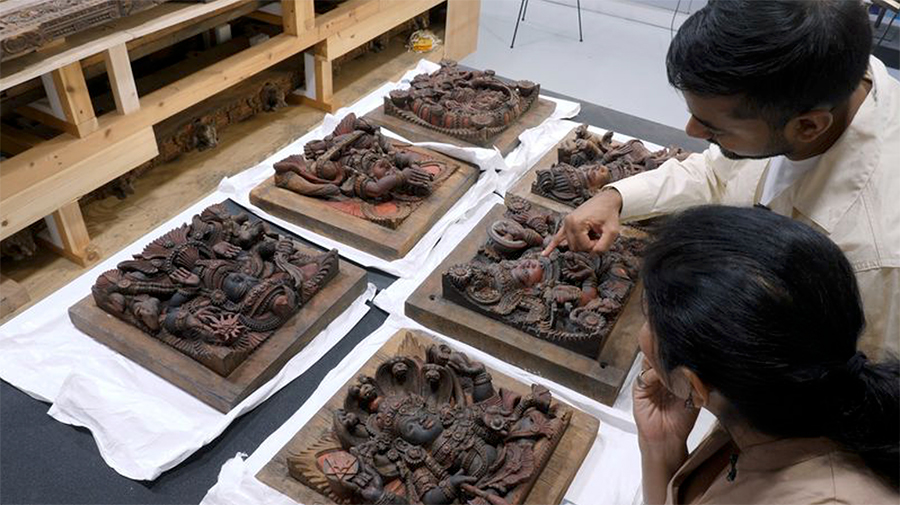
The first official meeting with the wider project development team took Ramaswamy and Seetharam behind the scenes to examine the historic Cochin Ceiling while it underwent delicate conservation work. Encountering the monumental artifact in person fundamentally altered their perception and understanding of the piece. While the sheer scale of the woodwork was immediately apparent, the physical proximity exposed critical details that photographs simply could not capture: the impressive depth and intricacy of the hand-carving, the structural integrity of the transverse framework holding the heavy panels together, and the subtle variations distinguishing each individual carved piece. Most importantly, the visit revealed the vibrant polychromy and original colors gradually emerging through the meticulous cleaning process undertaken by the museum’s conservation specialists.

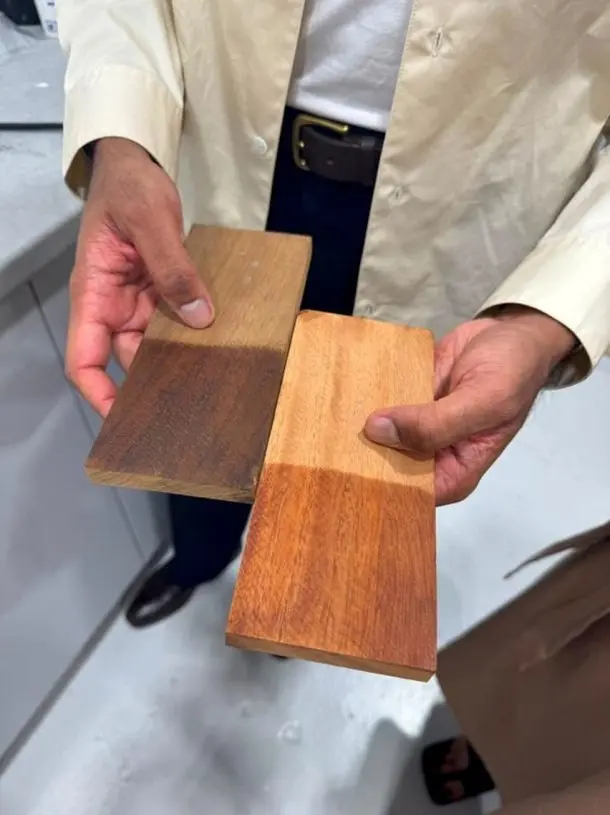
Working side by side with the conservation team also presented a vital opportunity to evaluate how the materiality of the contemporary artistic intervention might sit in harmony with the original historical fabric. The creators had arrived prepared with physical samples of various timber species commonly utilized for traditional wood carving in India today, alongside a range of oils and stains. This allowed them to place the modern wood samples directly against the historic material for immediate comparison.
While the historic ceiling is constructed predominantly from teak, observing the uncovered polychromy firsthand forced the creators to reconsider whether simply matching the timber species was the most artistically sympathetic response. They noted that darker wood samples receded more quietly into the background, whereas warmer timbers subtly complemented the rich hues and tones being brought back to life through ongoing conservation efforts.

Exploring the collection
The significance of the London visit extended far beyond the immediate confines of the conservation studio and the ceiling itself. The creators engaged extensively with staff members across multiple museum departments and areas of expertise, drawing on diverse perspectives to ensure their approach to the commission retained the highest possible degree of historical sensitivity and conceptual depth. They spent considerable time navigating the V&A’s public galleries, archival holdings, and secure storage facilities, closely examining more than a hundred distinct objects. While some artifacts had been specifically targeted due to a predetermined relationship with their ongoing research, others only revealed their true significance through spontaneous, physical encounters in the galleries and stores.
There was a profound creative value in allowing the research process to remain open-ended and fluid. Examining a glazed ceramic bowl up close might reveal a delicate indentation or surface texture that had gone completely unnoticed in high-resolution digital scans. Similarly, a small metal object could suggest an innovative technique for reducing a complex floral petal down to a few essential, elegant lines. Through these hands-on observations, qualities such as translucency, material distortion, surface texture, precise line weight, and dramatic shifts in scale naturally entered the core of their design conversations.

Seetharam utilized the time to sketch continuously while the creators examined objects taken directly out of storage for close-quarters analysis. Artifacts that appeared monumental or imposing in digital photography occasionally proved to be unexpectedly tiny in reality, while seemingly simple objects revealed astonishing layers of nuance when handled and observed with an experienced eye.
A way of looking
For the creative team, one of the most rewarding aspects of the residency was the seriousness and patience with which their exploratory research process was supported by the museum. Rather than feeling pressured to identify a specific traditional motif and immediately translate it into a finished design, Ramaswamy and Seetharam were given the essential time and space to observe, question, and follow unexpected creative threads wherever they led. Consequently, their initial encounter with the Cochin Ceiling evolved from a search for immediate design answers into the cultivation of a refined, methodical way of looking—an observational practice designed to inform and ground all the creative work yet to come.

The forthcoming contemporary commission is destined to form an integral part of the major transformation of the V&A’s South Asia Gallery, which is currently scheduled to open its doors to the public in 2028. The extensive refurbishment and redevelopment of the South Asia Gallery is made possible through the generous support of The National Lottery Heritage Fund, the Dunard Fund, private patron Mandakini Puri, and numerous other dedicated donors committed to expanding global access to cultural heritage.