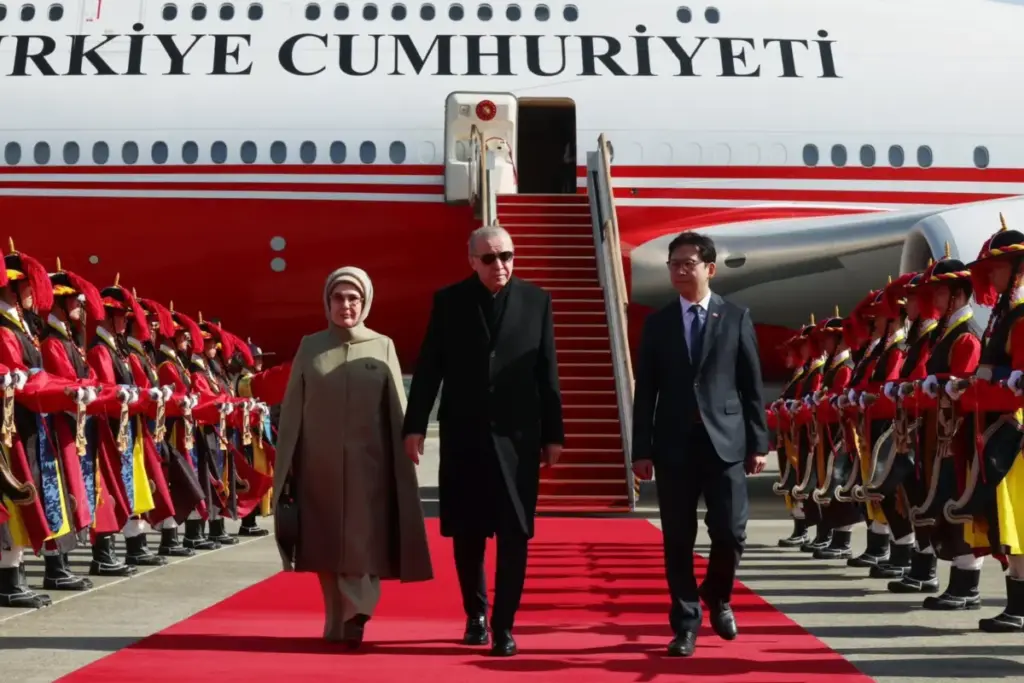
The cornerstone of President Erdoğan’s itinerary in South Korea is the expansion of economic relations, with a particular focus on prospective cooperation in the energy sector, most notably nuclear power development. Türkiye has been steadily advancing its national energy strategy to diversify its power grid, integrating large-scale nuclear and renewable energy initiatives to meet its rising industrial and domestic electricity demands. This visit serves as a crucial platform to advance discussions on how South Korean expertise and technology can contribute to Türkiye’s ambitious energy roadmap.
To address these expansive economic and strategic objectives, President Erdoğan brought along a robust delegation of key government figures. The delegation includes Foreign Minister Hakan Fidan, Energy and Natural Resources Minister Alparslan Bayraktar, National Defense Minister Yaşar Güler, Industry and Technology Minister Mehmet Fatih Kacır, Justice and Development Party (AK Party) Deputy Chair and head of Health Policies Halit Yerebakan, and Defense Industries Secretary Haluk Görgün. The presence of these high-level officials underscores the comprehensive nature of the discussions, spanning foreign policy, defense, energy security, industrial innovation, and technological collaboration.
In an interview with the Yonhap News Agency released on Monday, President Erdoğan highlighted a major prospective energy initiative, stating that South Korea could become a vital partner in developing Türkiye’s planned Sinop nuclear power station. Türkiye has been closely studying both the technical and economic terms surrounding the Black Sea project in coordination with the state-run Korea Electric Power Corp. Erdoğan emphasized that Ankara would carefully weigh critical factors such as financing structures, long-term electricity costs, and overall tangible benefits to the Turkish economy before finalizing a partner for the multi-billion-dollar infrastructure undertaking. The Sinop project represents a crucial pillar in Türkiye’s long-term strategy to secure stable, low-carbon baseload energy, and collaboration with an experienced nuclear builder like South Korea could provide the technical rigor and financial stability required for such a monumental engineering endeavor.
Beyond the energy sector, President Erdoğan’s discussions with South Korean leadership reach deep into advanced technology and industrial manufacturing. In his interview with Yonhap, the Turkish president identified defense, semiconductors, artificial intelligence, and robotics as prime areas for mutual cooperation. He made a strong appeal for increased South Korean investment and joint production ventures within Türkiye, noting that both nations possess complementary industrial strengths that can be leveraged to compete more effectively on the global stage.
Trade expansion also occupies a prominent place on the diplomatic agenda. Erdoğan noted that both countries are actively working toward a bilateral trade volume target of $15 billion. However, he also pointed out the necessity of addressing the existing trade imbalance that currently favors South Korea, signaling that future commercial agreements should aim for a more equitable exchange of goods and services. As part of this broader economic vision, Erdoğan extended a direct invitation to South Korean corporations, encouraging them to participate actively in Türkiye’s extensive transport and logistics projects. These strategic initiatives are designed to bridge infrastructure networks between Asia and Europe, offering South Korean firms a vital gateway to Western markets through Türkiye’s uniquely positioned geographic corridor.