As leaders and diplomats gather for the 81st session of the United Nations General Assembly (UNGA), the international system finds itself confronting a geopolitical reality far more complex than a simple uptick in global violence. The architecture of modern conflict is undergoing a profound structural shift. Rather than remaining localized or isolated, crises that were once treated as separate and distinct are increasingly interacting with one another. Through a dense web of military alliances, critical strategic chokepoints, vital energy transit routes, and overlapping deterrence commitments, the geography of global instability is expanding rapidly.
This dynamic is starkly visible across multiple theaters. The war in Ukraine is steadily edging closer to the broader European security space, with Poland functioning as the vital, highly vulnerable threshold dividing the active battlefield from the wider NATO alliance. Farther north, the expansion of American military access to Greenland underscores the renewed, high-stakes strategic importance of the Arctic and the North Atlantic. Meanwhile, in the Middle East, the ongoing fallout from the conflict with Iran leaves key maritime passages like the Strait of Hormuz exposed to severe disruptions. At the same time, Yemen has surged back to the center of regional geopolitics as Houthi forces consolidate their influence around the Bab el-Mandeb strait and resume direct attacks against Saudi Arabia.
Crucially, these flashpoints do not constitute a single, monolithic global war, nor does an all-encompassing planetary confrontation remain an inevitable destiny. Instead, a more intricate and volatile phenomenon is unfolding. Conflicts are becoming organically linked not merely because they happen to occur at the same time, but because an escalation in one theater directly alters the security calculations, deterrence thresholds, and strategic choices of another. The international community is actively transitioning away from an era defined by multiple, parallel wars and entering an age defined by connected wars.
Expansion of Conflict
This fundamental transformation is most clearly visible across the European continent. Although the war in Ukraine remains territorially anchored within Ukrainian borders, its strategic boundaries are growing increasingly porous and ambiguous. Russian military strikes executed in close proximity to the Polish border, the repeated emergency mobilizations of Polish air-defense systems, and Warsaw’s escalating anxieties regarding stray missiles and drones vividly illustrate how narrow the geographical buffer has become between the ongoing war in Ukraine and the broader framework of NATO-Russia deterrence.
Poland occupies a uniquely precarious position because it serves as the physical intersection where these two distinct strategic spaces collide. Western military strategy has long relied on a delicate and increasingly difficult distinction: providing robust military assistance to Ukraine while simultaneously striving to prevent a direct, catastrophic military confrontation between the NATO alliance and the Russian Federation. While that policy distinction remains officially intact, the practical challenge of maintaining it grows more formidable by the day. Western Ukraine simultaneously functions as sovereign Ukrainian territory, an indispensable logistical corridor for Western aid, and the immediate geographical neighborhood of NATO’s eastern flank.
Consequently, the operational escalation ladder has grown dangerously short. Russian missile strikes near the border provoke immediate Polish military readiness. Polish mobilizations activate the collective radar and defense posture of NATO’s eastern flank. A stray missile or rogue drone crossing the frontier at any moment risks generating intense domestic and international pressure for a direct kinetic response. While none of these developments render a direct clash between Russia and NATO an absolute certainty, they continuously reduce the strategic distance separating the two sides.
In the high north, the emerging framework regarding Greenland introduces an entirely new dimension to Western defense planning. The developing arrangement appears to supplant controversial notions of territorial acquisition with expanded, long-term American military access while preserving local sovereignty intact. The practical outcome is the deeper integration of Greenland into Western collective security architecture, signaling a renewed, urgent focus on the geopolitical significance of the Arctic.
When viewed comprehensively, the strategic geography of Europe can no longer be evaluated in isolation. It must be understood as an expansive, interconnected security continuum that links the North Atlantic and the Arctic directly with Scandinavia, the Baltic states, Poland, Ukraine, and the Black Sea.
Middle East’s Connected Fronts
A parallel expansion of strategic geography is simultaneously reshaping the security landscape of the Middle East. The recent military confrontations involving Iran demonstrated with alarming clarity how swiftly a regional conflict can acquire profound global ramifications. The Strait of Hormuz links military escalation directly to international energy flows, maritime shipping lanes, and the stability of the global economy. Yet, Hormuz is merely one critical node in a much wider network of vulnerabilities.
In this context, Yemen has re-emerged as a focal point of strategic centrality. The multifaceted conflict there must be analyzed through four distinct, overlapping layers. The first layer involves Yemen’s complex internal power struggle, defined by Houthi territorial ambitions, the deep fragmentation of their domestic opponents, and fierce competition among various local factions. The second layer directly concerns the national security of Saudi Arabia. The resumption of ballistic missile and drone attacks highlights how rapidly the Yemeni arena can transform into an immediate, physical threat to the Kingdom.
The third layer is explicitly regional. While the Houthis maintain a close relationship with Tehran and have historically benefited from significant Iranian military and technological backing, the Yemeni movement cannot be reduced to a mere proxy or an unthinking extension of Iranian grand strategy. The Houthis possess a distinct domestic constituency, autonomous political objectives, and independent military decision-making processes. Consequently, the Saudi-Houthi confrontation maintains its own internal logic, even as it constantly interacts with the wider regional environment.
The fourth layer is geoeconomic. Houthi military activities centered around the Bab el-Mandeb strait carry vastly greater weight when evaluated alongside the persistent instability surrounding the Strait of Hormuz. These two vital waterways sit at opposite geographical ends of the crucial energy and trade corridor linking the Persian Gulf, the Indian Ocean, the Red Sea, the Suez Canal, and the Mediterranean Sea.
As a result, Yemen can no longer be dismissed as a peripheral or localized conflict. It has rapidly evolved into a primary strategic center of gravity for the entire regional crisis. Whether located in Poland, Greenland, Hormuz, or Bab el-Mandeb, these disparate flashpoints point toward a single underlying reality: physical geography is forcefully returning to the center of international politics, and developments occurring within one strategic theater inevitably shape the calculations of actors in another.
Türkiye’s Emerging Responsibilities
For Türkiye, this sweeping systemic transformation is far from an abstract theoretical debate. Ankara is already confronting difficult, concrete choices across nearly every one of these interconnected theaters. This ground reality renders traditional descriptions of Turkish foreign policy as mere "balancing" increasingly inadequate.
The evolving situation regarding Iran serves as a clear case in point. Türkiye firmly opposes the expansion of military hostilities against Iran, recognizing that a prolonged conflict or the sudden collapse of Iranian state capacity would unleash severe, direct security, migration, energy, and economic shocks across its borders. Consequently, Ankara continues to prioritize diplomatic channels and regional de-escalation.
However, opposition to a wider war does not equate to uncritical alignment with Tehran. Türkiye is simultaneously taking decisive steps to insulate its economy from the severe financial risks radiating outward from the Iranian crisis. A prominent example is the recent decision to revoke the operating license of Bank Mellat’s Istanbul branch. This move unfolded amid intensified American economic pressure on Tehran, following earlier Washington sanctions targeting a Türkiye-based investment bank and associated companies over alleged illicit financial transactions tied to Iran.
This broader pattern points toward an increasingly differentiated and pragmatic approach. Ankara can vigorously oppose the military destabilization of Iran while simultaneously taking rigorous measures to limit its own exposure to the economic and financial fallout of Tehran’s high-stakes standoff with Washington.
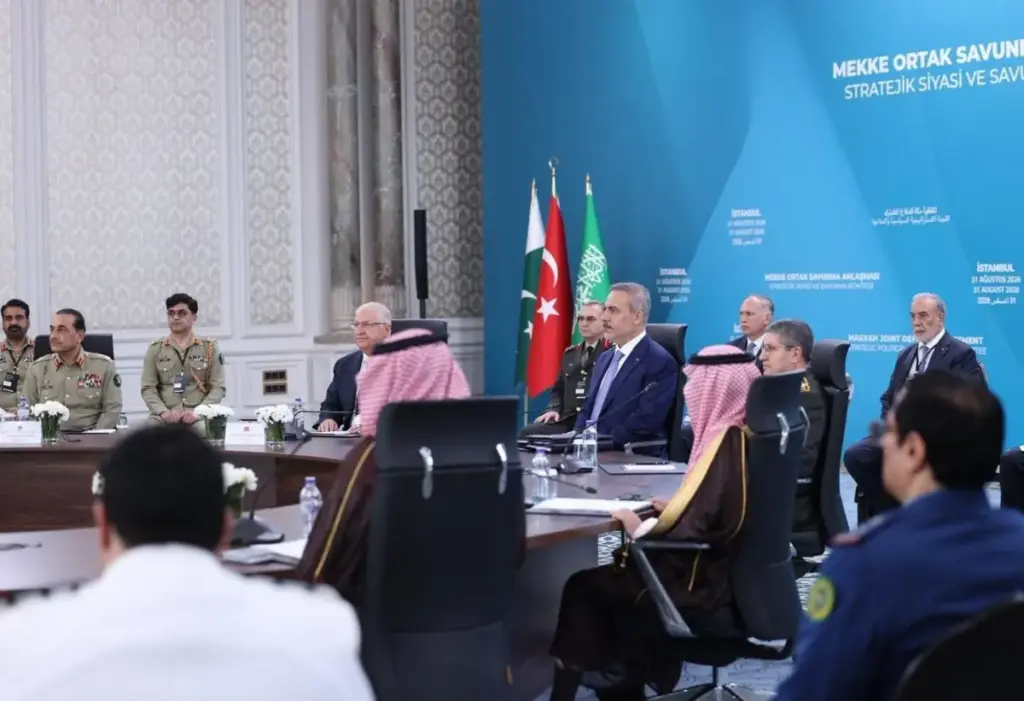
Yemen presents Türkiye with an entirely different kind of strategic test. The recent wave of renewed Houthi drone and missile attacks directed against Saudi Arabia has occurred in the wake of the establishment of the Mecca Joint Defence Agreement, forged between Türkiye, Saudi Arabia, and Pakistan. This new security arrangement imbues the current escalation with a level of significance that previous Saudi-Houthi confrontations simply did not hold for Ankara.
The Mecca Agreement can no longer be discussed merely as an aspirational blueprint for regional security architecture; it is now facing its inaugural, high-stakes test of deterrence credibility. Repeated kinetic strikes targeting Saudi territory, if met with silence or inaction from its newly minted defense partners, would inevitably raise damaging questions regarding the reliability and deterrence value of the pact.
Recent public statements delivered by Turkish Foreign Minister Hakan Fidan underscore the gravity of this moment. Fidan emphasized that member states bear mutual responsibilities toward one another, that diplomatic and military consultations are actively underway, and that Türkiye remains fully capable of meeting Saudi military requirements, particularly within specialized technical domains. He also noted that preparations concerning the agreement’s permanent secretariat and joint military headquarters are nearing completion.
Crucially, this initial test does not require direct Turkish offensive military intervention inside Yemen. A far more practical and consequential contribution would lie in the realm of defensive deterrence. Saudi Arabia confronts a complex threat environment heavily saturated with advanced ballistic missiles, cruise missiles, and loitering munitions. Over recent years, Türkiye has successfully developed indigenous military capabilities directly tailored to counter such asymmetric threats. These include sophisticated radar and early-warning systems, electronic warfare platforms, counter-drone technologies, layered air-defense batteries, and resilient command-and-control infrastructure.
The Mecca Agreement’s first credibility test may therefore hinge on achieving deterrence by denial rather than through offensive retaliation. Upgrading Saudi Arabia’s early-warning capabilities, air and missile defense networks, intelligence-sharing protocols, and critical infrastructure protection would send an unmistakable signal that attacks against a member state carry tangible, operational consequences, all without transforming the defensive pact into an offensive coalition.
This careful distinction is equally vital for managing Türkiye’s policy toward Iran. Ankara is not required to treat independent Houthi actions as direct Iranian state directives, nor does contributing to Saudi Arabia’s defensive resilience necessitate joining a hostile anti-Iran coalition. Türkiye retains the diplomatic space to oppose the dangerous expansion of war against Iran while simultaneously fulfilling narrowly defined, defensive alliance commitments toward Saudi Arabia.
In a similar vein, the war in Russia presents Ankara with another variant of this complex geopolitical challenge. Türkiye officially champions Ukraine’s recognized territorial integrity and remains firmly anchored within the NATO alliance, while simultaneously maintaining crucial diplomatic channels with Moscow in an effort to prevent the Black Sea from deteriorating into a direct Russia-NATO military combat zone. Yet, Poland’s increasing exposure to the conflict fundamentally alters this equation. Any direct military incident involving Russia and Poland would instantly cease to be treated primarily as a regional Ukrainian issue by Ankara and would instead transform directly into a core alliance-security imperative.
Consequently, Türkiye finds itself actively managing three distinct strategic responsibilities: sustaining robust NATO deterrence without severing critical channels of dialogue with Russia; opposing a destructive military campaign against Iran while strictly limiting national exposure to its aftermath; and lending genuine credibility to an emerging defense commitment toward Saudi Arabia without allowing that partnership to drag the country into a broader, uncontrollable regional conflagration.
These diverse responsibilities do not coalesce into a single, uniform strategy directed against a singular, well-defined threat. Instead, Türkiye increasingly operates through a flexible array of security arrangements tailored specifically to distinct geographical environments. The NATO alliance remains the bedrock of its European security policy. Meanwhile, its rapidly expanding national military and defense-industrial capabilities provide enhanced room for independent maneuver within its immediate neighborhood. Finally, the Mecca Agreement introduces an additional, complementary layer of security cooperation stretching across the Gulf and the Red Sea.
The resulting framework can best be characterized as a layered strategic architecture, wherein different security arrangements function across distinct geographical theaters, linked effectively by Turkish defense capabilities without being subordinated to any single, rigid geopolitical bloc.
This multi-tiered architecture reflects the defining challenge of the age of connected wars. As global conflicts grow increasingly intertwined, Türkiye must actively prevent its own national security commitments from becoming automatically interlinked as well. Supporting collective NATO deterrence must not entail closing the door on dialogue with Moscow. Opposing the dangerous destabilization of Iran should not preclude Türkiye from actively assisting in the defense of Saudi Arabia. Furthermore, upholding Saudi security must not automatically convert the localized conflict in Yemen into yet another front in a wider regional crusade against Tehran.
Türkiye’s unique geopolitical position affords it considerable latitude to operate across these diverse theaters, but this very positioning simultaneously exposes it to the risks inherent in each. The ultimate test will therefore be whether Ankara can successfully maintain the functional boundaries separating its various commitments while retaining absolute credibility whenever those commitments face real-world stress tests.
In this volatile age of connected wars, true strategic autonomy will increasingly rely not only on maintaining traditional freedom of action, but equally upon possessing the institutional and diplomatic capacity to prevent one raging conflict from dictating Türkiye’s sovereign choices in another.