LONDON — Since stepping into the role of Archives Cataloguer at the V&A Wedgwood Collection, a recurring motif has continually emerged across the historic archives: shells. For the cataloguer, whose childhood was spent scouring the Yorkshire Coast for interesting rocks, sea-glass, and marine specimens, discovering that shells formed such a foundational and enduring subject within Wedgwood’s centuries-old design library came as a welcome and delightful surprise.
This deep-rooted nautical influence stretches back to the very origins of the company and reflects the eclectic scientific and artistic passions of its iconic founder, Josiah Wedgwood I.

The Scientific Curiosity of Josiah Wedgwood I
Born in 1730, Josiah Wedgwood I established the world-renowned pottery firm in 1759, quickly earning a legendary reputation as a highly skilled and relentlessly experimental potter. Yet, history often overlooks the breadth of his intellectual pursuits outside the kiln. Beyond his mastery of clay and glazes, Wedgwood harbored a profound fascination with chemistry, botany, drawing, and design. He was deeply captivated by the natural world, a passion that nurtured a particular enthusiasm for conchology—the scientific collection and study of shells—alongside palaeontology, the study of fossils.
During the 18th and 19th centuries, conchology was far more than an academic pursuit; it was a fashionable pastime embraced by the wealthy elite. Affluent collectors would meticulously gather, curate, and display rare shells, sometimes even incorporating them into intricate decorative artworks. Josiah himself fondly referred to this absorbing hobby as "shell fancying."

This personal fascination with the geometry, textures, and forms of marine life did not remain a private pursuit. Instead, it directly inspired the commercial output of his burgeoning pottery empire, shaping the design of early Wedgwood wares and leaving an indelible mark on ceramic history.
Rococo Taste and Early Shell-Inspired Wares
Evidence of this marine influence is thoroughly documented in the historic Wedgwood Shape Books, which preserve a variety of shell-inspired designs originating in the late 18th century. This period coincided with a soaring commercial demand for Rococo aesthetics, a style characterized by fluid natural motifs and "rocaille" ornamentation—a term derived from the French words for rock and broken shell.

Among the archival treasures is a late 18th-century shape sheet detailing sketches for the Wreathed Shell Dessert Set. Notably, the document includes a handwritten list of the precise technical names of the individual shells that served as the models for the tableware. Historical sketches and surviving artifacts demonstrate that the Argonauta Argo, commonly known as the Paper Nautilus shell, was an especially favored form, maintaining production popularity straight through to the 20th century.
Another prominent example of this early shell-inspired production is a hand-painted Queen’s ware dish crafted in 1770 as part of the extensive Husk Service. This comprehensive dinner and dessert service was commissioned by Empress Catherine II of Russia, herself a known connoisseur and enthusiast of shell collections.

Expanding into Tiles and Fine Tableware
As the Wedgwood enterprise grew, its artistic ambitions expanded beyond traditional dinnerware. Beginning in 1776, the company commenced the production of plain, printed, enamelled, and painted tiles at its Etruria factory near Stoke-on-Trent, which operated from 1769 to 1950. The natural world heavily influenced these architectural elements, with marine shells appearing repeatedly across the pages of the firm’s tile pattern books. Tile manufacturing remained a staple of the company until 1902, when the Etruria tile department was ultimately forced to close due to a broader economic decline in the wider tile industry.
The decorative motifs developed for these architectural tiles frequently crossed over into functional tableware. For instance, intricate shell tile designs catalogued under pattern number 432 in late 19th-century pattern books can be directly linked to bone china pieces like the delicate Scallop shell-shaped plates produced at Etruria during the same era.

Shell motifs were similarly adapted into Wedgwood’s iconic jasperware—a fine-grained, unglazed white stoneware that can be permanently tinted through the introduction of metal oxides. Developed by Josiah Wedgwood I during the 1770s and successfully perfected in 1775 after thousands of meticulous chemical experiments, jasperware became celebrated for its smooth, matte finish and striking neoclassical reliefs.
By 1785, as the middle classes developed an intense cultural obsession with tea-drinking, Wedgwood capitalized on the trend by manufacturing specialized accessories, including teapots, cups, and teaspoons. Among these were colorful jasperware tea caddy spoons skillfully moulded in the exact form of Pecten scallop shells.

Conchylomania and 19th-Century Innovation
As the 19th century progressed, the popularity of shell collecting intensified into a widespread cultural phenomenon often dubbed "conchylomania." To satisfy this enthusiastic consumer market, the Wedgwood company continued to innovate, introducing vibrant majolica-glazed wares. A striking example from the archive is a creamware teapot and sugar bowl produced in 1879, featuring heavy moulding and colorful majolica glazes explicitly celebrating seashell and coral motifs.
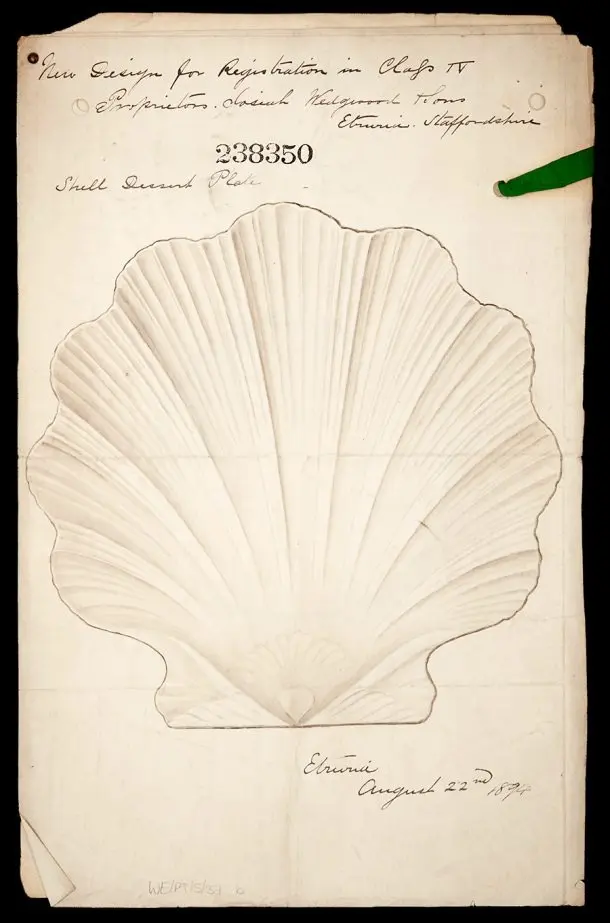
The V&A Wedgwood Collection Archive preserves numerous design patent certificates that granted the company exclusive legal protection over its innovative shapes. One notable patent record features an illustration of a shell dessert plate registered in August 1894, offering concrete evidence that shell-shaped ceramics remained commercially vital and highly fashionable toward the close of the Victorian era.

20th-Century Revivals and Modern Glazes
The enduring appeal of these marine forms persisted well into the 20th century. In 1982, Wedgwood released a series of jasperware items, including bowls and jugs decorated with white applied relief Pecten shells. Because Pecten shells had featured prominently on 18th-century pieces, these modern productions demonstrated how the company continually mined its own extensive archives for inspiration to create fresh products for contemporary buyers.
Throughout the 20th century, Wedgwood’s master potters experimented relentlessly with new ceramic bodies and glaze compositions. These trials frequently resulted in modern reinterpretations of classic 18th-century forms, such as the perennial favorite "Nautilus" shape. To align with the prevailing 20th-century market demand for soft interior aesthetics, historical shell designs were reimagined in delicate pastel tones, such as those found within the Alpine Pink dessert service.

Furthermore, Nautilus shell centrepieces were elevated through the application of lustrous iridescent glazes. This shimmering finish was achieved by brushing a specialized metallic solution directly across the ceramic surface before firing it in the kiln, creating a captivating play of light reminiscent of mother-of-pearl.
Although shell shapes and patterns are not currently active in standard Wedgwood production lines today, shell-inspired ceramics remain intensely coveted by international collectors and museum enthusiasts alike. Across the globe, contemporary artists and designers continue to draw inspiration from natural marine forms, using the beauty of the natural world to promote environmental appreciation and preservation—echoing the deep intellectual curiosity that drove the 18th-century conchologists whose historic collections continue to enrich museum archives today.