Step back into the vibrant, analogue landscape of 1997. Oasis had just played their historic, era-defining weekend at Knebworth, Tony Blair was weeks away from securing a landslide election victory, and virtually everything in the live music industry was still coordinated entirely on paper. There were no Spotify algorithms, no targeted Instagram advertisements, and no digital recommendation engines telling listeners what song or artist to check out next. Instead, grassroots music promotion relied on raw, physical legwork. If a fledgling band wanted an audience for their upcoming gig, someone who believed in their sound had to hit the pavements, pressing handmade flyers into the hands of strangers outside pubs or on busy street corners on a Friday night, hoping against hope that enough curious music fans would show up to make the endeavor worthwhile.
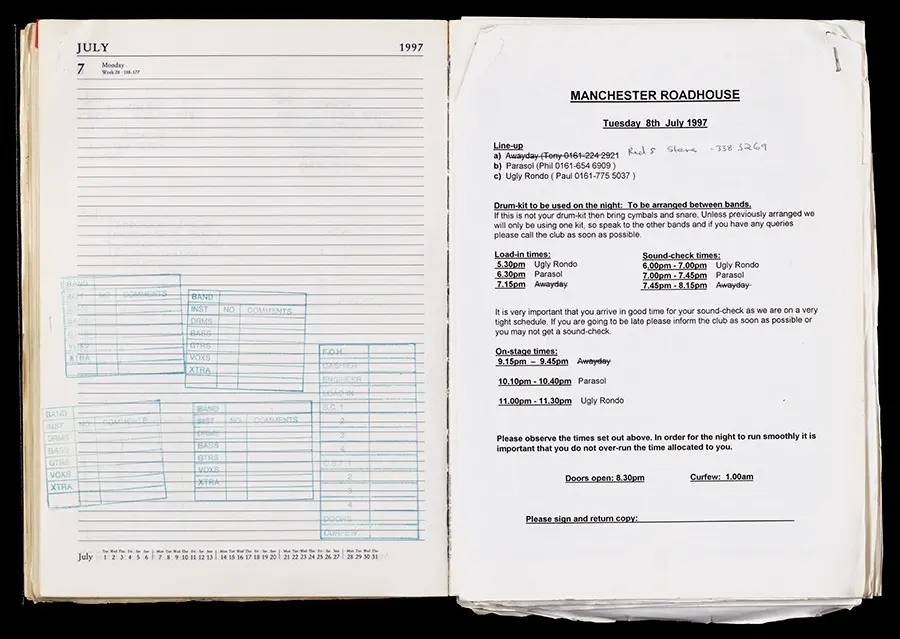
The small, often sweaty grassroots venues where these acts performed formed the vital backbone of this analogue promotion network. Today, the immense labor, grit, and careful organization required to keep that system moving are laid bare through a remarkable archival artifact: the 1997 bookings diary of the Manchester Roadhouse. Preserved as part of a collaborative academic initiative, this historic diary serves as a window into an era that shaped modern British rock.
The diary is currently being featured as part of Lost Music Venues, a major exhibition curated by Harriet Reed for the Theatre and Performance Galleries at the Victoria and Albert Museum (V&A) in London. Running from May 30, 2026, through October 30, 2027, the display brings together roughly 50 lost performance spaces active from the 1980s through the 2010s. By celebrating these spaces as dynamic centers of artistic creativity, the exhibition shines a much-needed spotlight on both their immense cultural contributions to British music and the severe systemic challenges that grassroots venues face as a sector.
The inclusion of the Roadhouse diary in the V&A exhibition stems from an innovative partnership with the University of Liverpool. Students enrolled in the "Curation and Heritage" module, led by Dr Marion Leonard, were given the unique opportunity to study and write curatorial responses to the objects featured in the Lost Music Venues display. Among them is student Rebecca Dickinson, whose deep dive into the Manchester Roadhouse’s scheduling pages captures the delicate, chaotic ecosystem of 1990s gig promotion.
The ‘Toilet Circuit’ and the Making of Music Legends
Located on Newton Street, the Roadhouse was a quintessential fixture of the UK’s unglamorous yet profoundly influential grassroots venue network, colloquially known as the "toilet circuit." Despite their humble physical conditions, these small spaces were the literal incubators for major international acts. Over its years of operation, the Roadhouse hosted legendary early-career performances by heavy-hitters such as The Verve, Coldplay, and Elbow. In fact, the cultural footprint of the venue runs so deep that members of Elbow famously worked the doors, collected tickets, and pulled pints at the Newton Street venue before mainstream audiences had even learned their names.
The 1997 bookings diary documents the exact scheduling machinery that kick-started the careers of bands who would eventually graduate from sticky basement floors to sold-out stadium arenas. Flipping through pages 16 and 17, which cover mid-April, reveals the wonderfully organized chaos inherent to running a venue on this rigorous circuit. For instance, a typical Tuesday schedule could easily feature four separate acts crammed into a single evening. Scrawled performance numbers sit in the margins, artist names are crossed out and rewritten as lineups shift, and marginal notes outline bands printing their own DIY flyers to drum up interest.
Local acts such as Psycle and Laughing Gravy shared these pages, demonstrating the venue’s vital importance as a cultural anchor within Manchester’s fiercely independent local music scene. Furthermore, these pages contain the unglamorous logistical data essential for daily gig coordination: precise load-in times, staff scheduling notes, direct band contact details, and technical set-up requirements.
Financial Realities and the Fragile Architecture of Grassroots Live Music
The day-to-day operations captured within the diary were managed by booker Debs Wild—who famously went on to discover Coldplay—alongside John McBeath, the founder of the venue. The pages are filled with constant adjustments, sudden cancellations, and hurried rescheduling, reflecting the inherent financial instability and daily high-wire act of live music promotion at a small, independent venue.

These underlying financial risks are clearly visible in the venue’s attendance records, which show distinct inconsistencies in nightly revenue and audience numbers. These were risks willingly absorbed by management in the name of supporting emerging artists and preserving their access into a notoriously difficult music industry. The attendance logs also highlight the venue’s versatility, featuring entries for popular club nights that generated crucial alternative income. Among these was the renowned "Electric Chair" club night, which took over the venue on the last Saturday of every month.
A tangible piece of this financial architecture is physically preserved inside the diary. Stapled onto the page for April 1st is a typed revenue-sharing agreement drafted by "Debs and John." The document outlines modest adjustments, such as door prices rising from two pounds to two pounds fifty, alongside the specific ticket-split percentages agreed upon with the performing bands. This artifact exposes the exceptionally thin profit margins on ticket sales that characterized the toilet circuit, laying bare the exact financial negotiations required to keep a grassroots venue afloat while fairly compensating artists.
Adapting to Survival in a Changing Industry
As the year progressed, a distinct evolution occurred within the pages of the diary. The informal, frantic, and chaotic handwritten scribbles that dominated the entries of April gradually gave way to a much more formalized approach to live music promotion by the time July arrived.
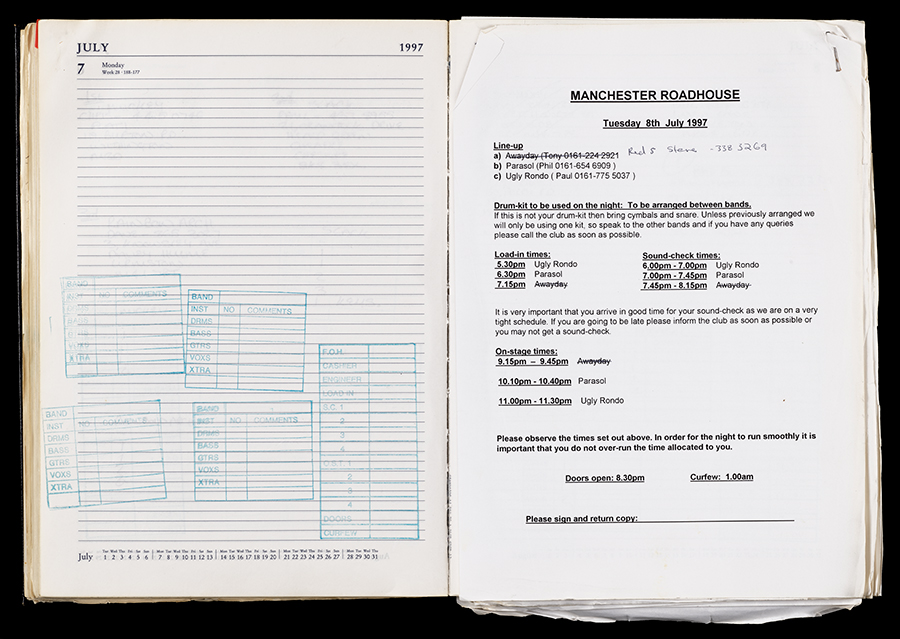
Stapled into the July entries is a typed, formally titled scheduling sheet for a gig held on July 8, 1997. The level of planning and administrative precision evident here is entirely absent from the earlier spring entries, which relied heavily on small, standardized rubber stamps to denote set times rather than comprehensive, signable legal documentation. This observable shift toward typed schedules points to a changing industry environment, reflecting a developing need for the venue to adapt to shifting legal and professional relationships between artists and promoters—transitioning away from loose, handshake partnerships toward formalized contracts.

The stark contrast between the chaotic April pages and the structured July documents illustrates how management was forced to continuously modify their operational strategies simply to survive within a rapidly modernizing music business landscape.
The Legacy of the Roadhouse and the Cost of Its Loss
Following John McBeath’s departure from the venue in 1999, management of the Roadhouse was taken over by Kate Mountain, the venue’s former general manager, alongside Steve Lloyd. Mountain steadfastly ran the establishment for more than a decade after McBeath’s exit, maintaining an unwavering, passionate commitment to championing local musicians and small-scale independent artists.
However, despite decades of cultural service, the Roadhouse ultimately closed its doors in 2015. It fell victim to the exact same compounding financial pressures, rising rents, and urban development challenges that have steadily squeezed out numerous other legendary institutions on the UK’s grassroots music circuit.
The loss of the Roadhouse was not merely the disappearance of a popular weekend music venue or a favorite local weekend hangout; it meant the removal of an essential load-bearing pillar in the broader infrastructure of the British music industry. Venues of this caliber have historically provided the critical mobility and accessible platforms that emerging musicians need to hone their craft. Through items like the 1997 bookings diary, preserved for public view in the V&A exhibition, visitors are offered a rare, tangible look at the immense hidden labor, administrative dedication, and foundational groundwork required to launch musicians from a Newton Street basement onto the global stage.