When visitors step into the Victoria and Albert Museum in London to view the upcoming Lost Music Venues display, curated by Harriet Reed for the Theatre and Performance Galleries, they are invited to look beyond the nostalgia of the gig experience. Running from May 30, 2026, through October 30, 2027, the exhibition features roughly 50 "lost" performance spaces that operated from the 1980s to the 2010s. It celebrates these grassroots venues not just as social hubs or weekend hangouts, but as the foundational engines of creativity, while casting a stark light on the profound systemic and financial challenges that continue to plague the sector.
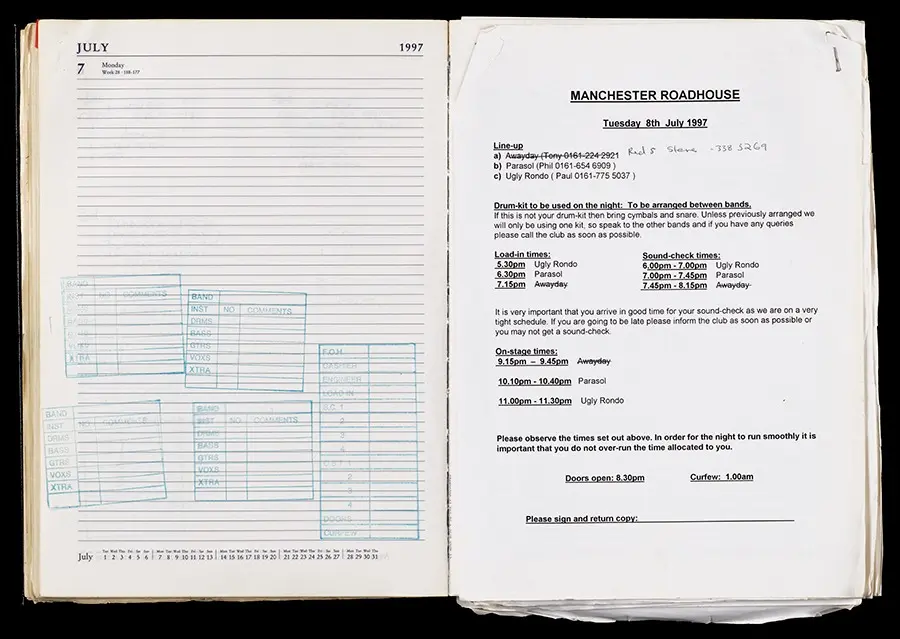
Among the objects anchoring this exhibition is a humble, paper artifact that encapsulates an entirely different era of the British music industry: the 1997 bookings diary of the Manchester Roadhouse.
Selected as the subject of a student response piece by Rebecca Dickinson—undertaken as part of the "Curation and Heritage" module at the University of Liverpool, led by Dr. Marion Leonard—the diary provides a tactile, ink-stained portal into the raw, unpolished mechanics of live music promotion on the cusp of the digital age.
The Analogue Landscape of 1997
To understand the weight of the Roadhouse diary, one must first transport themselves back to the cultural and technological landscape of 1997. It was a time when Oasis had just played their historic, era-defining concerts at Knebworth, Tony Blair was on the verge of sweeping into power with a landslide election victory, and the daily operations of the cultural world were handled entirely on paper.
There were no streaming algorithms on Spotify whispering tailored song recommendations into listeners’ ears, nor were there targeted Instagram ads or automated event reminders pinging smartphones. Instead, the promotion of live music relied entirely on a gritty, physical network of human effort and analogue hustle. If an emerging band wanted a crowd at their show, they relied on people who believed in them—often the musicians themselves or dedicated local promoters—to pound the pavement. They spent Friday nights pressing hastily printed flyers into the palms of passing strangers on Northern streets, operating on a mixture of blind faith and elbow grease, trusting that enough people would show up to justify the endeavor.
At the center of this ecosystem sat the small, often unglamorous grassroots venues that formed the backbone of what was affectionately and colloquially known as the "toilet circuit." The Manchester Roadhouse, situated on Newton Street, was a quintessential pillar of this network. Long before international arena tours beckoned, bands cut their teeth in spaces like the Roadhouse. Its stage played a critical role in the early trajectories of now-iconic British acts such as The Verve, Coldplay, and Elbow—the latter of whom had members who famously worked the venue’s doors and pulled pints behind the bar before anyone outside of Manchester knew their names.
Organized Chaos: Inside the Daily Entries
Turn to pages 16 and 17 of the 1997 bookings diary, covering mid-April, and you are immediately confronted with the organized chaos that defined day-to-day operations on the circuit. On a single Tuesday, four distinct acts were scheduled to perform. The pages are alive with the messy realities of venue management: numbers scrawled hurriedly in the margins, band names crossed out and overwritten as lineups shifted, and handwritten marginalia noting the logistical hurdles of bands printing their own promotional materials.
Local acts such as Psycle and Laughing Gravy feature prominently in the schedules, serving as a tangible reminder of how vital these spaces were for nurturing and sustaining local music scenes. Alongside the creative chaos, the diary contains the vital operational data required to make a gig actually happen: precise load-in times, staff scheduling notes, direct band contact details, and technical set-up requirements.

This hectic administrative work was primarily managed by booker Debs Wild—later famed for her role in discovering Coldplay—and John McBeath, the founder of the venue. The constant need to adapt to sudden cancellations, shifting lineups, and rescheduled dates reflects the baseline instability and financial precariousness that characterized live music promotion at the grassroots level.
The Financial Architecture of the Toilet Circuit
The economic realities of running a small music venue are laid bare in the diary’s attendance records. They reveal stark inconsistencies in nightly revenue and audience numbers—financial risks that venue operators willingly absorbed for the sake of keeping the doors open and providing emerging artists with a gateway into the broader music industry.
The attendance records also map out the venue’s diverse programming, highlighting the presence of influential club nights that helped subsidize the live music side of operations. Notably, audience numbers are absent on weekends when major club nights took place, such as the legendary "Electric Chair" parties that electrified the venue on the last Saturday of every month.
A particularly revealing financial document is stapled directly into the page for April 1st: a typed revenue-sharing agreement bearing the names "Debs and Johns." The document outlines modest adjustments, such as door prices rising from two pounds to two pounds fifty, alongside the specific ticket splits agreed upon with performing bands. This artifact lays bare the fragile financial architecture of toilet-circuit promotion, exposing razor-thin profit margins on ticket sales and the careful negotiations required to divide those meager earnings equitably between the venue and the artist.

From Informal Partnership to Formal Contracts
As the months progress, the diary reveals a fascinating structural evolution. The informal, chaotic handwritten scribbles that defined the entries from April gradually give way to a more formalized approach to live music promotion by July.
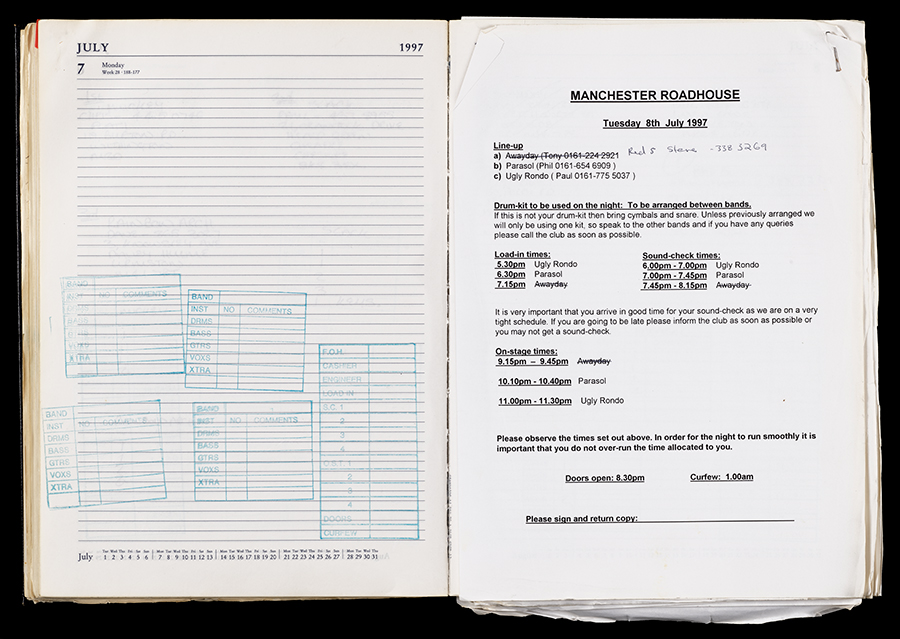
Stapled into the pages for a gig on July 8, 1997, is a typed, formally titled scheduling sheet. The meticulous planning and rigid formatting stand in sharp contrast to the earlier April entries, which relied on small, standardized rubber stamps to detail times rather than executing a formal, signable contractual document.
This administrative shift reflects a changing industry environment. It demonstrates how venues were forced to adapt to shifting relationships between artists and promoters, transitioning from informal partnerships built on a handshake to formal, legally binding contracts. The stark visual and procedural contrast between April and July highlights the desperate adaptability required by venue operators attempting to survive in an increasingly professionalized and unpredictable industry landscape.
The Legacy of the Roadhouse
John McBeath eventually left the Roadhouse in 1999, handing the reins over to Kate Mountain, the venue’s previous general manager, alongside Steve Lloyd. Mountain maintained leadership of the space for over a decade, carrying forward McBeath’s fierce commitment to local musicians and small-scale artists with unwavering dedication.

However, in 2015, the Roadhouse ultimately closed its doors for good, falling victim to the relentless financial pressures, gentrification, and operational challenges that have claimed countless other venues on the UK’s historic toilet circuit.
When the Roadhouse fell, what was lost extended far beyond physical bricks and mortar, or simply a reliable destination for a Saturday night out. The closure dismantled an essential pillar of the music industry’s foundational infrastructure—a space that actively supported geographical mobility, artistic experimentation, and professional access for generations of emerging musicians.
Through artifacts like the 1997 bookings diary, now preserved and exhibited at the Victoria and Albert Museum, the grueling behind-the-scenes labor of grassroots music promotion is brought back into focus. It serves as a permanent reminder of the immense hard work, financial risk, and cultural dedication that laid the groundwork for modern music success stories, honoring a lost institution that helped shape the sound of British independent music.