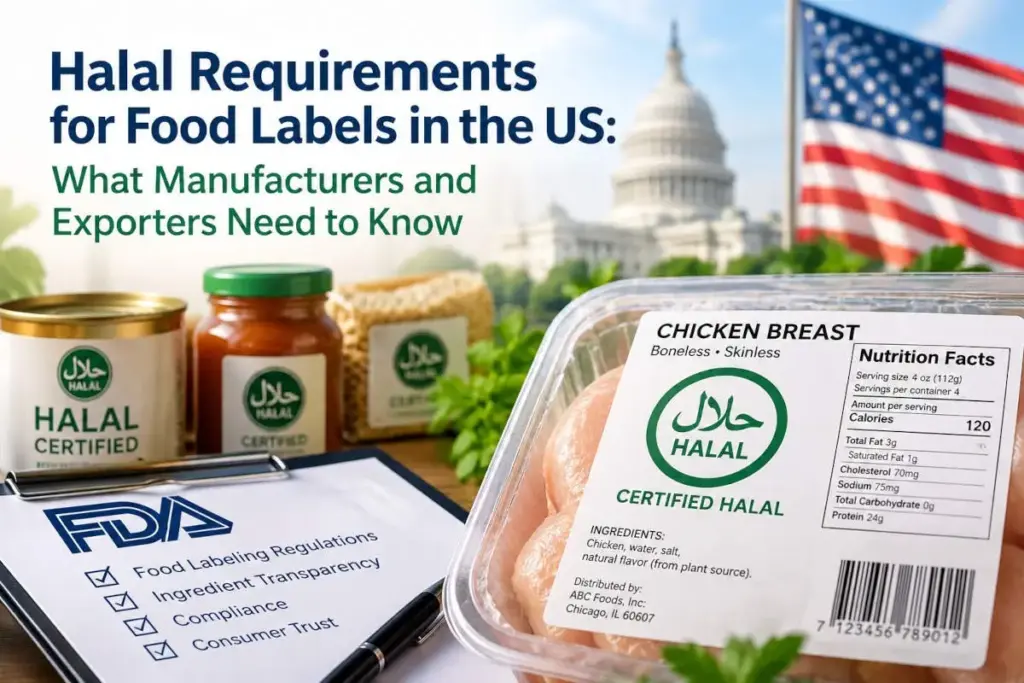
For food manufacturers looking to enter or expand within the American market, labeling a product as "halal" introduces a unique set of commercial opportunities alongside complex regulatory obligations. While the term carries profound significance for Muslim consumers and drives substantial retail demand, it operates within an environment characterized by a distinct lack of formal federal oversight. The United States government does not officially define halal, nor does it issue seals of approval or certify products as compliant with Islamic law.
Instead, the responsibility falls squarely on food producers to ensure that any halal claims made on packaging or in marketing materials are entirely truthful and substantiated. Because federal regulatory agencies treat halal statements like any other commercial claim, a misleading label can quickly trigger severe regulatory penalties, product recalls, and a loss of consumer trust. Understanding how federal regulations interact with religious standards, private certification processes, and supply chain management is critical for companies seeking to avoid costly missteps.
At its core, halal is an Arabic term meaning permissible under Islamic law. In the context of food production, establishing compliance generally involves evaluating three major components: ingredients, sourcing and slaughter practices, and handling procedures. Ingredients represent the primary hurdle, with pork and its derivatives strictly prohibited, alongside alcohol, which must be excluded even when utilized as a processing aid. For meat and poultry products, the animal must be slaughtered according to specific Islamic guidelines, which typically require a Muslim slaughterer to invoke the name of God while ensuring the complete drainage of blood. Finally, the handling phase dictates that a halal product must never come into contact with prohibited substances during production, storage, or shipping.
However, interpreting these standards is not always straightforward, as Islamic scholars occasionally hold differing views on specific details. Ingredients such as gelatin, enzymes, emulsifiers, and complex flavorings frequently present compliance challenges, and two independent certifiers might arrive at different conclusions regarding the exact same component. This nuance underscores the importance for manufacturers to thoroughly understand the specific standard underpinning their marketing claims.
The regulatory landscape in the United States begins with the reality that no federal agency defines or certifies halal food. Because halal is fundamentally a religious standard, officials at the Food and Drug Administration (FDA) and the United States Department of Agriculture (USDA) do not inspect production lines to verify adherence to Islamic law. Instead, federal oversight focuses strictly on label truthfulness.
The FDA oversees the vast majority of food labeling, deeming any product misbranded if its labeling is false or misleading. Meanwhile, meat and poultry products fall under the jurisdiction of the USDA’s Food Safety and Inspection Service (FSIS), which applies similar truthfulness standards and requires pre-market review for certain label claims before a product can be shipped to commerce. Consequently, a halal claim is treated as a standard commercial representation. If a company maintains robust records to substantiate the claim, it remains compliant. If the claim cannot be supported, the business faces the same enforcement risks as any enterprise making an unsupported marketing statement, including regulatory actions, product recalls, and liability from disillusioned consumers.
Meat and poultry products demand a particularly rigorous approach due to the central role that slaughter practices play in halal compliance. USDA inspections focus primarily on food safety and humane handling, meaning federal inspection stamps do not verify whether a slaughter followed Islamic law. Consequently, any halal claim attached to meat or poultry relies entirely on supply chain documentation and private certification, rather than government validation. Furthermore, the FSIS reviews specific label claims and product categories, requiring companies to verify current label approval rules before printing packaging featuring halal statements. Businesses that manage both meat and non-meat production lines must establish separate labeling workflows to accommodate the distinct review processes utilized by the FDA and the FSIS.
Because federal agencies do not issue halal certifications, the vast majority of food companies operating in the United States partner with private, third-party certifying organizations. These entities audit everything from individual ingredients and suppliers to entire production lines and corporate records, ultimately issuing formal certificates and licensing the use of specific certification logos.
The certification process typically begins when a manufacturer submits a comprehensive ingredient list complete with supplier details, processing aids, specifications, and certificates of analysis. The certifier evaluates each component, often scrutinizing complex flavorings or enzymes, before conducting an on-site facility inspection to observe production, cleaning, and storage protocols. Once certified, companies must submit to periodic audits, product sampling, and mandatory reporting requirements for any future formula or supplier modifications.
Industry experts emphasize that obtaining third-party certification does not replace federal label compliance; rather, it serves as the evidentiary backing for the claim. The finished product must still feature an accurate label, and companies are restricted to using certification logos strictly in accordance with the certifier’s licensing rules. When selecting a certifier, manufacturers typically weigh several factors, including whether target retailers and distributors recognize the organization, whether the certification standard aligns with intended export markets, how transparent the ingredient review process is, and what specific rules govern logo usage.
State laws introduce an additional layer of consideration for food producers. Several states have enacted statutes touching upon halal food, primarily concerning restaurant disclosures or specific retail sales practices. While these laws vary widely and are subject to periodic change, their requirements for packaged goods are generally narrower than federal standards. Nonetheless, state regulations can impact packaging, shelf signage, and marketing descriptions, making it prudent for national brands to incorporate state-level reviews into their launch strategies.
International exporters aiming to enter the United States face the same fundamental rules as domestic producers, alongside several logistical hurdles. Exporters must first confirm their eligibility, ensuring that meat and poultry originate from establishments authorized by the USDA for export to the US, while other food products must satisfy FDA requirements, including facility registration and food safety compliance. Subsequently, packaging must be adapted to US conventions, encompassing proper translations, unit conversions, ingredient declarations, and allergen statements that conform to domestic formatting rules.
Exporters must also secure comprehensive halal paperwork, as importers and retailers routinely request certificates matching the exact product, facility, and shipment date, alongside detailed supplier records. Furthermore, exporters must verify which certifiers are accepted by their US buyers, as many retailers maintain limited approved lists. Finally, shipments are subject to routine inspection and sampling upon entry, reinforcing the necessity of maintaining verifiable documentation at every stage of the supply chain. Experience shows that treating the US market as a monolith is a frequent misstep, as individual buyers often demand distinct documentation.
Before committing packaging to print, industry veterans recommend a thorough pre-print review process. Manufacturers must confirm that halal claims are accurate across every ingredient and production process, backed by a current certificate covering the specific product, facility, and formulation. Label wording must align strictly with the certifier’s usage rules, and ingredient declarations must be scrutinized for completeness, including proper allergen disclosures. Ensuring that labels have been vetted against FDA or FSIS requirements, checking state-level regulations in all target markets, and maintaining organized supplier records tied to each ingredient are essential safeguards. Establishing a formal change-management procedure ensures that any future product reformulation triggers a comprehensive review before updated labels are produced.
Common operational errors often lead to significant commercial and legal friction. Using a certifier’s logo without proper authorization remains a frequent misstep that invites severe legal and reputational consequences. Similarly, assuming that federal USDA inspection covers halal compliance can lead to regulatory exposure, as inspected meat still requires independent halal documentation. Lapsed certificates can instantly render a halal claim unsupported, while quiet supplier substitutions—such as introducing a new flavoring or enzyme—can inadvertently compromise a product’s halal status despite the finished item remaining unchanged. Furthermore, absolute phrasing such as "100 percent halal" must be carefully matched to the exact scope of the underlying certification to avoid misleading consumers.
Establishing a successful halal product line requires a structured operational approach. Companies typically begin by cataloging every product intended for halal labeling, mapping its constituent ingredients and suppliers, and selecting a recognized certifier acceptable to key buyers. Developing comprehensive product files, vetting labels against federal and state requirements, and establishing continuous review triggers for formula and supplier modifications help maintain ongoing accuracy. For successful enterprises, treating halal documentation as an integral component of overall product quality rather than a superficial marketing afterthought remains the foundation of long-term compliance.