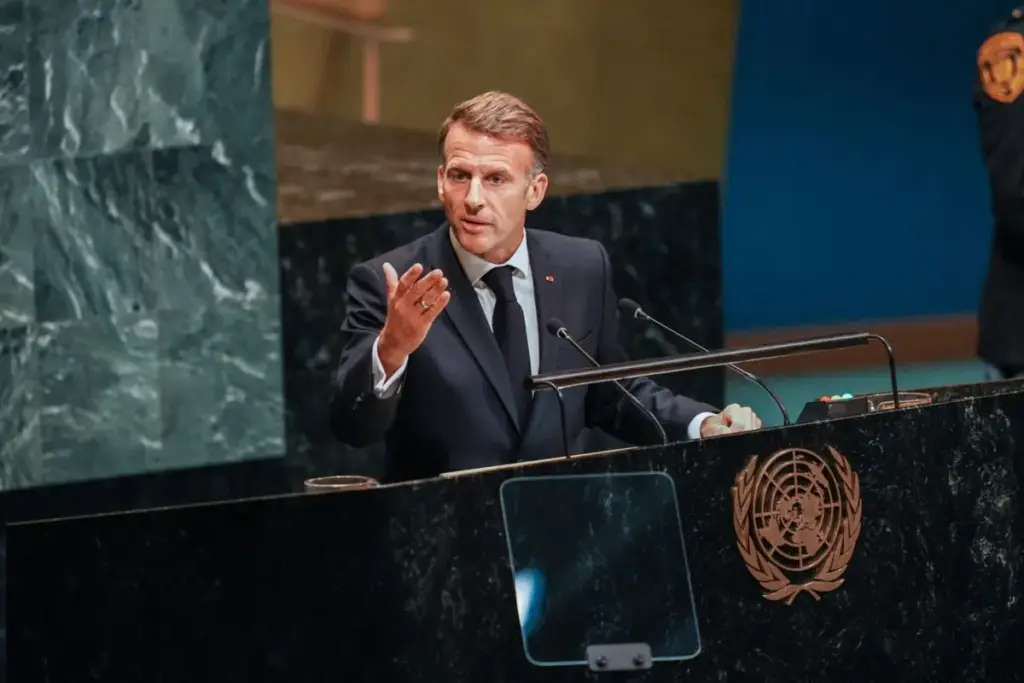
The French leader used his platform at the high-level global gathering to critique what he perceives as a profound disconnect between diplomatic rhetoric and grim realities on the ground. He pointedly challenged the narrative advanced by some international actors that peace has been successfully achieved in Gaza, noting that such optimistic claims have failed to translate into any meaningful surge in essential humanitarian supplies reaching civilians trapped in the conflict zone.
"Some claim that peace has been achieved, but this has not opened up humanitarian deliveries," Macron told world leaders assembled in New York. "The spectacle, it is shameful. Shame on all of us."
Expanding on his critique of global diplomacy, Macron questioned the sincerity and effectiveness of sovereign states that have formally extended recognition to Palestine yet remain passive and ineffective in the face of catastrophic humanitarian conditions inside Gaza. He challenged his counterparts directly on the matter of international standing, asking pointedly what the collective credibility of nations is genuinely worth if governments choose to remain inactive while civilians suffer.
Moving beyond the immediate confines of the Gaza Strip, the French president drew global attention to the deteriorating security and political climate in the occupied West Bank. He strongly condemned the daily violations occurring in the territory, questioning the strategic or moral justification behind them by noting that Hamas has historically maintained minimal operational presence in the West Bank. This ongoing friction, he argued, further destabilizes an already volatile region and undermines the foundational principles of international law.
While reiterating France’s steadfast and unwavering commitment to the security and defense of Israel, Macron asserted that the international community has an absolute obligation to uphold the legitimate rights of the Palestinian people. Central to these rights, he emphasized, is the fundamental acknowledgment of their right to exist as a sovereign people. However, he offered a firm cautionary note against strategic arguments suggesting that Israel’s national security requires or justifies violating the territorial sovereignty of neighboring states.
Focusing his diplomatic lens on Lebanon, Macron underscored the vital necessity of respecting the country’s sovereignty as an indispensable prerequisite for resolving regional security challenges. He argued that only a fully sovereign and empowered Lebanese state can effectively address the presence and armed status of Hezbollah while restoring long-term stability to its borders.
"Sovereignty for Lebanon and its people. Sovereignty for Palestinians. Their very basic and most basic rights are once again being violated," Macron declared, linking the struggles for sovereignty across the region to broader systemic failures of international protection.
Turning his address toward the protracted conflict in Syria, the French leader reaffirmed Paris’s continued diplomatic and political support for the country’s unity and territorial integrity. As Syria navigates years of devastating civil conflict and geopolitical maneuvering, Macron cautioned that the historic aspirations of the Syrian people must not be squandered, stating emphatically that the revolution must not turn into a permanent disappointment.
Macron’s address also broadened into a sweeping critique of the state of global governance, warning that foundational frameworks such as international humanitarian law and the Geneva Conventions are facing unprecedented stress and erosion amid contemporary conflicts. He painted a grim picture of modern warfare, asserting that atrocities have reached an industrialized scale in various global hotspots.
"War crimes have been industrialized. We’ve seen the destruction of civilian infrastructure, human rights violations. It’s a new era of barbaric acts," Macron said. "The Geneva Conventions offered a protective framework, but it is being dismantled."
Reaffirming France’s institutional alliances, the French leader reiterated Paris’s robust support for the International Court of Justice, pledging that France will continue to back the tribunal’s central role in maintaining international order and accountability. He warned that the global community cannot simply acquiesce to a emerging international order defined by impunity, which certain powers are allegedly attempting to establish.
In line with long-standing French diplomatic priorities, Macron called for comprehensive structural reforms to the United Nations Security Council. He argued that the powerful UN body must be adapted to modern geopolitical realities by becoming more effective, transparent, and inclusive. To achieve this, Macron stated that France firmly supports measures aimed at opening up the Security Council to new permanent members and historically underrepresented regions of the world.
Concluding his address with a forward-looking assessment of global technological governance, the French president urged the international community to take a proactive stance on the regulation and future of artificial intelligence. He issued a strong warning against permitting the trajectory of AI to be dictated exclusively by a duopoly of two dominant superpowers or a small clique of powerful economic actors.
"We must hold fast and not yield on artificial intelligence," Macron said, emphasizing the need for broad multilateral oversight. "There are some who wish to make us believe that only two powers, the US and China, will be taking the decisions. They want us to believe that just a few economic actors will make all the decisions."
He added that nations must collectively reject any framework that allows a narrow circle of governments or multinational corporations to unilaterally steer the course of technological innovation and manage its sweeping societal consequences.