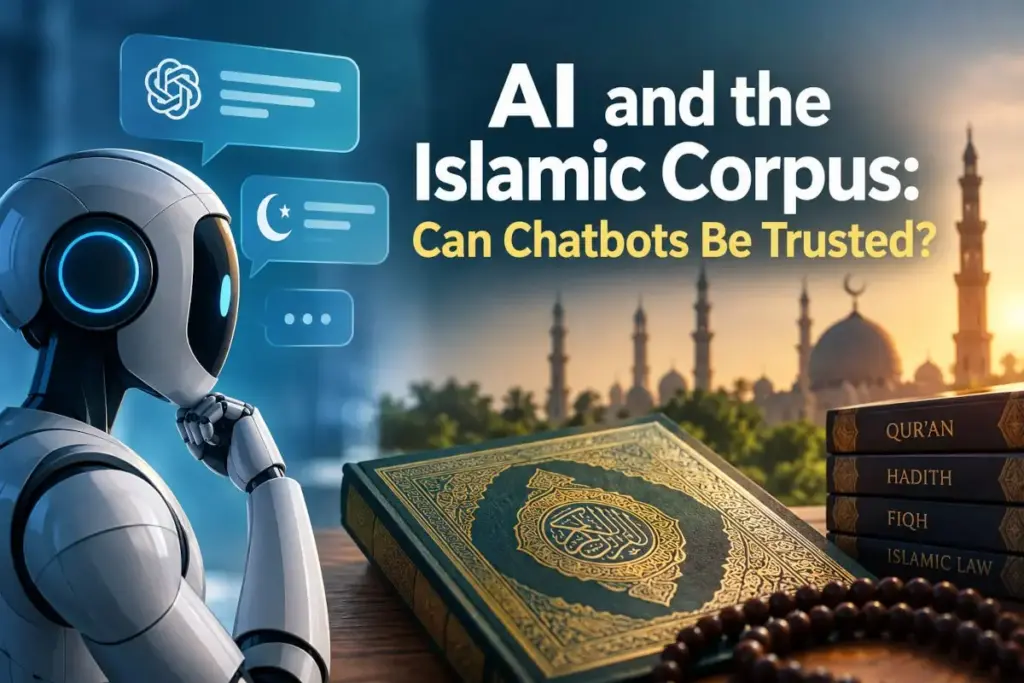
Picture a student sitting alone at midnight, their face illuminated by the harsh glow of a smartphone screen. They type a pressing question into a popular conversational chatbot: “Is this loan allowed in Islam?” Within seconds, before they have even set the phone down, a response flashes back. The tone is confident, measured, and seemingly wise. Yet, looking closer, there is no classical text cited, no renowned historical scholar referenced, and no recognized school of jurisprudence named. The student is left in a delicate dilemma. Did this instant ruling emerge from centuries of rigorous, authenticated Islamic scholarship, or does it simply mimic the cadence of authority without possessing its substance?
This modern friction point—the collision between rapid artificial intelligence and traditional Islamic jurisprudence—captures a profound transformation currently underway. As millions of Muslims worldwide turn to digital tools for everyday religious guidance, scholars, researchers, and technologists are grappling with a fundamental question regarding the integrity of the data powering these models.
The Record is Bigger Than It Looks, and Patchier Too
At the heart of the issue lies the vast Islamic textual corpus. Comprising the Quran, hadith collections, tafsir (exegesis), and fiqh (jurisprudence), this body of literature has increasingly been converted into digital formats. Computers can now search, analyze, and learn from these digital archives. However, the completeness, cleanliness, and structural integrity of these digital collections ultimately dictate what artificial intelligence can—and cannot—accurately do with them.
Certain foundational elements are in relatively robust shape. For instance, the Quranic Arabic Corpus has meticulously tagged each of its 77,430 words for granular grammatical properties, utilizing the traditional i’rab system rather than modern linguistic frameworks. Subsequent technological initiatives, such as the MASAQ project, have expanded upon this foundation by introducing more than 131,000 word-level details alongside 123,000 contextual notes detailing how individual words fit cohesively within larger sentences.
Hadith literature, by contrast, presents an entirely different set of operational hurdles. A 2025 research paper published by an Iranian team detailed the processing of more than one million narrations utilizing machine learning models. Yet, internal inconsistencies within the paper’s statistical reporting highlight the precarious nature of handling massive historical datasets, underscoring the necessity for rigorous manual verification before citing aggregated figures. Furthermore, the researchers noted that comprehensive digital hadith collections remain constrained, even as newer archives slowly emerge.
Accessibility remains another structural barrier. A specialized collection locked behind impenetrable walls serves no practical purpose, while fragile digital repositories risk vanishing entirely, leaving future models without reliable training data.
Compounding these challenges is the widespread absence of short-vowel markings, known as tashkeel. The same 2025 research paper revealed that over 80 percent of the hadith texts processed lacked these vital diacritics. Without them, a single written Arabic word can often be interpreted in multiple ways, forcing automated machine learning models to infer pronunciation and meaning. When a machine guesses, it frequently guesses incorrectly.
Simply accumulating vast amounts of unstructured text does not resolve the underlying problem. A development team building a specialized Islamic search tool recently reported an abundance of general data, but a severe shortage of properly labeled, high-fidelity Islamic data necessary to train a reliable model. Meanwhile, ambitious endeavors such as IslamGPT 1.0, a project spearheaded by Hamad Bin Khalifa University, aim to systematically tag every paragraph of their source texts by author, historical era, scholarly affiliation, academic field, and genre. While slated to run through 2027, such initiatives represent future blueprints rather than immediate solutions. The underlying logic remains unyielding: a legal ruling cannot be properly interpreted or contextualized if the model cannot discern who issued it, under what circumstances, and during which historical era.
Why the Chatbot on Your Phone Gets Religion Wrong
The vulnerabilities of modern artificial intelligence become starkly apparent when examining general-purpose conversational models. The vast majority of these systems have been trained predominantly on English-language and Western-centric corpora. Consequently, these models frequently overlook nuanced Islamic perspectives or articulate them inaccurately.
A preliminary blog post by the Leibniz Centre for the Modern Orient (ZMO) tested three popular commercial chatbots alongside a specialized Islamic tool against a series of targeted religious questions. While the specialized tool outperformed the general models, researchers noted the experiment was informal and served primarily as an exploratory observation. A more expansive study conducted in Malaysia subjected six popular chatbots to ten fundamental Quranic queries administered in the Malay language. The evaluation revealed widespread inaccuracies in contextual application, with numerous responses failing to align with established Islamic orthodox teachings.
Beyond mere factual accuracy, experts express mounting concern over the erosion of scholarly authority. A 2026 study published in the Online Journal of Research in Islamic Studies evaluated GPT-4o using fourteen complex legal inquiries that had previously been adjudicated by qualified jurists. The model answered six correctly while failing eight. Notably, every single erroneous response skewed in the exact same direction, systematically leaning toward permissive rulings. Furthermore, the model relied heavily on mainstream news articles and Wikipedia rather than turning to authoritative fatwa repositories or classical legal texts.
The broader philosophical implications run deep. Scholars argue that an algorithm can never replicate the moral and religious standing of a qualified jurist who issues a formal fatwa. A human scholar carries ultimate accountability before God and the community for their rulings; a software application bears no such responsibility. Because this specific study evaluated a single model on a targeted dataset, researchers emphasize that its findings should be interpreted as a cautionary warning rather than a universal condemnation of all automated tools.
Specialized retrieval systems tailored specifically for religious texts have demonstrated improved performance. An Indonesian-language search tool built exclusively on Quranic verses and authenticated hadith collections from Sahih al-Bukhari and Sahih Muslim reported a precision rate of 0.78, indicating that roughly one in five retrieved results was irrelevant. While such tools offer practical utility following rigorous human review, the imperative to independently verify automated outputs remains absolute.
What Students and Ordinary Muslims Can Do Right Now
For contemporary students of Islamic studies, maintaining traditional academic rigor is more critical than ever. When an artificial intelligence tool references a specific Quranic verse or hadith narration, students must independently locate the citation within trusted, verified editions. Demanding that a model disclose its source material—and exercising extreme caution when it fails to do so—is becoming an essential digital literacy skill.
Users must also remain vigilant against the illusion of false certainty. Because classical Islamic jurisprudence features legitimate scholarly divergence on a wide array of topics, an automated tool that delivers a single, neatly packaged answer to a debated issue is fundamentally misrepresenting the rich tradition of scholarly discourse. Preserving classical habits—such as systematic memorization, direct study under qualified human teachers, and firsthand engagement with primary texts—remains indispensable.
For ordinary Muslims navigating daily religious inquiries, drawing a clear line between practical assistance and theological ruling is paramount. While artificial intelligence can efficiently handle mundane tasks such as drafting letters, organizing study schedules, or generating recipes, questions pertaining to matters of halal and haram require consultation with qualified scholars or recognized official fatwa councils. Cross-referencing digital guidance against authoritative community institutions before acting ensures that faith remains anchored in authentic tradition rather than algorithmic convenience.
Preparing the Next Generation and the Broader Ummah
Children maturing in the present era will never know a world untouched by artificial intelligence. Consequently, the objective is not to isolate youth from digital tools, but rather to instill critical thinking habits that outlast any single application. Cultivating a reflex of asking rigorous source-verification questions, maintaining traditional recitation and memorization practices to establish an internal benchmark of knowledge, and demanding digital etiquette and intellectual honesty are vital steps in safeguarding young minds.
Simultaneously, systemic changes at the community level are urgently required. Preserving the Islamic intellectual heritage necessitates the large-scale digitization, verification, and long-term archiving of foundational hadith, tafsir, and fiqh texts under open, responsible licenses. Increased financial investment in Arabic and Islamic artificial intelligence research is equally crucial to counterbalance a market heavily skewed toward Western languages.
Furthermore, establishing rigorous data-labeling standards by qualified scholars, demanding transparency from technology developers regarding training datasets, and publishing contemporary fatwas in machine-readable formats will help bridge the gap between traditional authority and modern innovation. By training educators and community leaders in digital literacy, the global Muslim community can ensure that as the midnight student continues to seek knowledge, the digital library behind the screen remains faithful, transparent, and worthy of the profound trust placed in it.