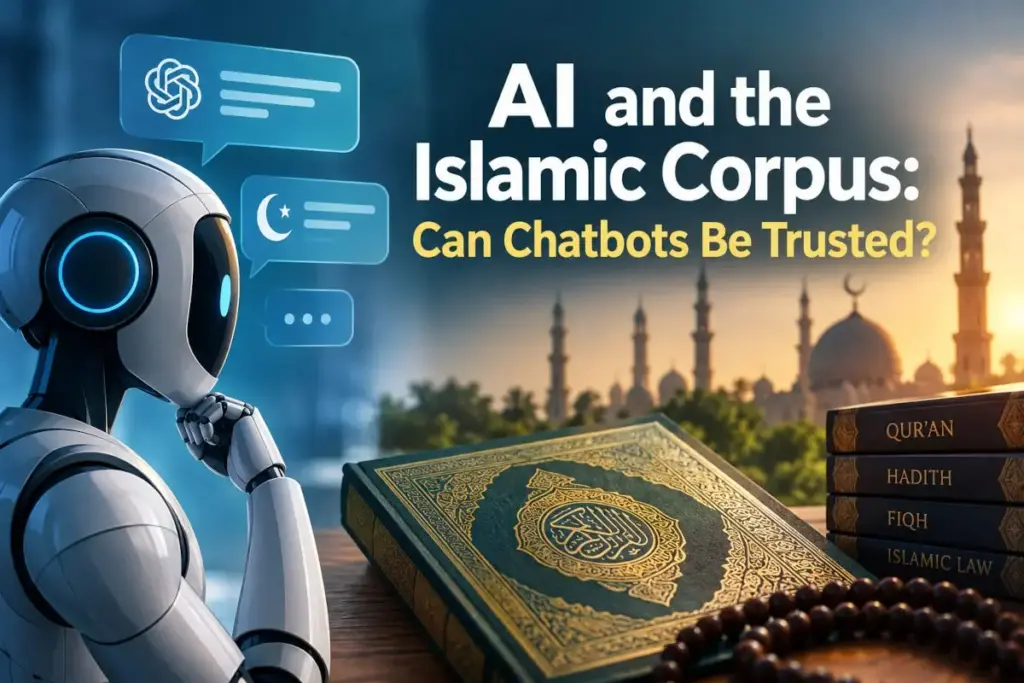
Picture a student sitting alone at midnight, the blue light of a smartphone illuminating a quiet room. They tap out a fast, urgent question: "Is this loan allowed in Islam?" Within seconds, an answer appears before they have even set the phone down. It sounds confident, measured, and even carries a tone of traditional wisdom. Yet, there is no sacred text cited, no classical scholar named, and no recognized school of Islamic jurisprudence mentioned. The student is left suspended in a digital dilemma: Did this answer emerge from centuries of rigorous, verified human scholarship, or does it simply mimic the cadence of authority while lacking any real foundation?
This central question captures the growing friction between modern artificial intelligence and traditional Islamic learning. At the heart of this unfolding challenge are the texts themselves—the digital bedrock upon which all AI models operating in this space must be built.
The Digital Islamic Corpus: Expansive, Fragmented, and Patchy
The vast body of classical Islamic literature—encompassing the Quran, hadith collections, works of tafsir (exegesis), and fiqh (jurisprudence)—is increasingly being digitized, converted into formats that modern computers can parse, index, and learn from. The completeness, cleanliness, and structural integrity of this digital archive will ultimately determine what AI can achieve when interpreting sacred traditions.
Certain foundational segments of this corpus are in remarkably good shape. The Quranic Arabic Corpus, for instance, meticulously tags each of its 77,430 words for precise grammatical function, relying on the traditional i’rab system rather than modern linguistic frameworks. Building upon this, subsequent computational projects like MASAQ have added more than 131,000 word-level details alongside 123,000 contextual notes detailing how individual words fit together within complex sentences.
Hadith literature, however, presents an entirely different set of challenges. A research paper published in 2025 by an Iranian research team detailed the processing of more than a million narrations using advanced AI systems. Yet, a closer inspection of the paper revealed internal inconsistencies, with statistical figures failing to align from one section to the next. Researchers note that while new collections are gradually being processed, available hadith databases remain limited. Furthermore, data locked behind inaccessible archives serves no one, while digital collections that vanish or degrade over time cannot reliably train the machine learning models of tomorrow.
Compounding these structural hurdles is the widespread absence of vowel markings. The same 2025 research paper noted that more than 80 percent of the hadith texts handled during the study lacked tashkeel—the crucial diacritical marks that dictate exact pronunciation and meaning. Without these markings, a single written Arabic word can often be read in multiple ways. Left to its own devices, a machine must rely on probabilistic guessing, and when it guesses incorrectly, the doctrinal implications can be severe.
Sheer volume of data does not solve these foundational errors. Teams developing specialized Islamic search tools have repeatedly found themselves overwhelmed by vast quantities of general internet data, while lacking sufficient, accurately labeled Islamic datasets to train robust models. Looking toward future solutions, a dedicated project at Hamad Bin Khalifa University known as IslamGPT 1.0 has set out to systematically tag every single paragraph of its source materials by author, historical era, cited scholars, academic field, and literary genre. Scheduled to run through 2027, the initiative represents a vital roadmap for the future, reinforcing a fundamental reality: an artificial intelligence cannot accurately interpret a legal ruling if it cannot properly identify who issued it and under what historical context.
Why General Chatbots Fall Short on Religious Authority
Most commercially available chatbots are trained predominantly on English-language and Western-centric datasets, an architectural bias that routinely leads them to overlook nuanced Islamic perspectives or misrepresent them entirely. A qualitative blog post published by the Leibniz Centre for the Modern Orient (ZMO) put this phenomenon to the test, evaluating three popular mainstream chatbots alongside one specialized Islamic AI tool by posing three distinct theological questions. While the specialist tool outperformed its generalist counterparts, researchers emphasized that the evaluation was informal, serving merely as an initial exploratory look into how generic models handle specialized faith-based queries.
A more expansive study conducted in Malaysia subjected six different chatbots to ten basic Quranic questions administered in the Malay language. The results revealed persistent shortcomings: many of the generated responses lacked appropriate contextual grounding, and a significant portion flatly contradicted established Islamic teachings.
Beyond mere factual inaccuracy, a deeper anxiety surrounds the erosion of religious authority. A 2026 study published in the Online Journal of Research in Islamic Studies evaluated GPT-4o by presenting it with fourteen legal queries that had already been formally addressed by qualified human scholars. The chatbot answered six correctly while getting eight wrong. Notably, every single error leaned in the exact same direction: toward theological permissibility, uniformly concluding that "it’s fine." Furthermore, the model relied far more heavily on general news articles and Wikipedia entries than on verified, official fatwa collections.
The broader philosophical argument extends far beyond simple response tallies. Scholars contend that an artificial intelligence can never possess the moral standing or legal accountability of a qualified jurist issuing a binding fatwa. A human scholar bears the ultimate moral and religious responsibility for a ruling; a software application does not. Because this particular study was limited to a single model, one specific topic, and dataset snapshots from June 2025, experts view it as a cautionary warning rather than a definitive verdict on every emerging tool.
Specialized retrieval tools designed specifically for sacred texts demonstrate noticeably better performance, though they still require human oversight. One such system, built using verified Quranic verses alongside hadith collections from Bukhari and Muslim in the Indonesian language, reported a precision rating of 0.78—meaning roughly one out of every five retrieved results was irrelevant to the query. When two human specialists independently reviewed thirty sample queries, the system proved helpful, yet underscored the reality that machine-generated results always demand rigorous human verification.
Navigating the Digital Landscape for Students and Believers
For students actively engaged in Islamic studies, treating primary sources as the absolute first line of defense is paramount. Whenever an artificial intelligence cites a Quranic verse or a hadith narration, learners must independently locate and verify the reference in a trusted, printed edition. Users should consistently interrogate these tools regarding the origin of their answers, exercising extreme caution when a model is unable or unwilling to disclose its sources.
Students must also remain vigilant against the illusion of false certainty. Islamic jurisprudence is characterized by centuries of scholarly debate and diverse opinions on a vast array of questions. A software application that hands down a single, pristine answer to a deeply debated issue is artificially erasing a rich intellectual tradition.
Preserving classical learning habits remains essential. Traditional methods—such as systematic memorization, direct study under qualified teachers, and reading classical texts cover-to-cover—are what forge a true scholar. While artificial intelligence can serve as a supportive study aid along the way, it can never substitute for authentic human pedagogy. When an AI tool yields conflicting answers to the same inquiry, users should treat that discrepancy as an immediate signal to slow down and consult traditional commentaries.
For ordinary Muslims navigating everyday spiritual questions, boundaries are equally necessary. AI tools can effectively assist with routine administrative tasks, drafting correspondence, or organizing study schedules. However, when determining whether a matter is halal or haram, individuals must turn directly to qualified scholars or established official fatwa bodies, many of which maintain accessible online platforms.
Believers are advised to cross-reference AI-generated guidance against official religious authorities before taking action, while maintaining a healthy skepticism toward any tool that conveniently tells them precisely what they were hoping to hear. Authentic spiritual guidance occasionally requires a difficult correction. Cultivating open conversations within the home is equally vital; children should understand that while AI can be a convenient utility, it is prone to error and should never be trusted blindly.
Preparing the Next Generation and Strengthening the Ummah
Children growing up today are digital natives who will never remember a world without artificial intelligence. Consequently, the objective is not to banish these technologies from their lives, but rather to instill critical habits that will outlast any single software application. Educators and parents must continuously ask young learners how they verify information, turning source-checking into an instinctive reflex.
Keeping traditional memorization and Quranic recitation vibrant provides children with an internal reference point, making it far easier to spot structural or factual errors in digital outputs. Bringing traditional adab—respect for teachers, reverence for sacred texts, and an unwavering commitment to honesty—into digital chat windows helps maintain moral grounding in virtual spaces. Furthermore, encouraging youth to move beyond passive consumption by learning basic data literacy and coding allows them to one day contribute actively to improving the very datasets that train future AI models. Allowing students to grapple with difficult, complex questions by hand rather than seeking instant algorithmic shortcuts remains a cornerstone of genuine intellectual development.
While individual vigilance is critical, systemic changes must occur at the community level. The broader global Muslim community must prioritize the comprehensive digitization and preservation of its intellectual heritage. Hadith manuscripts, commentaries, and legal compendiums must be scanned, verified, and stored using sustainable formats with clear open-source licenses, ensuring that independent researchers and developers can build ethical applications.
Substantial financial investment is urgently required to support Arabic and Islamic artificial intelligence initiatives, which currently operate in the shadow of heavily funded Western tech projects. Scholars must be centrally involved in labeling and tagging source materials according to historical era, legal school, and thematic genre. At the same time, universities, academic institutions, and community organizations should demand transparency from tech companies regarding their training data.
Publishing official legal rulings in machine-readable formats can dramatically reduce the likelihood of chatbots misquoting authoritative bodies. Simultaneously, training imams, educators, and community leaders in digital literacy ensures that those guiding communities understand the genuine capabilities and profound limitations of these technologies. Ultimately, establishing shared ethical standards across fatwa councils, universities, and Islamic organizations will help regulate how AI tools handle citations and acknowledge uncertainty.
The student sitting in the dark at midnight will undoubtedly continue asking questions. The shared responsibility of the community is to ensure that the vast digital library behind those answers remains complete, transparent about its limitations, and thoroughly worthy of the trust placed in it.