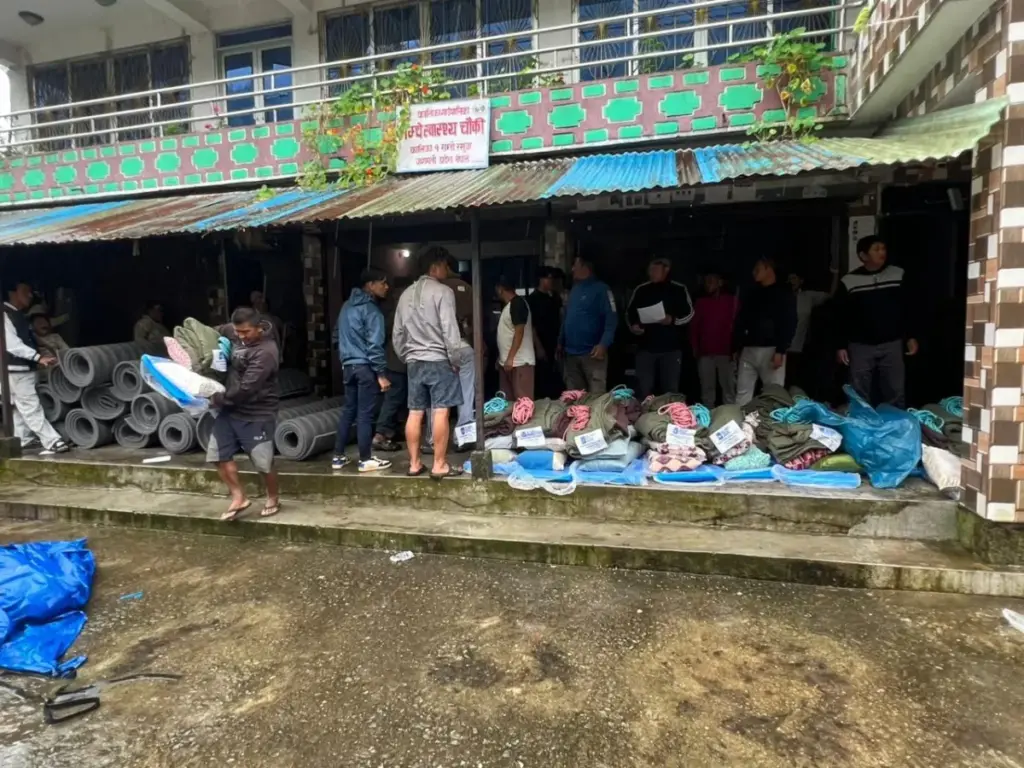
KATHMANDU — Survivors of the catastrophic floods in Nepal are facing an escalating humanitarian emergency, with aid workers on the ground reporting that thousands of families remain displaced and their homes completely submerged in thick layers of mud, silt, and debris.
The death toll from the disaster continues to climb steadily, having now surpassed 1,300 people, while approximately 5,000 individuals remain unaccounted for. In response to the crisis, humanitarian organizations are scaling up their operations. Islamic Relief is actively working alongside local authorities to distribute an initial batch of 1,000 emergency shelter kits to families who have lost everything. However, aid agencies emphasize that the current scale of the disaster means far more resources are urgently required.
Logistical Nightmares Hamper Desperately Needed Relief
Delivering life-saving aid to the hardest-hit regions has become an extraordinary challenge due to relentless heavy rain and widespread infrastructure destruction. Dozens of critical roads and bridges have been washed away or severely compromised, cutting off entire communities.
Major transport routes are impassable for large relief trucks, forcing organizations to rely on smaller vehicles. Consequently, journeys that would typically take a mere four to five hours are now stretching into grueling 13-to-15-hour trips over treacherous terrain.
Pragya Adhikari, an Islamic Relief aid worker who recently travelled to the flood-affected areas of Galchi in Dhading district, painted a harrowing picture of the devastation.
"The suffering I can hear and see is so tragic. Even three-storey buildings are inundated with sand and debris, with the floods reaching eight or nine metres high," Adhikari said. "Many children have been orphaned as they were at school while the floods killed their parents. Other entire families are still missing—I heard of families of 24 and 30 people who are still unaccounted for."
The unprecedented magnitude of the disaster has left local populations in a state of profound shock. According to Adhikari, the psychological trauma runs deep within communities that have never witnessed such an environmental catastrophe.
"The level of flooding and trauma of people that have lost their family is something these communities have never seen before. I met an elderly man in his seventies who told me he’d never seen flooding like this in his lifetime. He said it’s at least four times bigger than even the most intense flood they can remember," she noted, adding that recovery will be a long and arduous process. "Some areas are still only accessible by helicopter, but we have to start debris clearance as quickly as possible."
Hazardous Journeys to Reach Isolated Communities
Managing the response in Rasuwa, Iccharam Thapa Magar, another Islamic Relief aid worker, detailed the perilous conditions his team encountered while trying to access cut-off populations.
"All the connecting roads from Kathmandu to Rasuwa were devastated and destroyed. It took around 15 hours to reach here, mostly off-road crossing the jungle and many narrow mountainous dirt roads," Magar explained. "There was heavy rainfall and the roads were treacherous on the way. But we arrived around midnight to deliver aid the next day."
The human toll of the disaster is acutely visible in remote settlements like Grang and Ramche, where survival has come at a devastating cost to family unity.
"Most displaced people we met in Grang and Ramche have lost at least one family member. They were crying and numb. When we brought them supplies, they said they wished we could bring back their loved ones instead," Magar said.
With homes destroyed or rendered completely uninhabitable, displaced families are currently seeking refuge wherever they can find it. Many are crowding into temporary community shelters, while others are sleeping on the floors of relatives’ houses. To address these immediate living conditions, Islamic Relief’s emergency shelter kits are being distributed to provide essential comfort and protection, containing items such as heavy-duty tarpaulins, blankets, pillows, and foam mattresses.
Lifetimes of Hard Work Swept Away Overnight
For many survivors, the floods have not only taken the lives of loved ones but also wiped out the entirety of their life savings and livelihoods in a matter of hours.
In Galchi, Dhading, local resident Sharmila Pakhrin shared the heartbreaking story of how her family’s future was erased by the rising waters. She and her partner spent 33 years saving money to build a home, a dwelling that is now completely uninhabitable. Pakhrin explained that they had spent decades working grueling hours transporting and selling sand from the river to earn an honest living, only to find their hard-earned home now completely filled with the very same sand left behind by the devastating floods.