As museums continue to process and catalogue their vast historical holdings, unexpected treasures frequently emerge from the archives, shedding new light on the lives of past artists. A five-month cataloguing project currently underway at the Victoria and Albert Museum (V&A) in London has uncovered a delightful and previously uncatalogued piece of art history. An intern at the institution, undertaking a detailed research initiative supported by The Randolph Caldecott Collection Trust, has brought to light a fascinating, long-overlooked sketchbook that links the renowned 19th-century illustrator Randolph Caldecott directly to the museum during its early years.
Randolph Caldecott, who lived from 1846 to 1886, remains celebrated as one of the preeminent artists and illustrators of the Victorian era. He is best remembered today for his beloved annual "Picture Books," a series of illustrated volumes that captured the imaginations of children and adults alike with titles such as "The House that Jack Built" and "Babes in the Wood." His distinct style, characterized by lively lines, witty observation, and effortless charm, helped revolutionize children’s book illustration in Great Britain. Through the current cataloguing project, researchers hope to illuminate not only Caldecott’s expansive career and personal life, but also the meticulous institutional processes required to organize and understand the V&A’s extensive holdings of his works on paper.
The V&A’s permanent collection contains a total of seven sketchbooks utilized by Caldecott over the course of his artistic journey. When the recent research project commenced, six of these sketchbooks had already undergone initial cataloguing phases. A preliminary review of their descriptions revealed that these volumes contained foundational studies, preliminary outlines, and observational sketches that would eventually inform many of the more highly developed pieces preserved within the museum’s archives. Consequently, these six books offered curators and historians a valuable window into the developmental background of Caldecott’s celebrated published works.

However, it was the seventh sketchbook—which had remained entirely uncatalogued prior to the project—that yielded the most delightful and surprising discoveries. This particular volume not only provides intimate insights into Caldecott’s daily life and travel habits as a young artist, but it also establishes a tangible, physical link between the illustrator and the historic London institution that now houses his papers.
Historical records and biographical details indicate that Caldecott was in the habit of carrying a small, portable sketchbook with him whenever he traveled. A pencil annotation scrawled onto the inside front cover of this specific, seventh sketchbook provides an immediate clue regarding his itinerary and mode of transit, noting simply: "Manchester to London 5hrs."
The contents of the sketchbook unfold chronologically, beginning with a rich collection of observational drawings depicting rural life around Northwest England, a region where Caldecott lived and worked until 1872. Among these early entries is a delicate pencil drawing capturing the historic Old Dee Bridge in Chester. Soon enough, however, the pages transition to document his long railway journey southward. Caldecott chronicled the five-hour trip from Manchester to the capital with his trademark good humor, drafting a sequential cartoon that depicts a male passenger growing progressively fatigued and disheveled hour by hour, only to miraculously perk up, adjust his posture, and don his top hat the moment the train pulls into the London station.

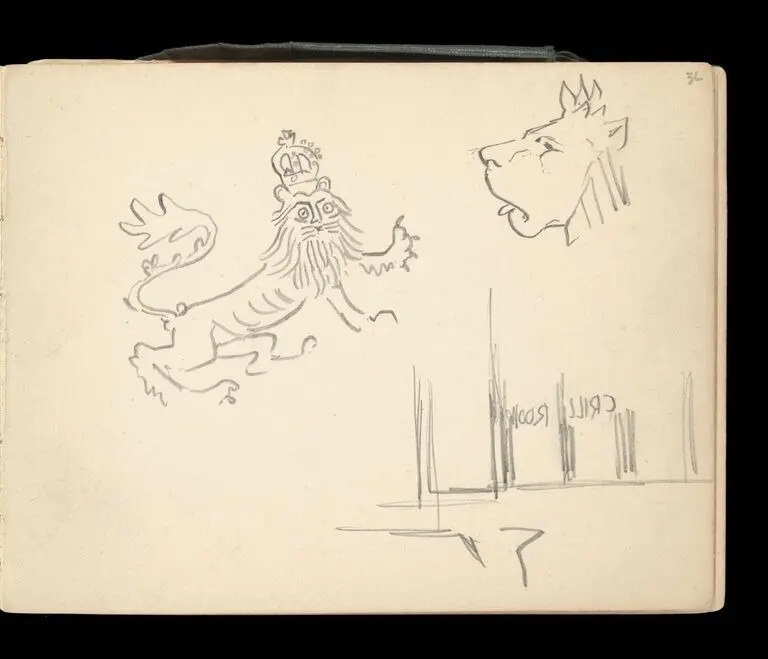
Upon turning the page, the researcher encountered what is arguably the most exciting detail in the entire volume. Tucked away amongst two casual sketches of lions, a modest drawing depicts a building window featuring the words "GRILL ROOM" written backwards. This subtle notation provides definitive contemporary evidence that Caldecott visited the site that would eventually become the Victoria and Albert Museum, though in his era, the institution was widely known as the South Kensington Museum.
Historical context helps illuminate the significance of this architectural doodle. The Grill Room, which is known today as the Poynter Room, originally opened in 1868 as one of the V&A’s three pioneering refreshment rooms designed to feed and comfort museum visitors. While the physical space of the room was famously adorned with richly decorated ceramic tiles and elaborate architectural features, Caldecott chose not to sketch the ornate surroundings—perhaps, as researchers playfully suggest, because he was simply too preoccupied with enjoying his lunch during his museum visit.
Further analysis of the sketchbook reveals that Caldecott’s London sightseeing expedition extended beyond the immediate boundaries of the South Kensington site. Positioned directly above the sketch of the Grill Room is a highly stylized drawing of a lion. Art historians have successfully traced the origin of this motif to a specific 17th-century earthenware dish crafted by the English potter Thomas Toft.

Toft’s pottery designs possess a distinct, easily recognizable aesthetic, making it straightforward for modern curators to spot the original dish within the V&A’s extensive ceramics galleries. Interestingly, however, the dish was not part of the South Kensington Museum’s collection at the time of Caldecott’s 19th-century visit. When the young illustrator made his sightseeing trip to London, the Toft dish was actually housed within the collections of the Museum of Practical Geology, which was located at Jermyn Street in Westminster. This provenance is firmly corroborated by its inclusion in the 1871 published catalogue of British pottery and porcelain held by the geological institution.
The Museum of Practical Geology—later renamed the Geological Museum—subsequently became a geographical neighbor to the V&A along Exhibition Road in 1935, before its collections were eventually absorbed into the Natural History Museum, where numerous historical objects now form part of the institution’s Red Zone galleries. For modern visitors and art enthusiasts hoping to replicate a slice of Caldecott’s Victorian museum experience, a journey to level four of the V&A South Kensington campus offers a direct connection to the past. Approximately 1,500 of the more than 2,500 decorative arts objects that were officially transferred between the museums in 1901 remain on public display at the V&A today, including the exact 17th-century Thomas Toft dish meticulously captured in Caldecott’s pocket sketchbook. Alternatively, these artifacts can be explored digitally through the museum’s online collection portals.
Re-examining this rediscovered sketchbook serves as a powerful reminder of the enduring cultural footprint left by the V&A’s collections. For generations, the museum has functioned not merely as a repository for historical artifacts, but as an influential sourcebook and creative catalyst for artists, designers, and curious visitors alike. It underscores the critical importance of maintaining and researching these institutional archives to support the creative economy for years to come.

As researchers continue to process the paper collections, one cannot help but reflect on the historical irony of the volume’s survival. It remains an open question whether Randolph Caldecott, visiting the South Kensington site as an ambitious yet relatively junior regional artist in the late 19th century, ever remotely imagined that the casual, pocket-sized sketchbook resting in his hand would one day become a treasured permanent fixture of the very museum he was pausing to document.
The ongoing cataloguing and research project is generously supported by The Randolph Caldecott Collection Trust.