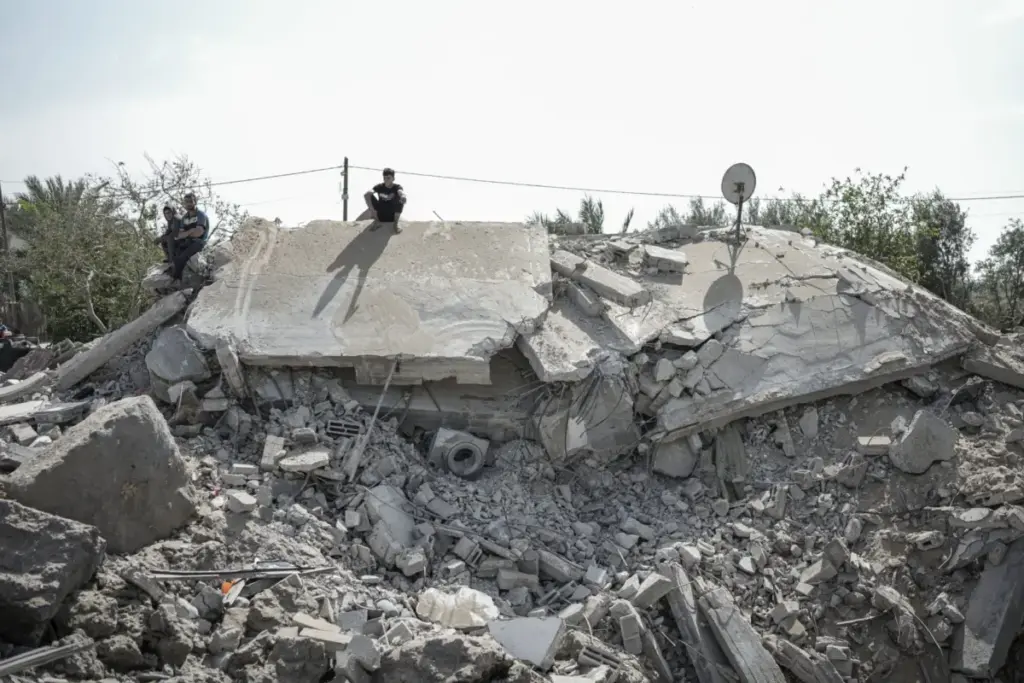
One year after a ceasefire was formally announced in the region, humanitarian workers on the ground in Gaza say that daily life remains defined by relentless military operations, widespread displacement, and severe shortages of basic necessities. Speaking out to highlight the realities of their situation, two aid workers with Islamic Relief—identified by the pseudonyms Layla and Sameer to protect their safety—describe an environment where the promise of a ceasefire stands in stark contrast to the destruction, fear, and humanitarian crisis unfolding around them.
The testimonies paint a grim picture of a population compressed into a fraction of the Gaza Strip, grappling with chronic shortages of food, clean drinking water, medical supplies, and electricity. While international attention has largely shifted away from the conflict, local humanitarians emphasize that the crisis is far from resolved, forcing aid organizations to navigate unprecedented security risks simply to keep life-saving operations running.
The Illusion of a Ceasefire: Constant Fear and Displacement
For Layla, the term "ceasefire" bears little resemblance to the reality on the ground. Despite agreements announced a year ago, bombing and airstrikes have continued to target displacement camps and densely populated residential areas.
"The current situation here in Gaza, with bombing and airstrikes still ongoing, cannot be called a ceasefire. There is no ceasefire in reality," Layla explains. "They target displacement camps and crowded areas, so there is still a lot of fear. We cannot say that we are 100% safe. We cannot go into the streets by car or on foot. We are scared to even leave our homes, and of the noise of the drones above us. Even our homes themselves are unsafe. It’s hard to think you could be next. These are the hardships we’re facing; displacement, fear. The killing is non-stop and we cannot live our lives normally."
This psychological toll is shared by Sameer, who initially felt a brief sense of relief upon hearing news of a ceasefire following years of intense conflict. That relief, however, quickly dissipated as military actions persisted.
"When we heard the news about the ceasefire, it brought us some relief that we were still alive after what had happened over the 2 years before. But afterwards we saw that it was not a ceasefire from the Israeli side," Sameer says. He recounts how a recent attack struck a crowded tent area filled with women and children nearby. With the vast majority of Gaza’s permanent housing stock damaged or destroyed over three years of conflict, millions are forced to shelter in fragile, temporary structures. "Most people are living in crowded tents and damaged buildings. I don’t know if you saw on the news, but a few weeks ago a damaged building collapsed on the sleeping children and families sheltering inside."
The physical destruction has left virtually no safe habitable spaces. Finding a reliable source of drinking water or electricity has become nearly impossible. For parents like Sameer, the routine acts of daily life—such as walking with children or commuting to work—are fraught with anxiety.
"When I go out walking with my children, any time a car comes up beside us, I fear that there will be an attack. Even when we’re at home, there is fear in every moment. Even leaving to go to work… it’s difficult to explain that feeling because it’s become something in our minds, in our lives, in every move we make," Sameer notes.
Confinement to 30 Percent of the Strip and Acute Shortages
According to United Nations Office for the Coordination of Humanitarian Affairs (OCHA) reports, Palestinians have been expelled or displaced from nearly 70% of the Gaza Strip, leaving more than two million people crowded into the remaining 30% of the territory.
"So, the feeling here is still the same as before the ceasefire. We cannot live in just 30% of the Strip, just waiting for them to move forward and occupy other parts of Gaza," Layla says. "A ceasefire with us in 30% of the Strip and still being attacked and denied aid is not actually a ceasefire. They are just pretending that they are maintaining minimum humanitarian standards."
This extreme overcrowding is compounded by critical shortages of essentials. While some commercial goods and limited supplies have trickled into Gaza, humanitarian agencies report that the volume is a fraction of what is required. Social media portrayals showing functioning coffee shops or restaurants fail to capture the broader devastation and the precariousness of recovery efforts.
"People here are still starving, they still don’t have medical supplies—there is a shortage of diabetic medications and people with chronic diseases cannot find their medicines," Layla explains. "The restrictions are very difficult and challenging and we’re still adapting to the situation. We are hoping that, insha’Allah, something will get better."
Sameer echoes these logistical hurdles, pointing out that bureaucratic restrictions and a severe cash shortage across Gaza make basic survival items unaffordable for the average resident. "It’s very difficult up to this point for organisations to get aid into Gaza. Only specific commercial goods are allowed to enter, but many essential items are still being blocked and the prices are very high and unaffordable for most people. There are few jobs and a major cash shortage across Gaza."
Adapting Aid Delivery Under Extreme Risk
To bypass some of the distribution bottlenecks and restore a sense of agency to local populations, Islamic Relief has adapted its programming. Rather than relying solely on pre-packaged boxes, the organization has implemented food voucher systems.
"We’re adapting by providing food vouchers, which allow people to choose what they want from local shops—giving families more choice and dignity, and supporting local businesses," Sameer explains. These vouchers have proven particularly vital for vulnerable populations, including people with disabilities and orphaned children. "We’ve provided food vouchers for many people, especially people with disabilities in Gaza who have been forgotten. Believe me, they’ve been forgotten."
Currently, Islamic Relief supports more than 25,000 orphaned children and their guardians, many of whom reside in desperate conditions within tent camps. However, routine monitoring and aid delivery are constantly hindered by security threats. Staff members must routinely verify whether their destinations are subject to active evacuation orders, drone strikes, or bombing before attempting travel.
The Risk of Global Indifference
As the conflict stretches past its multi-year mark, both aid workers express deep concern that international attention is waning. With numerous global crises competing for headlines, Gaza risks becoming a forgotten emergency.
"Maybe after 3 years, Gaza is being forgotten. We don’t have the action we used to see on social media and in the news," Layla reflects. "There is so much going on in the world, maybe Gaza is being forgotten even though the challenges and shortages are still enormous. Maybe the focus has gone because of the partial ceasefire. Maybe we’ll get a headline in the news—one or two people killed by an airstrike—and that’s it. People just move on to the next story. Gaza is maybe seen as just the last big trend…"
Despite the personal dangers—ranging from the threat of airstrikes to the daily psychological toll—humanitarian personnel continue their work out of a sense of moral obligation to their community.
"Even if it’s hard to travel or deliver aid, as humanitarian workers, we cannot just sit by and watch people suffering. We see them suffering and know we can help them, so we take the risk. In Gaza, just living is a big risk! We cannot see the struggles that people are facing and do nothing. It’s not in our nature or in the people of Gaza’s nature," Layla says.
While Layla acknowledges that her household is relatively fortunate to retain partially standing walls and a roof rather than living exposed in a tent camp, the motivation to serve remains universal among local staff.
"The humanitarian work must go on. We cannot just stop. Even if our intervention cannot help all 2 million people in Gaza, we can still make a difference in people’s lives, and this is the motivation for humanitarian workers. This is what moves us, this is what encourages us to just keep going, to just bear the hardships we are facing—the mental hardship, the physical, the stress, the exhausting circumstances—and just keep going."