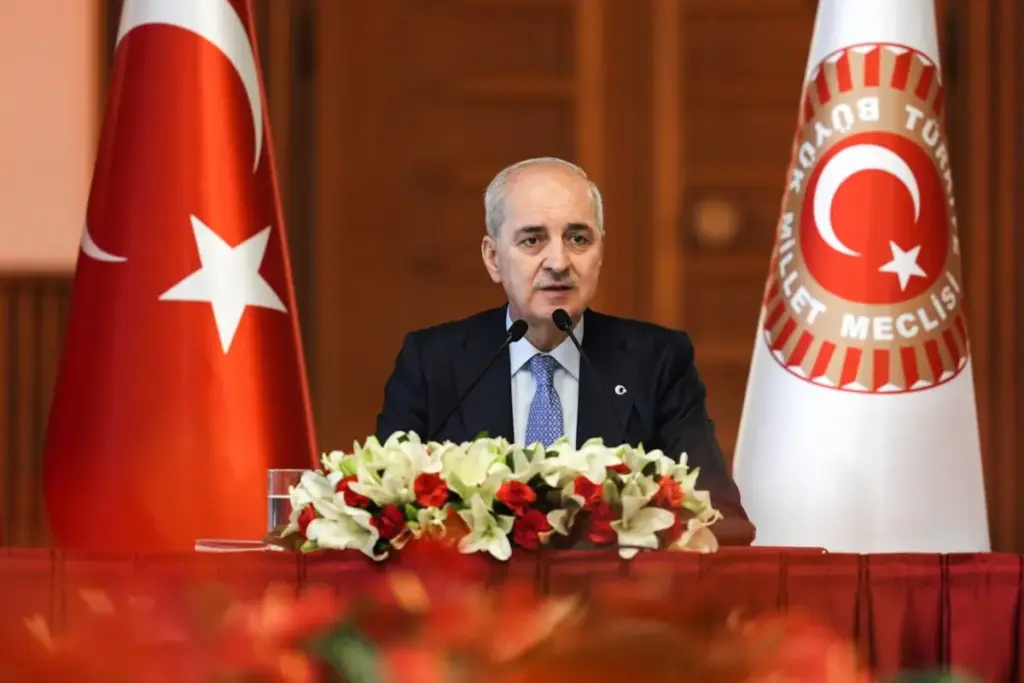
ANKARA — Parliament Speaker Numan Kurtulmuş delivered a comprehensive policy assessment on Friday, declaring that Türkiye is steadily building a future defined by national unity, a stronger and more resilient democracy, and the permanent eradication of terrorism. Speaking during a gathering with parliamentary reporters to mark the conclusion of the fourth year of the 28th legislative term, Kurtulmuş detailed the significant legislative and political milestones achieved under the government’s sweeping "terror-free Türkiye" initiative.
The parliamentary leader highlighted a productive legislative year in which lawmakers successfully submitted 51 bills, reflecting an active agenda focused on democratic reform, social integration, and security. However, he placed special emphasis on the unprecedented consensus achieved regarding national security and peace-building efforts, framing the current political environment as a historic turning point for both the country and the wider region.
At the heart of these domestic achievements, Kurtulmuş pointed to the extensive work carried out by the National Solidarity, Brotherhood and Democracy Commission. Operating as one of the most significant and inclusive initiatives undertaken by the legislature in recent years, the 50-member commission served as a vital forum for national dialogue. Over the course of its intensive mandate, the commission convened 21 formal meetings totaling 90 hours of rigorous discussion.
To ensure that the initiative reflected a broad spectrum of society, the commission reached out far beyond the halls of government, hearing testimony and collecting insights from civil society organizations, academic experts, political figures from various backgrounds, and former parliamentary speakers from all corners of the country. This exhaustive consultation process culminated in the drafting of a comprehensive report, which was formally approved on February 18 with the overwhelming support of 47 lawmakers. Kurtulmuş described this pivotal moment as the foundational step that successfully opened the pathway for the broader "terror-free Türkiye" process.
Building upon the momentum of the commission’s report, Parliament subsequently advanced a landmark bill aimed at strengthening national solidarity and enhancing social integration. The legislation secured an extraordinary 467 votes in the General Assembly, an achievement that Kurtulmuş hailed as the broadest and most profound parliamentary consensus ever reached on a legislative proposal in the modern history of the republic. This sweeping cross-party agreement, he noted, demonstrated a rare and unified national resolve to close the chapter on decades of terrorism and internal conflict.
Expanding his scope beyond domestic policy, Kurtulmuş emphasized that the initiative has rapidly evolved from a national aspiration into a concrete geopolitical reality, signaling a broader transformation toward a terror-free region. He pointed to ongoing developments in neighboring countries as tangible proof of this regional shift. Specifically, he cited the ongoing integration processes concerning YPG elements in Syria as an important practical step forward, while noting that a comprehensive process aimed at disarming armed militias in Iraq is slated to officially begin in early October. These regional movements, according to the parliamentary speaker, indicate that Türkiye’s strategic vision for regional stability is finding practical implementation on the ground.
To oversee and manage these multifaceted developments, administrative mechanisms are rapidly falling into place. Kurtulmuş announced that a high-level coordination and implementation board, operating under the direct chairmanship of Vice President Cevdet Yılmaz, has already commenced its crucial work. Furthermore, upon the return of the legislature from its recess, Parliament is scheduled to officially establish a dedicated monitoring commission to maintain rigorous oversight of the entire peace and security process.
Detailing the specific responsibilities entrusted to the legislature, Kurtulmuş explained that Parliament will play an active role in closely monitoring the trajectory of the initiative. This will include ensuring that all disarmament and reintegration efforts strictly comply with established legal frameworks, maintaining continuous coordination with the executive implementation board, and deliberating on any supplementary legislation that may become necessary as the process unfolds.
During the interactive question-and-answer session with journalists, Kurtulmuş addressed potential challenges, offering assurances that the ongoing peace and security initiative will continue undeterred despite any potential attempts from domestic or external actors to provoke unrest or disrupt the prevailing political stability.
Drawing a sharp distinction between Türkiye’s current domestic roadmap and traditional international conflict-resolution frameworks, Kurtulmuş underscored the complete absence of foreign involvement. Unlike many international peace processes that rely on outside mediation, external observers, or what is commonly referred to as a "third eye" to oversee negotiations, Kurtulmuş stressed that Türkiye’s approach is entirely homegrown and self-reliant.
"The third eye is the nation itself," Kurtulmuş stated firmly, using the phrase to characterize the Grand National Assembly of Türkiye as the ultimate, legitimate institution representing the will, sovereignty, and wisdom of the Turkish people.