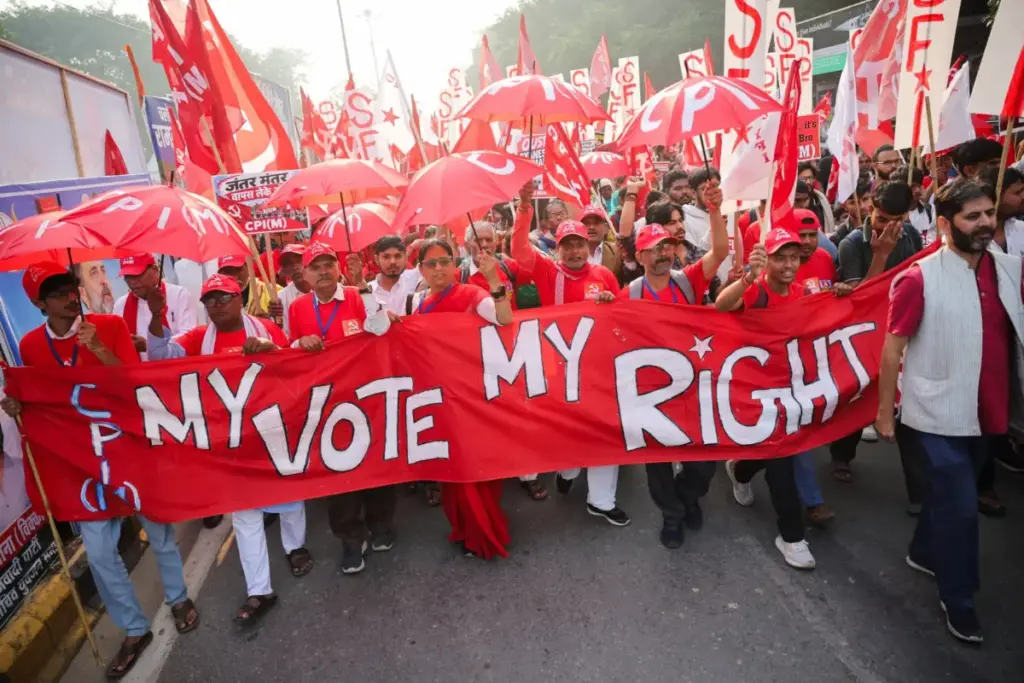
Rahul Gandhi, a prominent leader of the Indian National Congress, stood at the forefront of Sunday’s large-scale demonstration, guiding the procession through the capital’s streets. The rally served as the most recent and visible flashpoint in a sustained wave of civil unrest that has gripped parts of the country for more than a month. Throughout this turbulent period, opposition leaders and their supporters have persistently accused Chief Election Commissioner Gyanesh Kumar of presiding over a heavily biased revision of the electoral rolls, arguing that the integrity of India’s democratic framework has been severely compromised under his administration.
At the core of the mounting political crisis is the contentious removal of more than 130 million names from the voter registry. Opposition parties and civil society groups argue that this massive purge of the electorate was not merely an administrative error or routine cleanup, but rather a targeted operation. According to critics, the deletions have disproportionately impacted minority communities, most notably Muslims and other marginalized groups who traditionally are viewed as less likely to cast their ballots in support of Prime Minister Modi’s Hindu nationalist Bharatiya Janata Party, commonly known as the BJP.
The ramifications of such a vast reduction in the voter base have alarmed political analysts and democracy watchdogs, who point out that the exclusion of tens of millions of citizens from the electoral rolls could fundamentally distort future political outcomes. For weeks, opposition figures have amplified these concerns across public forums, television networks, and social media platforms, transforming the technical process of voter list revision into a national debate over the core neutrality of India’s autonomous constitutional bodies.
In the face of these fierce accusations, the Election Commission of India has consistently and firmly defended its actions. Commission officials have categorically denied favoring any political party, asserting that the revision of the electoral rolls was conducted in accordance with established legal procedures aimed at ensuring accuracy and preventing voter fraud. Furthermore, the election body has stated publicly that individuals whose names were mistakenly or improperly deleted from the registers are provided with legal and administrative avenues to re-register ahead of upcoming electoral contests.
The ruling Bharatiya Janata Party has pushed back aggressively against the opposition-led campaign, characterizing the protests and the relentless criticism of the election chief as an irresponsible and dangerous assault on democratic institutions. BJP spokespersons have accused opposition leaders of attempting to undermine public trust in foundational governance procedures simply because they disagree with administrative realities or fear electoral defeat. According to the ruling party, challenging the legitimacy of the Election Commission sets a perilous precedent that weakens the constitutional checks and balances vital to the nation’s stability.
As the political fallout from the voter roll controversy continues to reverberate across the country’s diverse political landscape, all eyes remain fixed on the horizon as the political parties position themselves for the long-term electoral cycle. India’s next general election is officially scheduled to take place in 2029, yet the intense skirmishes over voter lists, institutional independence, and democratic representation indicate that the political battlegrounds for that major national contest are already being fiercely contested today.