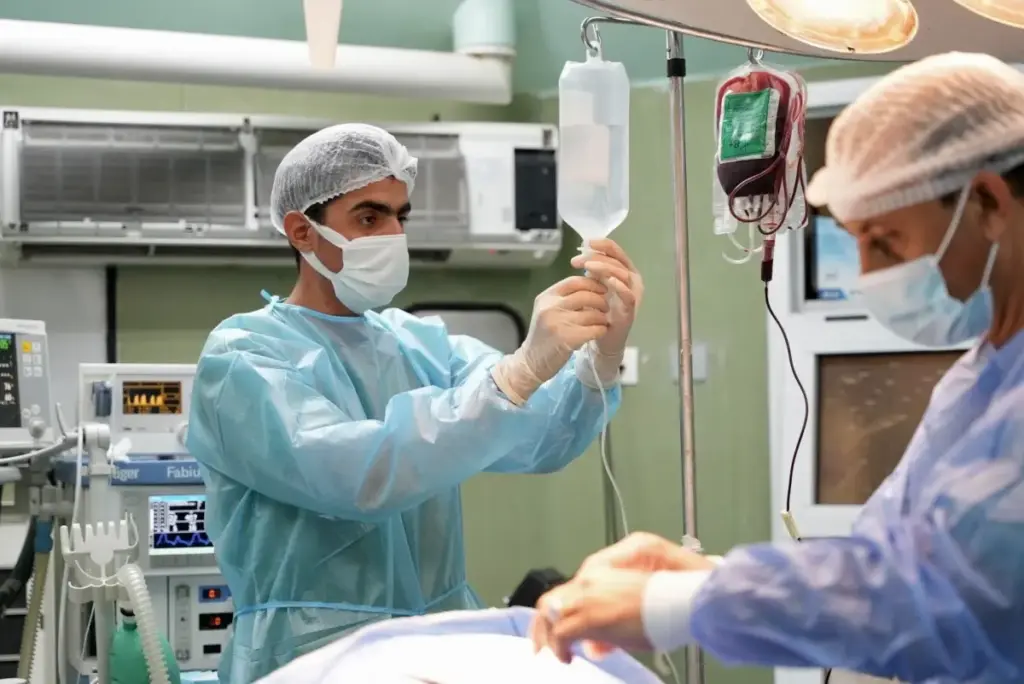
Deir el-Balah, Gaza — For the medical professionals working inside the besieged Gaza Strip, the line separating the operating room from the battlefield has effectively vanished. Day after day, doctors, nurses, and emergency responders are thrust into agonizing scenarios where their professional obligations to save lives collide with catastrophic personal grief. Behind the statistical counts of destroyed infrastructure and physical casualties lies an unprecedented, unquantified psychological catastrophe: a mental health emergency unfolding silently among the territory’s remaining healthcare workers.
Manar Fayyad, a 29-year-old anaesthesiologist at Al-Aqsa Martyrs Hospital in Deir el-Balah, represents the deeply human cost of this relentless conflict. Since the escalation of the war in October 2023, Fayyad has wrestled with severe psychological and neurological trauma. However, the definitive turning point in his life occurred on December 27, 2023, during an ordinary shift that transformed into a personal nightmare.
Summoned urgently to the operating room to administer anesthesia to a critically injured patient ahead of an emergency surgery, Fayyad rushed to perform his duty. But the fragility of life and the cruelty of the war intervened before he could even begin.
"He died before I could reach him," Fayyad recalled, recounting the harrowing moments that ended his career. "When I arrived in the operating room, I recognised the man’s clothes. I had a strange feeling, so I approached him and uncovered his face. To my shock, he was my brother Shadi, who was 34."
The discovery shattered Fayyad’s reality and welded his workplace to an inescapable memory of personal devastation. Unable to continue stepping foot into the hospital environment, his professional career came to a premature and abrupt halt. Today, he struggles to manage the lingering psychological fallout entirely on his own, navigating a lonely path without formal professional intervention. In his quest for a fleeting sense of peace, he has withdrawn from social life, actively avoiding people, crowds, and the constant, deafening noises of the war zone.
Seeking solace along the Mediterranean coastline, Fayyad spends his hours sitting by the sea and writing, using words as a fragile outlet to express his profound pain and process the sequence of events that disrupted his existence. Yet, his mind remains anchored to the idea of leaving Gaza altogether, driven by the desperate hope that geographical distance might finally free him of the constant, agonizing reminders of that single day. Having lost his brother, his lifelong profession, and his community, Fayyad’s daily battle is now fought entirely within his own mind against trauma he must face in isolation.
The weight of such unbearable loss is not unique to Fayyad. Khaled Raafat, a 29-year-old nurse working in the emergency department at the same Al-Aqsa Martyrs Hospital, faced a similarly catastrophic fracture in his personal and professional life. On October 18, 2023, an Israeli air strike targeted his family home, killing his wife, children, mother, and several siblings in a single blow. At the exact moment his family was being eradicated, Raafat was inside the hospital walls, desperately attempting to save the lives of other injured civilians brought in from various strikes across the enclave.

"Learning that I had lost my family marked a painful turning point in my life," Raafat told Al Jazeera. "I could no longer do my job in the same way. The hospital, once associated in my mind with my humanitarian duty, became a reminder of personal pain that was beyond what I could bear. It deeply affected my ability to continue my professional and social life."
In time, however, Raafat chose a different path toward survival, deciding that he had to find a way to rebuild from the ashes of his tragedy. Realizing that life could not simply stop despite the magnitude of his loss, he resolved to seek psychological healing, eventually marrying and starting a new family in an effort to restore stability and hope. With this renewed footing, he returned to his post at the hospital, stepping back into the grueling environment where medical staff remain perpetually overwhelmed.
The personal tragedies endured by Fayyad and Raafat mirror a systemic crisis across Gaza’s health sector. According to figures from Gaza’s Government Media Office, at least 1,700 medical personnel have been killed in Israeli attacks since the war began, while 83 healthcare workers remain detained by Israeli forces.
Yet these grim tallies fail to capture the invisible burden carried by the survivors. Medical workers continue to navigate persistent displacement, unrelenting professional pressure, and chronic exhaustion, all while wrestling with the daily reality of losing friends, colleagues, and family members. A study published in the Public Library of Science journal highlights the staggering scale of this strain, revealing that 41 percent of surveyed medical personnel reported losing family members, while 46 percent had experienced both personal bereavement and forced displacement from their workplaces.
Compounding this heavy emotional toll is an acute lack of resources dedicated to healing those who heal others. At least 78 percent of healthcare workers in Gaza lack access to proper mental health services, exposing a vast chasm between the immense psychological trauma they endure and the care available to treat it. This deficit threatens to accelerate a brain drain within an already devastated healthcare system, as exhausted professionals find themselves pushed past their breaking points.
Official reports have repeatedly acknowledged a severe "loss of human resources" and a "diminished capacity in the healthcare system," making it increasingly difficult to retain remaining staff. To halt this drain and protect workers who have experienced trauma—a category that likely encompasses nearly every medical professional remaining in the enclave—comprehensive psychological and social support systems are urgently required.
"They are caught between their professional duty to save lives and the pain of losing the people closest to them," Munir al-Bursh, director general of Gaza’s Ministry of Health, told Al Jazeera. "They find themselves treating others’ wounds while struggling to heal their own."
Al-Bursh emphasized that working under constant pressure without adequate rest or support deepens physical and mental exhaustion, threatening the viability of the healthcare workforce as a whole. Protecting medical personnel, he noted, goes far beyond securing essential medicines and surgical equipment; it requires safeguarding their mental health and granting them the space and time needed to recover.

"Those who save others also need someone to reach out and help them," al-Bursh said, adding that acute staff shortages resulting from killings, detentions, and injuries make it nearly impossible to grant remaining workers sufficient time off. This shortage is further aggravated by the ceaseless influx of patients, a lack of replacement personnel, and persistent equipment constraints.
For many, the workplace itself has transformed into a theatre of haunting memories. Nurse Hiba al-Tawil, 39, experienced the profound trauma of witnessing her brother’s death directly inside the intensive care unit at the Nasser Medical Complex in Khan Younis, where she was employed.
"Losing my brother at my workplace was a difficult experience that had a profound psychological impact on me," al-Tawil told Al Jazeera. "Being in the intensive care unit afterwards reminded me of what had happened and made it harder to cope with the loss."
To escape the relentless triggers of her grief, al-Tawil was eventually compelled to transfer to a different department within the medical complex. The change helped ease the immediate psychological pressure, allowing her to distance herself physically from the specific location where her brother drew his final breath.
Within facilities like the Nasser Medical Complex, specialized psychological clinics have been established to treat doctors and nurses grappling with bereavement and war-related trauma. Left unaddressed, these experiences frequently escalate into severe psychological disorders that impair everyday functioning and professional capability.
Reham Abu Rokba, a psychologist at the complex, explained that clinical intervention typically begins with a thorough evaluation of the patient’s psychological state, diagnosing specific symptoms and assessing their overall impact before formulating a tailored treatment plan. For patients struggling with post-traumatic stress disorder, interventions often incorporate cognitive behavioural therapy, which assists individuals in understanding their psychological responses to traumatic events and regaining effective coping mechanisms. Depending on individual requirements, a standard course of treatment might involve approximately 12 individual sessions, supplemented by medication when clinically necessary.
According to Abu Rokba, recovery is a gradual process that demands patience, commitment, and consistent engagement with mental health services. "Recovery requires time and ongoing participation in psychological support sessions," she told Al Jazeera. "Providing the appropriate treatment and ensuring adherence to it can help alleviate symptoms and lead to tangible improvements in an individual’s mental wellbeing."