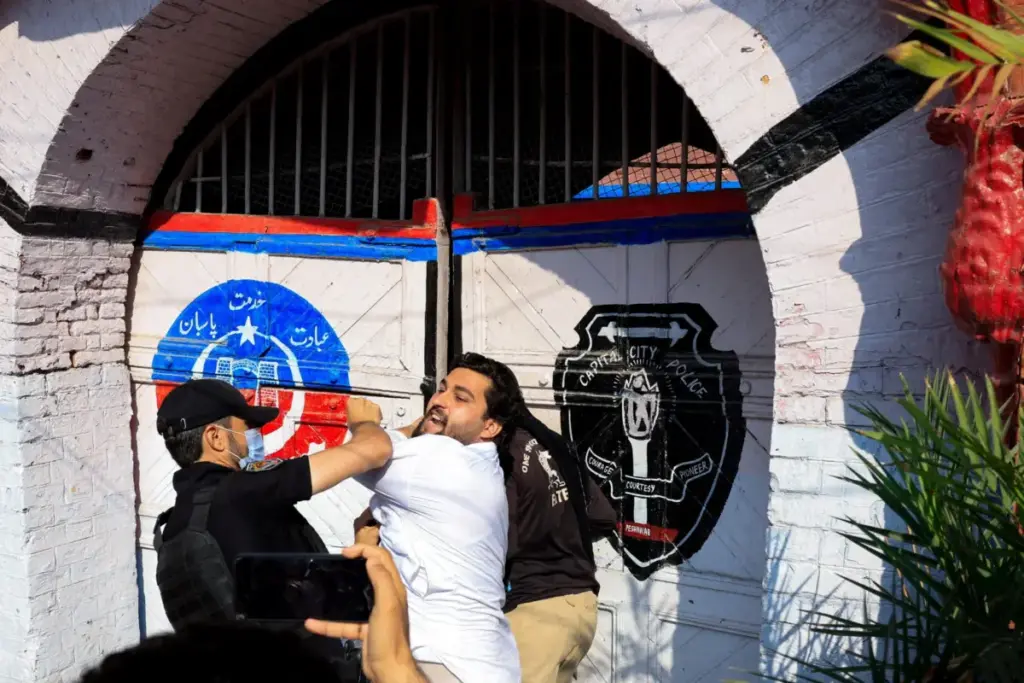
Islamabad, Pakistan — The Pakistan Tehreek-e-Insaf (PTI) party of jailed former Prime Minister Imran Khan is preparing to launch a major legal challenge against the federal government’s sudden takeover of Khyber Pakhtunkhwa, a strategically vital northwestern province that the party has governed for more than a decade.
The federal intervention, executed on Sunday through the imposition of emergency laws and governor’s rule, has abruptly suspended civil liberties and dismantled the provincial government in a move that has rapidly escalated into Pakistan’s latest and most volatile political flashpoint. The unfolding crisis comes at a particularly tense moment, colliding directly with a delayed PTI march toward Islamabad aimed at pressuring national authorities to release Khan, who has been incarcerated for more than three years.
Sheikh Waqas Akram, the central information secretary of the PTI, told Al Jazeera that the party’s legal team is finalizing a petition to contest the constitutional validity of the emergency measures and governor’s rule. The legal challenge is scheduled to be filed in court on Tuesday. The petition has been meticulously drafted by a specialized legal committee headed by PTI Secretary General Salman Akram Raja, though Akram noted that the ultimate destination of the filing—whether the Supreme Court or the newly established Federal Constitutional Court—was still being finalized by the party’s leadership.
The federal government’s decisive moves have sharply polarized the nation’s political landscape, generating vastly competing narratives from Islamabad and the displaced regional administration. While federal authorities insist the intervention is a necessary and strictly constitutional security measure to combat surging militancy, the PTI and independent legal experts have condemned the takeover as an authoritarian assault on provincial autonomy and democratic governance.
The Case for Intervention
Justifying the federal government’s extraordinary actions during a press briefing in Peshawar, Interior Minister Mohsin Naqvi argued that imposing federal rule in Khyber Pakhtunkhwa was an unavoidable prerequisite for Pakistan to effectively dismantle militant networks operating within the province, which shares a long and porous border with Afghanistan.
"No war can be won, however many resources you bring, whatever you do, until the government there leads it," Naqvi stated on Monday, defending the proclamation signed on Sunday by President Asif Ali Zardari.
According to the official text of the proclamation, the provincial administration had "failed to demonstrate the ownership, will and intent to adequately deal with the menace of terrorism."
Aasiya Riaz, joint director of the independent political think tank, the Pakistan Institute of Legislative Development and Transparency (PILDAT), elaborated on the government’s legal premise to Al Jazeera. "The federal government’s position is clearly described. A deliberate disengagement from the fight against terrorism, as communicated after the cabinet meeting. That’s the constitutional premise needed for the imposition of emergency," she said.
This stance was further reinforced last month through a comprehensive 14-page white paper presented in Islamabad by Ikhtiar Wali Khan, a political advisor to Prime Minister Shehbaz Sharif from the ruling Pakistan Muslim League-Nawaz (PMLN). The document highlighted severe institutional challenges within the province, pointing to a rising death toll among police personnel, critical shortages of staff and equipment within the provincial counterterrorism department, and questionable budgetary spending priorities. Official figures cited in the dossier noted that 122 police personnel were killed in the province during the first half of this year alone, a steep increase from the 63 casualties recorded during the same period in 2025.

Independent security trackers similarly point to escalating violence across the region. Data compiled by the Centre for Research and Security Studies (CRSS), an Islamabad-based think tank, recorded 556 violence-linked deaths in Khyber Pakhtunkhwa between July and September, marking a steady upward trend from 475 in the preceding quarter and 311 in the quarter before that. However, the data also highlights that neighboring Balochistan suffered an even heavier toll during the same timeframe, with violence-related fatalities surging by 213 percent to 829, establishing it as the worst-affected province in the country.
Despite these grim statistics, Hassan Abdullah Niazi, a Lahore-based lawyer and adjunct faculty member at the Lahore University of Management Sciences (LUMS), strongly disputed the central government’s constitutional rationale. "If all of this was true, then KP would be in a state of anarchy, but we know that is not the case. It had a functioning legislature and executive that commanded the confidence of the people, hence this entire exercise is an unconstitutional move against provincial autonomy," he told Al Jazeera.
PTI leaders have similarly rejected accusations of negligence or complicity in the fight against armed groups. Akram pointed out that the ousted provincial government had allocated 1.83 billion rupees ($6.6 million) from its own treasury to financially support the families of more than 900 soldiers, police officers, and paramilitary personnel killed in counterterrorism operations—a direct financial contribution he emphasized no other province in Pakistan had matched.
What Islamabad Wanted
The political collision stems from a complex backdrop of tense negotiations between federal authorities and the PTI regarding an intended mass sit-in protest in the capital to demand Khan’s release. Interior Minister Naqvi revealed during a Sunday press conference that Islamabad had engaged in extensive dialogue with the party over the proposed demonstrations.
"We have no problem with the sit-in. Do the sit-in as eagerly as you like, we have no issue with the sit-in. Our issue is entirely terrorism-related, and we want to get you on board on that," Naqvi maintained.
Taimur Jhagra, a senior PTI leader and former provincial finance minister, offered a vastly different perspective on the nature of those discussions, asserting that the talks were strictly intended to address the imprisonment conditions of the former prime minister. "It’s absurd that a negotiation about a protest movement to give Imran Khan Supreme Court-ordered medical and visitation rights becomes a negotiation about terrorism strategy," Jhagra told Al Jazeera.
According to Naqvi, the PTI leadership had initially agreed during discussions that emergency rule should be implemented across 12 specific districts within Khyber Pakhtunkhwa. However, Akram flatly rejected this claim, maintaining that the party firmly opposed the proposal out of fear that local civilian populations would bear the brunt of intensive military operations.
"We said ‘No, this cannot be. You cannot do whatever you like with them. We took the votes from them. Tomorrow they will blame us: you got us killed,’" Akram explained, adding that the party’s negotiating team had referred the federal proposal directly to the province’s Chief Minister, Sohail Afridi, who ultimately rejected it.
Federal Information Minister Attaullah Tarar escalated the rhetorical pressure during Sunday’s joint press conference, leveling severe accusations against the regional administration. "This government, which has been suspended through a constitutional option, is responsible for the deaths of thousands of citizens of Khyber Pakhtunkhwa," Tarar said, accusing Afridi’s administration of maintaining covert ties with the Tehreek-e-Taliban Pakistan—commonly known as the Pakistani Taliban—and the Afghan Taliban.
Political analysts noted that federal authorities have not publicly produced verifiable evidence to substantiate claims of direct official collusion between the provincial government and militant factions.

Security or Politics?
The sudden federal takeover has deeply divided observers regarding its true underlying motivations. While the ruling coalition maintains that the intervention is a pure matter of administrative necessity and national security, critics and opposition figures view the maneuver through a cynical political lens.
"I would say this decision is political, administrative and security. All three elements are present in it," Zaigham Khan, an Islamabad-based political analyst, told Al Jazeera.
Conversely, Ali Arqam, a long-standing observer of political dynamics in Khyber Pakhtunkhwa, dismissed the security justification entirely. "This is not really about security at all. It is basically a political move that they are just dressing up as some kind of administrative necessity," he said.
Jhagra echoed this sentiment, arguing that the federal establishment fundamentally miscalculated the resilience of the PTI and its voter base. He contended that the takeover was an attempt by the ruling coalition to engineer political legitimacy and fracture public support for Khan, which remains robust across the province and the wider country. Federal Law Minister Azam Nazeer Tarar, however, maintained during his public briefings that the suspension of the provincial assembly was executed in strict adherence to constitutional guidelines.
A Party Under Pressure
Following the presidential proclamation on Sunday, the PTI has found itself under unprecedented administrative and security pressure. Among the immediate casualties of the takeover is suspended Chief Minister Sohail Afridi, who had been spearheading the convoy toward Islamabad. Minister of State for Interior Talal Chaudhry confirmed on Monday that Afridi and several members of his provincial cabinet had been placed under preventive custody.
For the PTI leadership, establishing communication with detained officials has proven difficult. "There has been no contact. No one in the party has had any contact with the chief minister," Akram stated. Despite the decapitation of the provincial executive branch and the ongoing crackdown, party representatives insisted that the broader protest movement remains active. "The long march has not ended. But a historic crackdown against the party has begun," Akram affirmed.
As federal authorities prepare to manage the troubled province under emergency provisions, Naqvi acknowledged during Monday’s briefings that immediate breakthroughs against entrenched militant groups are unlikely, warning that the security apparatus faces a difficult path ahead with potential setbacks.
Meanwhile, regional analysts emphasize that the true test of the federal government’s intervention will ultimately lie in tangible outcomes rather than administrative decrees. "You test this government by looking at the exact same hard metrics: Does security actually improve, do the basic services get better, and do the promised fiscal resources finally show up?" Arqam concluded.