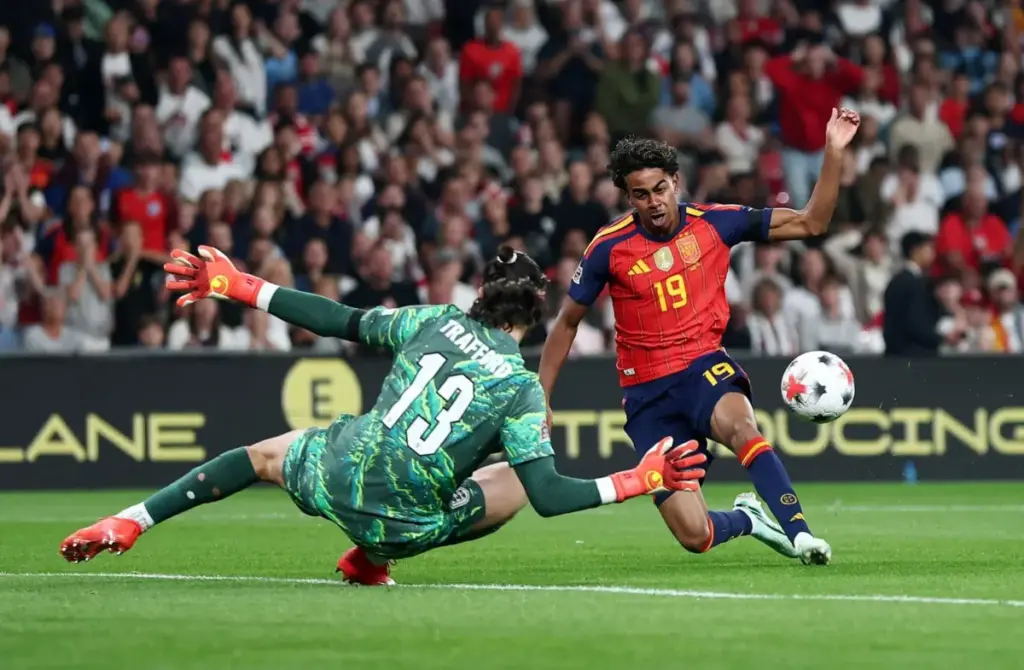
WEMBLEY STADIUM, LONDON — Spain’s Mikel Oyarzabal once again proved to be England’s ultimate nemesis, scoring the decisive winner as the world champions capitalized on two costly defensive errors to secure a thrilling 3-2 victory over the hosts at Wembley Stadium on Saturday in the standout fixture of the UEFA Nations League opening round.
Less than 10 weeks after lifting the World Cup trophy and extending their remarkable unbeaten streak to 39 matches, La Roja displayed the clinical ruthlessness that has made them the dominant force in international football. Yet, their triumph in the Group A3 clash was far from straightforward, requiring them to weather a ferocious English storm that briefly turned the match on its head before Oyarzabal ultimately settled the contest.
The tone for a chaotic and high-stakes encounter was set in the very opening moments. Just two minutes into the match, teenage sensation Lamine Yamal struck to give Spain the lead. The goal came after England defender Marc Guehi was caught in possession deep inside his own half, a catastrophic error against a pressing machine of Spain’s caliber. Yamal accepted the invitation with the poise of a seasoned veteran, firing past the goalkeeper to stun the capacity Wembley crowd.
England, playing under the stewardship of manager Thomas Tuchel, found themselves confronting the worst possible scenario against the world and European champions. Tuchel cut a frustrated figure on the touchline as his team struggled to find their footing against Spain’s immaculate possession play, which was marshaled brilliantly from the technical area by manager Luis de la Fuente.
"There are many matches within a match and we’ve known how to play them all at every moment," Luis de la Fuente remarked after the match, reflecting on his side’s tactical flexibility. "England has a lot of talent to hurt at any moment, but we’ve controlled the game."
That control, however, slipped temporarily around the hour mark, though not before another self-inflicted wound plagued the hosts. Just after the interval, on the hour mark, a misplaced pass from Nico O’Reilly handed possession straight back to the visitors in a dangerous area. Alex Baena pounced on the loose ball to double Spain’s advantage, seemingly putting the game out of reach and leaving the home side staring down a demoralizing defeat.
Yet, Spain’s victory ultimately spoiled what had briefly looked like being a memorable England comeback—and a small measure of redemption for the Three Lions after their heartbreaking World Cup semifinal loss to Argentina. Spurred on by the deficit, England summoned a response that electrified the stadium, turning the game on its head in a breathtaking, four-minute spell of high-intensity football.
The resurgence began in the 36th minute when Anthony Gordon capped a blistering counter-attack with a clinical equalizer, injecting fierce belief into the English ranks. The goal sparked an extraordinary period of momentum that left the Spanish defense reeling. Moments later, the pressure culminated when captain Harry Kane rose majestically to meet a cross, directing a powerful header past the goalkeeper to send the Wembley faithful into raptures and put the hosts in front.
For a brief period, it seemed England might pull off a statement victory against the continent’s elite.
"We’re playing against the world champions, the European champions, and we went toe-to-toe," Harry Kane told ITV in a post-match interview. "On another day for sure we’d have won that game."
Indeed, the match could easily have swung entirely in England’s favor had fortune favored their captain in the second half. Kane was left shaking his head in disbelief after squandering a golden opportunity from the penalty spot. Having stepped up to convert from twelve yards, his left foot slipped just as he planted it, causing his powerful strike to rattle violently off the inside of the crossbar and bounce clear, sparing Spain further punishment.
England manager Thomas Tuchel did not hide his disappointment regarding the nature of the goals conceded, though he was quick to praise his side’s resilience against formidable opposition.
"Terrible start, the worst start possible," Tuchel said. "Makes it so, so difficult to be behind against this kind of team. The reaction was very good, very good."
"The third goal was the only one they really scored—the others were from individual, big mistakes," the German manager added, lamenting the defensive lapses that ultimately cost his side a positive result.
The psychological backdrop to the fixture was stark. Both England and Spain had arrived at Wembley carrying very different memories from their recent World Cup campaigns. The Spaniards were looking to build upon the momentum of their ultimate triumph, while Tuchel’s men were still nursing the emotional scars of their tournament exit, desperately seeking to prove that they could bridge the gap against the global elite.
That gap, for now, remains narrow, but Spain’s ruthless exploitation of mistakes proved decisive once more. With the game finely balanced at 2-2 following England’s ferocious comeback, it required a moment of elite composure to break the deadlock. Step forward Mikel Oyarzabal. The Spanish forward, who famously scored the winner against England in the European Championship final, delivered another dagger to English hearts in the 74th minute. Showing exquisite technique and awareness, Oyarzabal collected a clever through-ball and executed a delicate dink over onrushing goalkeeper James Trafford, restoring Spain’s lead and sucking the air out of Wembley.
Despite late efforts from the hosts to find a second equalizer, Spain managed the remainder of the fixture with the seasoned composure of champions, sealing all three points and making an emphatic statement in the opening match of their Nations League campaign.
Evergreen Modric Inspires Croatia
In Saturday’s other compelling Group A3 encounter, Croatia began a new era under manager Slaven Bilic with a hard-fought 2-1 victory over the Czech Republic. The match highlighted the astonishing longevity of evergreen captain Luka Modric, who once again proved to be the decisive influence before Marco Pasalic struck the winning goal.
At 41 years of age, Modric continues to operate as the undisputed heartbeat of the Croatia national team, defying the passage of time more than two decades after making his international debut. The veteran midfielder made his mark two minutes after the break, orchestrating and finishing an attacking sequence to put the visitors ahead and demonstrate that his class remains permanent.
The Czech Republic, however, refused to roll over. They responded swiftly through Adam Karabec, who leveled the scoreline in the 54th minute to shift the momentum back to the hosts. The match remained tense and tightly contested as both sides adjusted to new tactical directions. Bilic had returned to the Croatia dugout following Zlatko Dalic’s departure in the wake of their Round-of-32 World Cup defeat by Portugal. Meanwhile, the Czechs were similarly under new management, having appointed Spaniard Santi Denia following their own group-stage exit at the global tournament.
Ultimately, Croatia’s experience and quality told in the closing stages. With 13 minutes remaining on the clock, Marco Pasalic restored the visitors’ advantage with a brilliantly taken goal, securing a vital 2-1 victory and all three points for Bilic in his managerial return.
Elsewhere across the continent, the opening round of the UEFA Nations League delivered contrasting fortunes for a host of other national teams embarking on new chapters.
In Group B1, Scotland began life under new manager Sebastien Pocognoli with a hard-earned 0-0 draw away to Slovenia. The fixture offered early glimpses of the more proactive, attacking style that the Belgian coach hopes to instill following the departure of long-serving manager Steve Clarke in the wake of Scotland’s World Cup exit. Oli McBurnie, making a welcome return to the international fold after a five-year absence, proved a constant threat and carved out some of the match’s best scoring opportunities. However, a string of world-class, brilliant saves from Slovenian goalkeeper Jan Oblak repeatedly slammed the door shut, forcing the Scots to settle for a frustrating share of the spoils.
Switzerland made a flying start to their first-ever League B campaign, sweeping aside North Macedonia with a dominant 3-0 victory away from home. Remo Freuler set the tone by opening the scoring early, before Zeki Amdouni took center stage by netting a brace before halftime, effectively killing off the contest and showcasing the depth of Swiss attacking talent.
Meanwhile, in Group C1, Finland produced the most resounding scoreline of the evening, thrashing San Marino 7-0. Joel Pohjanpalo led the rout for the hosts, delivering a magnificent individual performance by scoring a hat trick to headline a comprehensive victory.