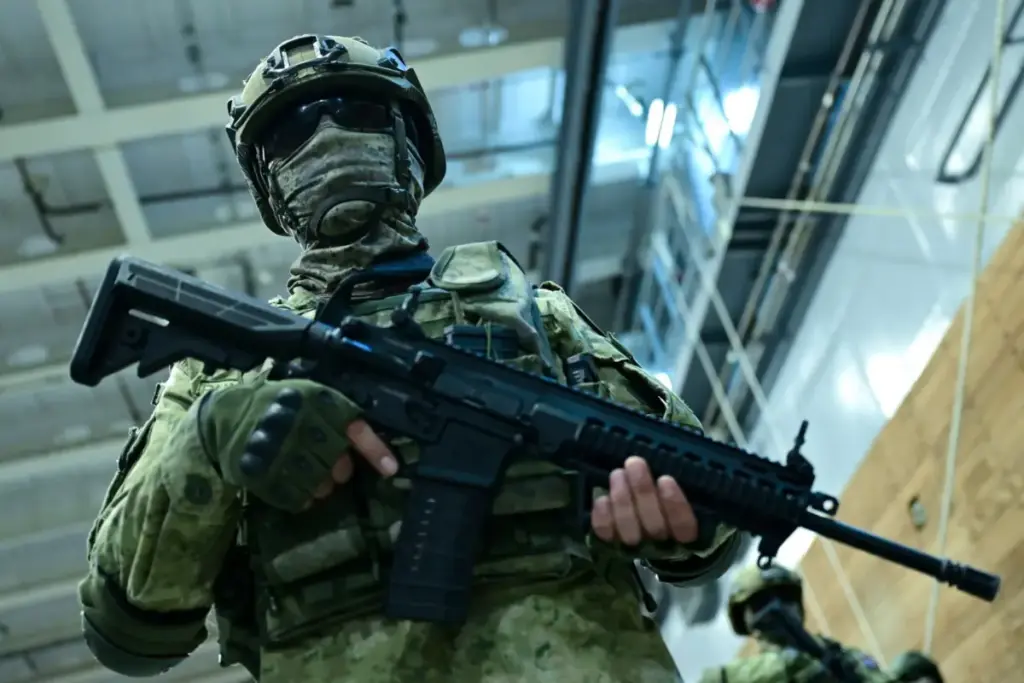
The recent strategic maneuver by Türkiye involving the deployment of the elite 51st Commando Brigade to Söke, located in the Aydin province along Türkiye’s western Aegean coast, has sent considerable shock waves through Athens. In an apparent bid to project readiness and counter the move, Greek military authorities swiftly moved to station a commando company in the Evros regional unit near the Turkish border. However, this localized and modest counter-deployment has offered little to no psychological or tactical relief to the political and military establishment in the Greek capital. A closer examination of the military assets, operational scales, and timelines reveals that Athens’ reaction cannot be portrayed as a strategic counterweight capable of altering the existing balance of power in the region.
To properly assess the unfolding developments across the Aegean theater, it is vital to first establish an accurate timeline of events. According to official records from the Turkish Ministry of National Defense, the administrative and operational relocation of the 51st Commando Brigade was formally approved months in advance, specifically in June 2026. Demonstrating the structured and methodical nature of the transition, the brigade commander officially assumed his post in Söke on August 28. Furthermore, personnel from the brigade actively participated in the official Victory Day ceremonies held in the district on August 30.
This chronology firmly establishes that the redeployment was not a hasty, knee-jerk reaction to a policy decision or military movement made by Greece in September. Rather, Türkiye formulated and executed its strategic decision months ahead of time, driven entirely by its own sovereign mission profiles, long-term defense planning, and operational requirements.
Conversely, the countermeasures taken by Greece materialized significantly later. On September 15, the Greek press heavily reported that a dedicated commando company would be stationed in the town of Avantas within the Evros region, situated near the northeastern border. The official opening ceremony for this unit at the Palaska Barracks took place shortly thereafter on September 17. Greek media outlets were quick to emphasize that the unit had been permanently stationed at the facility. Yet, despite the official ribbon-cutting and ceremonial inauguration of the barracks, independent military observers have noted a conspicuous absence of any tangible, sustained sign or operational indication of the Greek unit’s physical presence on the ground. But even assuming the unit is fully operational and stationed as claimed, defense analysts are left asking a fundamental question: what tangible difference would it actually make in a regional confrontation?
Company vs. Brigade: A Mismatch in Scale and Capability
This question highlights the core strategic disparity that Athens appears to struggle to grasp. The military force that Türkiye has introduced to Söke is a fully fledged, highly trained commando brigade. In stark contrast, the unit deployed by Greece to Avantas is, by the admission of Greek military sources themselves, a "lochos katadromeon," or a standard commando company. Pitting a single company—closer in scale to a platoon than a major combat formation—against an entire brigade, and subsequently presenting this maneuver to the public as a decisive response that alters the military balance, fails to reflect the realities on the ground. It is, by all professional military accounts, a peculiar approach that seems to originate more from the domestic political calculations of the Greek military elite than from sound strategic doctrine.
The disparity between these two formations is not merely a matter of semantic nomenclature or administrative sizing. A military brigade is an expansive, highly lethal combat force, vastly larger than a company, complete with integrated subordinate battalions, a sophisticated command and control structure, and robust logistical and fire support elements. In terms of sheer human personnel and heavy combat assets, military experts point to a roughly tenfold difference in scale between the two formations. While exact, classified troop strength figures are not publicly disclosed by either nation for operational security reasons, it remains an undisputed axiom of military science that a single company does not carry the equivalent strategic or tactical weight of a brigade.
Moreover, the geographical positioning chosen by Athens further undermines the logic of its response. The deployment area in question is situated in the Meriç region rather than on an Aegean island directly opposite Söke. Consequently, the move amounts to nothing more than a localized force reinforcement implemented by Athens within its own mainland border zone. There is neither a solid military justification nor a logical basis for presenting this routine garrison adjustment as a meaningful countermeasure intended to offset the strategic deployment of the 51st Commando Brigade to the vital coastal hub of Söke.
Battle-Tested Legacy: The 51st Brigade’s Extensive Field Experience
The combat readiness and institutional capability of the 51st Commando Brigade are well-documented among defense professionals. Having spent years operating in some of the most punishing and unforgiving terrain imaginable, the brigade possesses a level of operational seasoning that sets it apart from standard garrison units. For instance, personnel who served with specialized units in challenging regions like Tunceli during the late 1990s routinely participated in complex, high-stakes operations alongside this very brigade, proving its mettle in intense, real-world combat environments.
The rugged mountains, deep valleys, rushing rivers, and formidable water obstacles characteristic of regions like Tunceli serve as a constant, rigorous testing ground for commando forces. The specialized training, tactical discipline, and advanced equipment possessed by the 51st Brigade for executing river crossings and navigating difficult water obstacles must be evaluated directly alongside the profound expertise it has accumulated over decades of deployment in harsh geography. The operational and combat experience acquired under brutal winter conditions—including navigating deep snowpacks, sub-zero temperatures, and isolated terrain—represents an invaluable combat capability that takes years, if not decades, to cultivate.
The strategic positioning of the brigade in Söke consequently elevates the mobility and operational readiness of forces within the Aegean region to an entirely new level. When commanded to act, the unit possesses the specialized expertise, logistical depth, and amphibious capabilities required to navigate water obstacles and project force rapidly to designated objectives across the theater. Any serious strategic assessment of the vast 214,000-square-kilometer Aegean Sea that fails to account for this rapid-deployment capability would constitute a critical and irreparable oversight.
By comparison, open-source military assessments indicate that the newly established Greek commando company lacks specialized river-crossing assets and heavy amphibious deployment equipment. More importantly, it operates without a comparable depth of rigorous operational experience, leaving its broader combat capabilities extremely limited when measured against a specialized rapid-reaction force. In purely military terms, the deployment of a single company cannot create a strategic balance or establish tactical superiority against an entrenched, battle-hardened brigade.
Ultimately, when viewed through an objective lens, the Greek deployment along the northern border functions less as a viable military counterweight and more as a symbolic gesture designed to reassure a domestic audience in Athens. In attempting to counter a major strategic repositioning by its neighbor with a token force, Greece has once again miscalculated the fundamental realities of regional military dynamics.
The views and opinions expressed in this article are solely those of the author and do not necessarily reflect the editorial stance, values, or official position of Daily Sabah, which publishes diverse perspectives to foster open and informed public discussion.