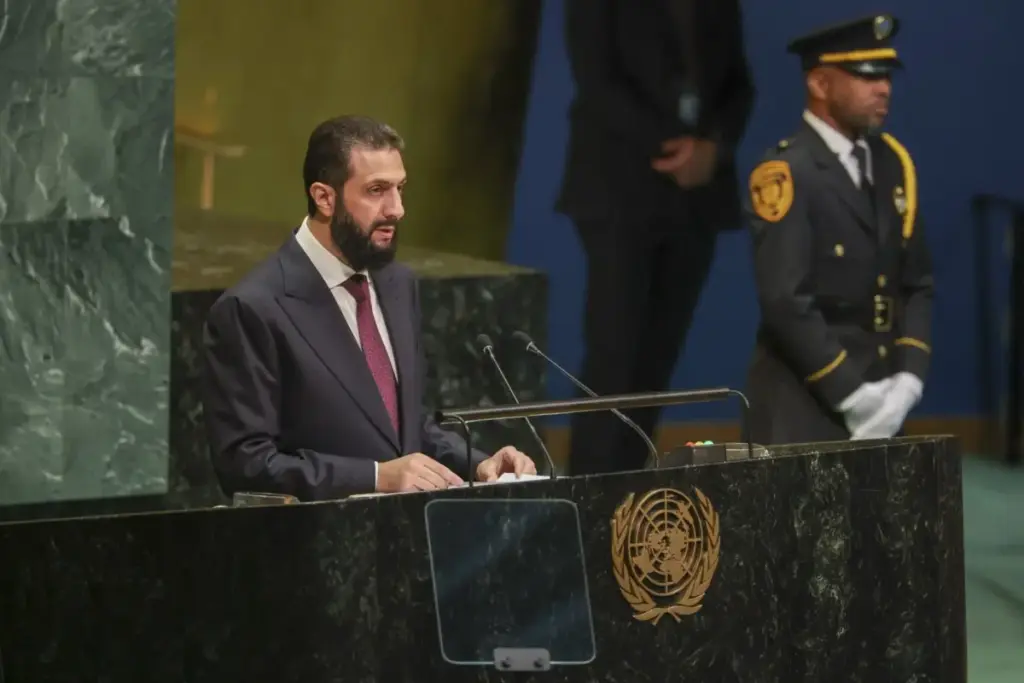
UNITED NATIONS — Syrian President Ahmed al-Sharaa delivered a firm and uncompromising message on the international stage Wednesday, forcefully declaring that the Israel-occupied Golan Heights will remain sovereign Syrian territory. Speaking before the 81st session of the United Nations General Assembly, al-Sharaa addressed mounting diplomatic friction surrounding the strategically vital plateau, directing particular criticism at recent international shifts in recognition.
The Syrian leader’s prominent remarks at the high-level global gathering follow a contentious diplomatic development last month, when Colombia broke with long-standing international consensus and formally recognized Israeli sovereignty over the territory. That move drew swift and severe condemnation from Damascus, setting the stage for al-Sharaa’s high-profile address at the United Nations headquarters in New York.
Addressing world leaders, diplomats, and international delegates assembled in the grand hall, al-Sharaa left no room for ambiguity regarding Syria’s legal and historical stance on the mountainous region, which has been a flashpoint in the Middle East for decades.
"Any attempts that violate our sovereignty, violate international law, will be stopped. Golan will remain Syrian territories. Any other attempts will be thwarted according to Security Council Resolution 497," al-Sharaa stated firmly during his address.
The reference to United Nations Security Council Resolution 497 forms the cornerstone of Syria’s legal argument and international backing on the issue. Adopted unanimously by the Security Council on December 17, 1981, the resolution declared that Israel’s decision to impose its laws, jurisdiction, and administration in the occupied Syrian Golan Heights was null and void and without international legal effect. The foundational international document also demanded that Israel, as the occupying power, rescind its decision immediately—a stance that Damascus continues to invoke in all multilateral forums to rally global opposition against any recognition of Israeli control.
The friction that prompted Wednesday’s fiery U.N. speech stems directly from Bogotá’s policy shift last month. Colombia’s decision to recognize Israeli sovereignty over the contested territory represented a notable diplomatic divergence from the mainstream position held by the vast majority of the international community, which views the Golan Heights as territory occupied by Israel during the 1967 Six-Day War and subject to the principles of international law concerning the acquisition of territory by force.
Syria’s immediate response to Colombia’s announcement last month was sharp, accusing the South American nation of undermining international law and challenging the collective security framework established by the United Nations. By taking the dispute to the podium of the 81st U.N. General Assembly, al-Sharaa sought to elevate the diplomatic pressure, reminding member states of their obligations under international charters and calling upon the global community to reject any unilateral steps that alter the legal status of occupied lands.
The Golan Heights region holds immense strategic, geographic, and economic importance. Rising steeply above the Jordan River valley, the plateau overlooks northern Israel and parts of Syria, making it a critical vantage point for military surveillance and regional security. Beyond its strategic military value, the territory is also rich in water resources and fertile agricultural land, further amplifying its significance to both nations.
Since capturing the territory in 1967 and subsequently extending Israeli law to the area in 1981—a move that went largely unrecognized by the international community—Israel has maintained a firm grip on the plateau, establishing numerous settlements and integrating its infrastructure. Meanwhile, successive Syrian governments have consistently maintained that the return of the Golan Heights is an absolute prerequisite for any durable, comprehensive peace in the Middle East.
Al-Sharaa’s address underscored the enduring nature of the dispute, signaling to both regional actors and international partners that Damascus has not relinquished its territorial claims despite years of domestic turmoil and shifting geopolitical alignments in the broader Middle East. By anchoring his declaration in the binding framework of Security Council Resolution 497, the Syrian president aimed to remind the global diplomatic corps that any bilateral recognition of sovereignty by third-party states remains a violation of multilateral consensus.
As the 81st General Assembly continues its deliberations, the reverberations of al-Sharaa’s speech are expected to influence diplomatic debates surrounding state sovereignty, international law, and the enforcement of decades-old United Nations resolutions. The direct rebuke of Colombia’s recent policy change, coupled with the unyielding pledge to defend territorial integrity, highlights the persistent sensitivity of the Golan Heights issue on the global stage.