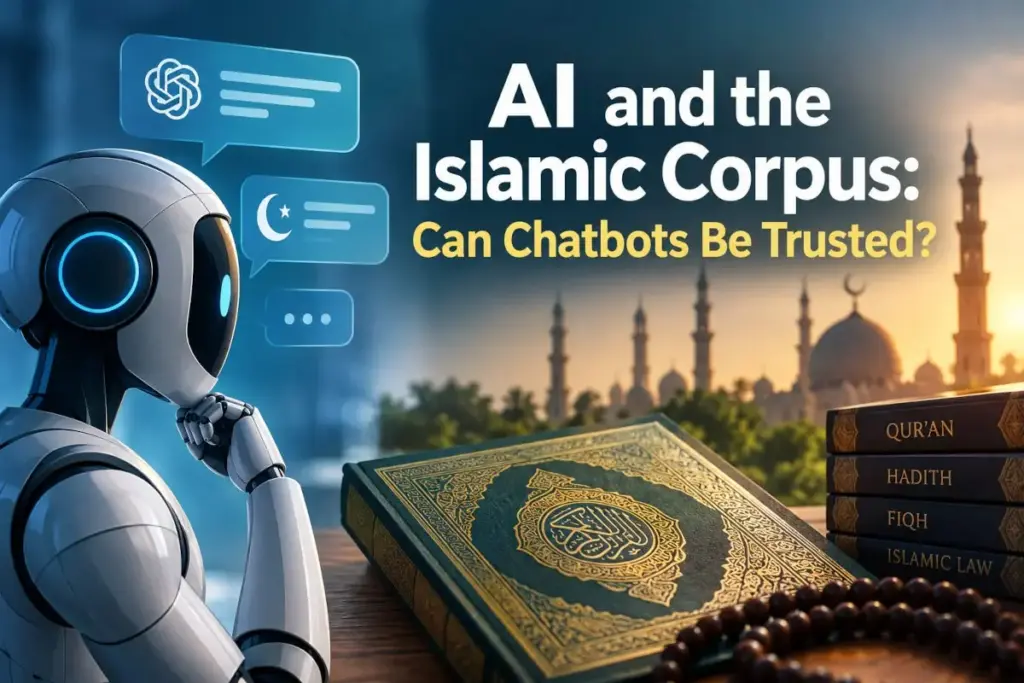
Picture a student sitting at a desk in the dead of night, the blue glare of a smartphone illuminating a room otherwise cast in shadow. They type a pressing question into a chat window: "Is this financial loan allowed in Islam?" Within seconds, long before they have even set the phone down, a response scrolls onto the screen. The tone is polished, confident, and carries an air of serene wisdom. Yet, looking closer, there is no sacred text cited, no classical scholar named, and no established school of legal thought referenced. The student is left stranded in a modern dilemma: Did this authoritative-sounding answer emerge from centuries of rigorous, verified human scholarship, or is it merely an algorithmic illusion that just sounds like it did?
This tension between the illusion of certainty and the reality of computational generation lies at the heart of a rapidly evolving digital landscape. As artificial intelligence permeates every corner of modern education and daily life, the intersection of cutting-edge technology and classical Islamic jurisprudence is raising urgent questions about accuracy, authority, and the preservation of religious heritage.
The Record is Bigger Than It Looks, and Patchier Too
At the foundation of this technological shift are the foundational texts of Islam—the Quran, hadith collections, works of tafsir (exegesis), and volumes of fiqh (jurisprudence)—which are increasingly being digitized, indexed, and fed into machine learning pipelines. The completeness and structural integrity of these digital corpora ultimately determine what artificial intelligence can achieve when tasked with parsing sacred law.
Some components of this digital library are remarkably well-maintained. The Quranic Arabic Corpus, for instance, meticulously tags all 77,430 of its words for precise grammatical structure, utilizing the traditional i’rab system rather than modern linguistic frameworks. Subsequent technological initiatives, such as the MASAQ project, have expanded upon this foundation by introducing more than 131,000 word-level attributes alongside over 123,000 contextual notes detailing how individual terms interact within complex sentence structures.
The landscape of hadith literature, however, presents an entirely different set of challenges. A research paper published in 2025 by an Iranian academic team detailed the processing of more than a million narrations using advanced AI tools. Yet, a closer examination of the study revealed internal discrepancies in data counts across different sections of the report, underscoring the necessity of independent verification when dealing with massive datasets. Furthermore, the researchers noted that comprehensive digital hadith repositories remain comparatively restricted, even as new collections slowly emerge.
Accessibility remains a persistent barrier. A sacred text repository that remains locked away behind proprietary walls benefits no one, just as fragile digital archives that vanish into obsolescence fail to provide a stable foundation for the next generation of computational models.
Complicating matters further is the widespread absence of necessary diacritical marks. The same 2025 research paper highlighted that over 80 percent of the hadith texts processed lacked tashkeel—the vital vowel markings that dictate correct pronunciation and grammatical function. Without these markers, a single written Arabic word can often be interpreted in multiple distinct ways. Left to its own devices, a machine learning model is forced to estimate the correct reading, a process that frequently results in critical errors.
The sheer volume of raw data does not automatically resolve these underlying structural deficits. Developers building specialized search tools frequently report an abundance of general information but a severe shortage of properly labeled Islamic data required to train robust, reliable models. To address this gap, ambitious undertakings like IslamGPT 1.0, a project spearheaded by Hamad Bin Khalifa University, aim to categorize every individual paragraph of their source material by author, historical era, scholarly affiliation, academic field, and literary genre. Although scheduled for completion through 2027, the initiative illustrates a fundamental truth of the digital age: a legal ruling cannot be properly interpreted by a machine if the system does not know who issued it or under what historical conditions it was formulated.
Why the Chatbot on Your Phone Gets Religion Wrong
Most commercial chatbots available to the general public have been trained primarily on English-language corpora and Western-centric sources. This systemic bias can lead these models to overlook nuanced Islamic perspectives or articulate them poorly. A preliminary observational study conducted via a blog post by the Leibniz Centre for the Modern Orient (ZMO) evaluated three mainstream chatbots alongside one specialized Islamic application by posing three targeted theological questions. While the dedicated Islamic tool outperformed its general-purpose counterparts, the evaluation was small and informal, serving more as a preliminary indicator than a definitive benchmark.
A more comprehensive evaluation conducted in Malaysia put six different chatbots to the test using ten foundational Quranic questions posed in the Malay language. The results revealed widespread inaccuracies regarding contextual interpretation, with many responses failing to align with established Islamic teachings.
Beyond factual accuracy, however, lies the deeper, more profound concern of religious authority. A 2026 study published in the Online Journal of Research in Islamic Studies evaluated GPT-4o by submitting fourteen complex legal questions that had already been adjudicated by qualified human scholars. The AI model provided correct answers to six of the inquiries while failing the remaining eight. Crucially, every single error leaned in the exact same permissive direction: toward the conclusion that a given practice was permissible. Moreover, the model relied heavily on mainstream news outlets and Wikipedia entries rather than consulting official, authoritative fatwa repositories.
The implications extend far beyond mere error rates. Scholars argue that an artificial intelligence model can never attain the standing or accountability of a qualified jurist who issues a formal fatwa. A human scholar bears the moral, ethical, and religious responsibility for their rulings before God and the community. A machine possesses no such moral agency. While the 2026 study was limited in scope—evaluating a single model on a specific dataset from June 2025—it serves as a stark warning rather than a universal verdict on all digital tools.
Specialized retrieval systems tailored specifically for religious texts demonstrate improved performance, though they still require human oversight. One such tool, developed using Quranic verses and canonical hadith collections from Sahih al-Bukhari and Sahih Muslim in the Indonesian language, reported a precision rating of 0.78. This indicates that roughly one out of every five retrieved results was irrelevant or out of context. When reviewed by human specialists across thirty distinct queries, the system proved helpful, yet the necessity of human verification remained paramount.
Navigating the Digital Landscape
For students of Islamic knowledge, the modern reality demands a return to first principles. When an artificial intelligence model supplies a Quranic verse or a prophetic hadith, students must independently locate the passage within trusted, printed editions. Furthermore, learners should interrogate these tools regarding the origin of their answers, exercising extreme caution whenever a system fails to cite verifiable sources.
Users must remain constantly vigilant against the illusion of false certainty. Islamic scholarship is characterized by centuries of vibrant debate and legitimate divergence of opinion among classical jurists. Any computational tool that flattens these complex intellectual traditions into a single, clean answer is fundamentally misrepresenting the breadth of the tradition.
The traditional habits of learning—memorization, studying under the direct guidance of qualified teachers, and reading classical texts directly—remain the irreplaceable pillars of genuine scholarship. Artificial intelligence may serve as a helpful digital assistant along the journey, but it can never substitute for the transformative experience of traditional study. When conflicting answers arise from digital queries, it should serve as a clear signal to slow down, consult primary sources, and seek human counsel.
For ordinary Muslims navigating daily religious questions, a clear boundary should be established. Everyday tasks such as drafting letters, organizing study schedules, or translating recipes are well within the capabilities of modern AI. However, when determining matters of halal and haram, individuals must turn directly to qualified scholars or official fatwa-issuing institutions, many of which maintain robust online portals.
Testing digital responses against official religious bodies before taking action is essential, as is maintaining a healthy skepticism toward any tool that invariably tells the user what they want to hear. Authentic spiritual guidance occasionally requires difficult answers. Fostering open household discussions about these technologies ensures that younger generations understand that digital tools can be simultaneously useful and deeply flawed.
Preparing the Next Generation and the Ummah Together
Children growing up today are digital natives who will never remember a world unshaped by artificial intelligence. Consequently, the objective is not to isolate them from technology, but to cultivate critical habits of mind that will outlast any single application. Parents and educators must consistently prompt young learners to question the validity of information by asking how a claim is verified, transforming source-checking into an instinctive reflex.
Preserving traditional methods of memorization and recitation provides children with an internal compass of sacred knowledge, making anomalies and errors in digital outputs much easier to detect. Instilling traditional ethics—adab—into digital interactions ensures that respect for teachers, reverence for sacred texts, and a commitment to intellectual honesty extend to computer screens. Allowing children to engage in basic coding and data literacy also empowers them to contribute meaningfully to the digital repositories that future AI models will learn from.
On a broader community scale, the preservation of the Islamic heritage requires concerted collective action. Academic institutions, community organizations, and religious councils must work together to digitize and safeguard manuscripts, hadith compilations, and legal commentaries in durable, future-proof formats. Releasing these foundational texts under open licenses will enable researchers and ethical developers to build safer, more accurate tools.
Directing financial and institutional support toward Arabic and Islamic artificial intelligence research remains a critical necessity, given that the vast majority of global tech investment is currently channeled into English-language applications. Scholars must take the lead in meticulously labeling and categorizing digital data by historical era, school of jurisprudence, and thematic genre.
Furthermore, Islamic organizations and universities can establish new standards by actively questioning technology companies regarding their training data and missing corpora. By publishing official religious rulings in machine-readable formats, scholarly bodies can ensure that authoritative fatwas are easily accessible to digital systems, thereby reducing the likelihood of misquotation. Training imams and educators in digital literacy will further equip community leaders to guide their congregations through an increasingly automated world, while cooperative efforts among international fatwa councils can help establish universal ethical standards for AI citation and transparency.
The student sitting at a midnight desk will undoubtedly continue to pose questions to the glowing screen. The collective responsibility of the global community is to ensure that the intellectual library standing behind that digital response is comprehensive, transparent about its limitations, and thoroughly worthy of the trust placed in it.