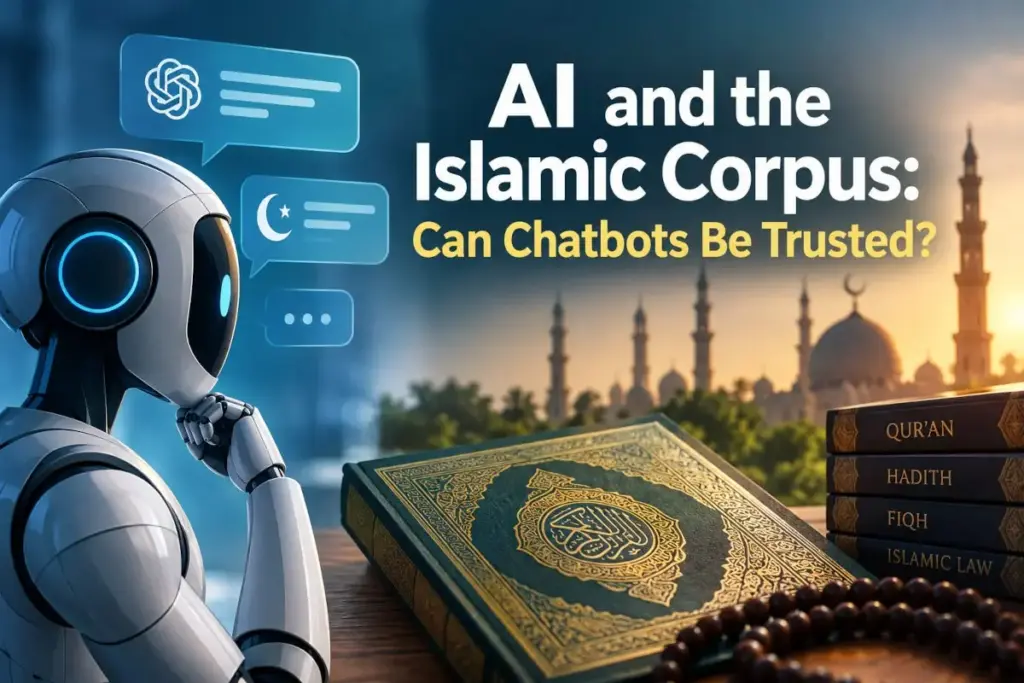
Picture a student sitting alone at midnight, the blue light of a smartphone illuminating a face caught between curiosity and anxiety. They tap out a quick query into a chat window: "Is this financial arrangement allowed in Islam?" Within seconds, an answer flashes back before they have even set the device down. The tone is preternaturally confident, carrying a polished veneer of wisdom. Yet, a closer inspection reveals a troubling void: no classical text is named, no renowned scholar is quoted, and no recognized school of jurisprudence is referenced. The student is left suspended in doubt. Did this authoritative-sounding guidance emerge from centuries of rigorous, verified scholarship, or is it merely an algorithm expertly mimicking the cadence of certainty?
This modern paradox sits at the heart of an escalating digital transformation within Islamic studies, a phenomenon that begins fundamentally with the raw texts powering these advanced models.
The Corpus: Vast, Expanding, and Unevenly Digitized
The contemporary Islamic corpus—comprising the Holy Quran, the Hadith collections, tafsir (exegesis), and fiqh (jurisprudence)—has increasingly been transcribed into digital formats, allowing powerful computers to search, index, and learn from a vast library of sacred tradition. However, the completeness, cleanliness, and structural integrity of these digital archives vary wildly, directly shaping what artificial intelligence can and cannot accomplish with religious data.
Some foundational elements are surprisingly well-maintained. The Quranic Arabic Corpus, for instance, meticulously tags each of its 77,430 words for precise grammatical function, relying on the traditional i’rab system rather than modern linguistic frameworks. Subsequent initiatives, such as the MASAQ project, have pushed this precision further by introducing more than 131,000 word-level details alongside 123,000 contextual notes explaining how individual terms weave together within complex sentence structures.
The landscape of Hadith literature, however, tells a remarkably different story. A 2025 research paper published by an Iranian academic team detailed the AI-driven processing of more than a million narrations. Yet, the paper’s internal metrics and numerical totals frequently conflicted from one section to the next, serving as a cautionary tale for researchers relying on unvetted aggregations. Furthermore, the authors noted that accessible Hadith collections remain inherently limited, even as fresh digital archives slowly emerge.
Accessibility remains a persistent barrier. A digital repository locked behind proprietary walls benefits no one, and a collection that suddenly vanishes online can undermine the training models of tomorrow. Compounding these structural hurdles is the widespread absence of short vowels. The same 2025 research paper revealed that over 80 percent of the Hadith texts it handled lacked tashkeel—the crucial diacritical marks that dictate exact pronunciation and semantic meaning. Without these markers, a single written Arabic formulation can often be interpreted in multiple ways. Left to its own devices, a machine learning model is forced to guess, and when it guesses incorrectly, the theological implications can be profound.
Even sheer volume does not solve the problem. One development team attempting to build a specialized search utility discovered an abundance of general internet data but a critical scarcity of properly labeled, authentic Islamic data required to train a robust model. Meanwhile, ambitious endeavors like IslamGPT 1.0, a project spearheaded by Hamad Bin Khalifa University, aim to systematically tag every paragraph of their source materials by author, historical era, traditional scholars, academic field, and literary genre. Scheduled to run through 2027, the initiative represents a forward-looking blueprint. Yet, the foundational logic remains indisputable: it is impossible to accurately interpret a legal ruling or jurisprudential opinion without knowing precisely who articulated it and under what historical circumstances.
Why Conversational Chatbots Often Misinterpret Religious Authority
Most mainstream conversational AI models are trained predominantly on English-language corpora and Western secular sources. This systemic bias frequently leads them to gloss over authentic Islamic viewpoints or mischaracterize them entirely. A preliminary blog post published by the Leibniz Centre for the Modern Orient (ZMO) put this phenomenon to the test, evaluating three popular general-purpose chatbots alongside a specialized Islamic tool by posing three distinct theological questions. While the specialist tool emerged as the most accurate, researchers emphasized that the evaluation was informal and should be viewed merely as an exploratory glimpse into the issue.
A more comprehensive study conducted in Malaysia subjected six different chatbots to ten fundamental Quranic inquiries administered in the Malay language. The results revealed persistent vulnerabilities: many models failed to provide sufficient contextual accuracy, and a significant portion generated outputs that conflicted directly with established Islamic teachings.
Beyond factual accuracy, scholars express deeper concerns regarding religious authority. A 2026 study published in the Online Journal of Research in Islamic Studies evaluated GPT-4o by presenting it with fourteen specific inquiries regarding legal matters that qualified scholars had previously addressed. The chatbot answered six correctly while failing eight. Every single error skewed in the exact same direction: toward theological permissibility, uniformly favoring lenient interpretations. Additionally, the model relied far more heavily on contemporary news articles and Wikipedia entries than on recognized, authoritative collections of official fatwas.
The broader philosophical argument extends much further. Scholars contend that an artificial intelligence model can never inherit the moral and spiritual standing of a qualified jurist empowered to issue a binding fatwa. A human scholar assumes personal responsibility for a legal ruling before God and the community; a piece of software does not. Although the study focused on a single model examining a specific topic utilizing data current up to June 2025, its findings serve as a stark warning rather than a definitive verdict on every technological tool.
Specialized retrieval systems engineered explicitly for religious texts fare considerably better. For instance, an experimental search tool built exclusively upon Quranic verses and canonical Hadith from Sahih al-Bukhari and Sahih Muslim in the Indonesian language reported a precision score of 0.78. This indicates that roughly one out of every five retrieved results was irrelevant, a margin of error that required two human specialists to manually review thirty distinct queries. While such tools offer practical assistance, they clearly underscore the necessity of rigorous human verification.
Navigating the Digital Landscape: Guidance for Students and Communities
For students actively pursuing Islamic knowledge, the proper methodological approach begins with returning to primary texts. When an artificial intelligence model cites a Quranic verse or a prophetic tradition, learners must independently verify its authenticity within trusted editions. Users should routinely interrogate these tools regarding the origin of their answers, exercising extreme caution whenever a system fails to provide verifiable citations.
It is equally vital to remain vigilant against artificial certainty. Classical Islamic scholarship is defined by a rich tradition of scholarly debate and divergent legal opinions. A technological tool that dispenses a single, immaculate answer to a complex, debated issue is fundamentally bypassing centuries of nuanced jurisprudence. Preserving traditional habits of study—such as memorization, direct engagement with qualified teachers, and independent reading of classical texts—remains essential. Artificial intelligence can serve as a supplementary study aid, but it can never replace the human elements of traditional learning. When conflicting answers arise, it serves as an immediate signal to slow down and conduct deeper research.
For ordinary Muslims navigating everyday life, digital tools can appropriately assist with mundane tasks such as culinary recipes, drafting routine correspondence, or organizing study schedules. However, when determining complex questions of halal and haram, individuals are urged to consult qualified human scholars or established, official fatwa bodies, many of which maintain accessible digital platforms. Testing any digital response against official religious authorities prior to acting remains a critical safeguard. Furthermore, users should approach any tool that invariably provides the exact answer they hoped to hear with deep skepticism, recognizing that authentic religious guidance occasionally requires difficult restraint.
These discussions naturally extend into the domestic sphere. As children grow up in a world saturated with digital technology, households must cultivate critical media literacy. Parents play a vital role in teaching youngsters that while artificial intelligence can be remarkably useful, it is also frequently prone to error, and that fundamental questions should always be verified before being trusted.
Preparing the Next Generation for an Algorithmic Future
The generation of children coming of age today will never know a world unshaped by artificial intelligence. Consequently, the objective is not to isolate youth from these technologies, but rather to instill habits of critical inquiry that will outlast any individual software application.
Educators and parents are encouraged to continuously pose fundamental questions to young learners, asking how they know a given piece of information is true, thereby transforming source-verification into an automatic reflex. Concurrently, maintaining traditional practices of Quranic memorization and recitation provides children with an internal spiritual and textual reference point, making it vastly easier for them to spot anomalous or incorrect religious assertions.
Bringing proper adab—respectful conduct—to the digital screen is equally important. The core values of respect for teachers, reverence for sacred texts, and an uncompromising commitment to truth should govern interactions within chat windows just as they do in physical classrooms. Moreover, encouraging youth not merely to consume technology, but to understand foundational coding and data principles, can empower them to contribute meaningfully to improving the digital datasets that future AI models learn from. Above all, allowing students to grapple with difficult, ambiguous questions through patient human effort teaches significantly more than obtaining an instant, automated answer.
Collective Action Across the Ummah
While individual habits and household practices are vital, systemic transformations require coordinated effort at the community and institutional levels.
First and foremost, the Islamic intellectual heritage must be comprehensively digitized and protected. Canonical Hadith collections, comprehensive works of tafsir, and classical fiqh manuscripts require professional scanning, rigorous cross-verification, and secure archival storage in enduring formats. To maximize utility, these digitized texts should be released under clear, open licensing frameworks, enabling academic researchers and ethical developers to build responsible applications.
Substantial financial investment is equally crucial. Because the vast majority of global funding in artificial intelligence development is directed toward English-language applications, Arabic and Islamic AI initiatives require steady, dedicated financial backing to remain competitive. Furthermore, data labeling must be prioritized; qualified scholars represent the indispensable demographic required to accurately and reliably tag historical sources by legal school, historical era, and thematic genre.
Stakeholders should actively demand transparency from technology corporations regarding the datasets used to train their models and the omissions therein. Universities, research centers, and Islamic organizations can establish this accountability as an industry standard. Simultaneously, contemporary fatwa councils must publish their legal rulings in machine-readable formats. The more accessible an official religious ruling is in the digital sphere, the more difficult it becomes for generic chatbots to misquote or misrepresent authoritative guidance.
Finally, imams, educators, and community leaders require specialized training in digital literacy to effectively guide their congregations through the technological landscape. By fostering broad consensus among fatwa councils, academic institutions, and religious bodies, the global community can establish shared ethical standards regarding how artificial intelligence systems cite sources and acknowledge their own limitations.
The student sitting alone at midnight with a glowing smartphone will continue to ask difficult questions. The collective responsibility of the community is to ensure that the vast digital library standing behind those answers remains comprehensive, candid about its imperfections, and worthy of the profound trust that human seekers place in it.