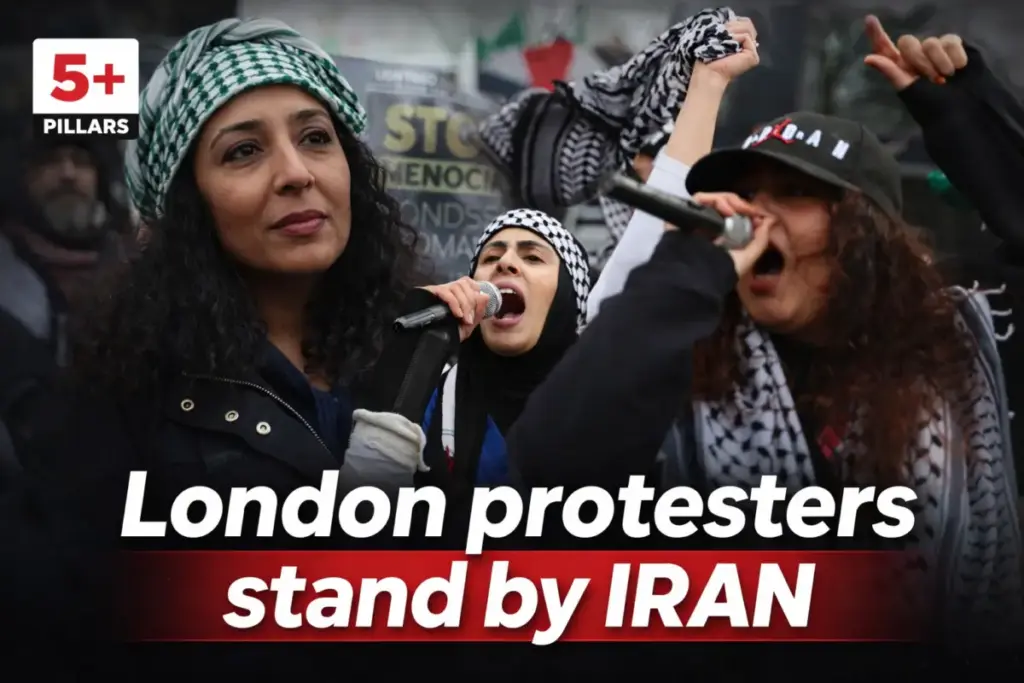
Thousands of demonstrators took to the streets of London in a powerful display of solidarity with Iran, marching through the heart of the British capital to vehemently condemn the ongoing military aggression orchestrated by the United States and Israel. Amid escalating geopolitical tensions in the Middle East, the mass mobilization served as a platform for activists, community leaders, and concerned citizens to voice their fierce opposition to what they termed a reckless and dangerous military campaign. Protesters used the high-profile demonstration to demand that the British government immediately distance itself from the hostilities and refuse any form of military, logistical, or political entanglement in the unfolding conflict.
The atmosphere in central London was charged with urgency as vast crowds gathered, carrying a sea of banners, placards, and national flags. The demonstration drew a diverse coalition of peace activists, anti-war organizations, and members of various diaspora communities who came together under a shared banner of anti-imperialism and international peace. Marchers chanted slogans criticizing Western foreign policy in the Middle East and calling for an immediate halt to military escalations that threaten to plunge the wider region into an all-out catastrophic war.

A prominent visual element of the march was the array of sharply worded placards carried by participants, highlighting multiple grievances against Western interventionism. Banners bearing messages such as "Stop Trump’s wars," "Tell Starmer: stop arming Israel," "End nuclear hypocrisy," and "Stop bombing Iran" were held aloft throughout the procession. Alongside these pointed political statements, demonstrators proudly waved Palestinian and Iranian flags, drawing explicit connections between the plight of people across the region under the weight of Western-backed military campaigns. Speakers at the rally emphasized that the security and stability of the Middle East cannot be achieved through continuous bombardment, economic blockades, and proxy warfare, urging international bodies to intervene diplomatically rather than militarily.
The focus of the protest quickly turned toward the current Labour government led by Prime Minister Keir Starmer, with activists directing sharp criticism at Downing Street’s foreign policy decisions. Protesters argued that the United Kingdom is complicit in the wider cycle of violence by continuing to supply weaponry and diplomatic cover to Israel, while simultaneously aligning too closely with Washington’s aggressive posture toward Tehran. Addressing the crowds, organizers warned that any British participation in a wider war against Iran would be catastrophic for international stability, domestic security, and the standing of the UK on the global stage. They urged ordinary citizens to hold their elected representatives accountable and to demand a fundamental shift toward a foreign policy rooted in diplomacy, international law, and human rights.
As the march wound its way past notable landmarks in the British capital, it attracted significant public attention, drawing supportive honks from passing vehicles and applause from bystanders on the pavements. The demonstration proceeded peacefully under the watchful eye of the Metropolitan Police, though its sheer scale caused temporary disruptions to central London traffic and public transport networks. For hours, the sound of resounding chants echoed through the city streets, reflecting a deep-seated public anxiety over the trajectory of international relations and the looming specter of a wider global conflict.

The protest in London forms part of a growing wave of international dissent against the current military escalation, with similar demonstrations taking place in major cities across Europe and beyond. Activists vowed to continue mobilizing and organizing public actions until governments heed the call for de-escalation and peace. As the geopolitical landscape remains perilous and the threat of a wider conflagration hangs in the balance, organizers stressed that grassroots pressure and public visibility remain critical tools in the ongoing fight against militarism and war.