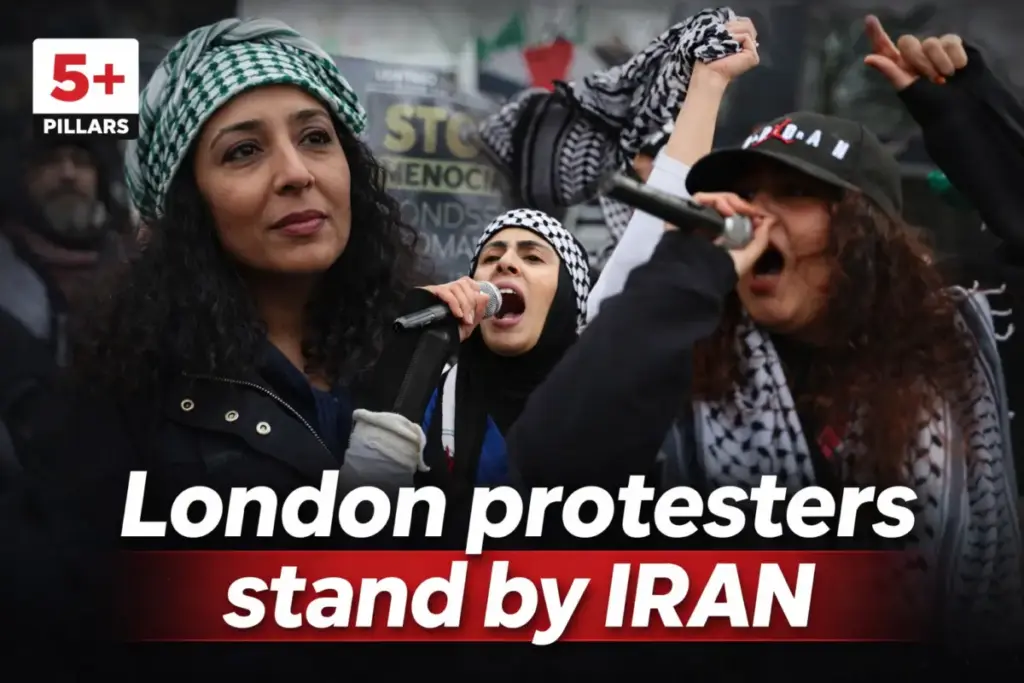
Thousands of demonstrators took to the streets of London on a major day of mobilization, marching through the heart of the British capital to protest against the ongoing military aggression by the United States and Israel against Iran. Activists, community members, and concerned citizens converged to voice their vehement opposition to what they termed a reckless and catastrophic escalation of hostilities in the Middle East, demanding that the British government immediately distance itself from any participation or complicity in the unfolding conflict.
The demonstration drew a diverse crowd carrying an array of banners, placards, and national symbols. Prominent among the visual displays were Iranian and Palestinian flags, reflecting a broader solidarity network among anti-war campaigners who view the current military actions against Tehran as part of a wider, destabilizing campaign across the region. Protesters marched along designated routes in central London, chanting slogans against foreign military intervention and calling for immediate diplomatic solutions rather than military escalation.

Placards held high by demonstrators carried direct messages directed at international and domestic political leaders. Slogans such as "Stop Trump’s wars," "Tell Starmer: stop arming Israel," "End nuclear hypocrisy," and "Stop bombing Iran" dominated the procession. The inclusion of these specific demands highlighted the protesters’ deep frustration with both Western foreign policy traditions and the current Labour government’s handling of the crisis, particularly regarding arms exports and diplomatic alignment with Washington and Tel Aviv.
Speakers addressing the crowds during the mobilization emphasized the extreme danger posed by the military confrontation between the US-Israeli alliance and Iran. Activists warned that any sustained conflict involving Iran would not only devastate the immediate region but also ripple outward, triggering severe global economic consequences, mass displacement, and an unpredictable security crisis. Speakers strongly criticized what they described as a dangerous political consensus among Western powers that consistently favors military solutions and economic blockades over diplomatic engagement and international law.
The involvement of British political leadership came under intense scrutiny during the demonstrations. Chants and speeches frequently targeted Prime Minister Keir Starmer, with organizers urging the UK government to break from its historical pattern of supporting US-led military interventions in the Middle East. Protesters argued that by continuing to supply military hardware and diplomatic backing to Israel, the United Kingdom is actively enabling the broader cycle of violence that now threatens to engulf Iran. They called on Parliament to debate and vote against any prospective British involvement in offensive operations or logistical support for strikes against Iranian territory.

The demonstration also highlighted the intersection of various geopolitical struggles, with many participants drawing direct parallels between the plight of Palestinians in Gaza and the military pressure being applied to Iran. The dual presence of Palestinian and Iranian flags underscored a unified narrative among anti-war groups, who argue that regional stability is impossible so long as international law is applied selectively and military force is used to subvert national sovereignty. Activists stressed that ordinary citizens in the UK bear a moral responsibility to hold their elected officials accountable for the consequences of British foreign policy abroad.
As the march concluded, organizers vowed to continue their grassroots mobilization efforts, warning that public pressure on the streets of London will only intensify if the UK government fails to alter its foreign policy course. The protest served as a powerful reminder of the deep domestic opposition within Britain to foreign military adventures, reflecting widespread public anxiety over the prospect of a wider war in the Middle East and demanding an immediate halt to actions that push the region closer to the brink.