As American voters prepare to cast their ballots in the high-stakes United States midterm elections, President Donald Trump’s job approval rating continues to hover near a historic low. According to the latest Reuters/Ipsos public opinion poll, only 32 percent of registered voters express approval of Trump’s performance in the Oval Office.
While this figure represents a slight uptick of one percentage point compared to his standing two weeks prior, it underscores a deeply challenging political environment for the administration and the broader Republican Party. With control of both chambers of the US Congress hanging in the balance, the newly released polling data paints a grim picture for conservative candidates seeking to maintain their legislative majorities against a motivated and energized Democratic opposition.
The latest survey data reveals a persistent enthusiasm gap between the two major political parties. When respondents were asked whether they intended to cast their ballots for a generic Democratic or Republican candidate in their local congressional districts, 46 percent indicated a preference for the Democratic contender. In contrast, only 38 percent expressed support for the Republican candidate, signaling a formidable structural disadvantage for the GOP on the eve of the nationwide vote.
Although President Trump’s name is not directly on the ballot this election cycle, he has aggressively inserted himself into the national conversation. In rallies and public appearances across the country, Trump has repeatedly implored his base to treat the midterm elections as a referendum on his presidency itself. Raising the stakes for his supporters, the president has issued stark warnings that if the Republican Party loses its majority control in Congress, congressional Democrats may immediately pursue aggressive oversight and potentially seek to initiate impeachment proceedings against him for a third time.
Political analysts attribute the steady erosion of the president’s approval ratings to a convergence of domestic economic anxieties and major foreign policy developments. Specifically, polls indicate a sharp downward trend for Trump since the late-winter outbreak of the US-Israel war on Iran, which commenced on February 28. The outbreak of military conflict in the Middle East has sent shockwaves through global energy markets, driving up retail prices for petrol and diesel across the United States. For American consumers already grappling with stubborn inflation and broader economic uncertainty, the soaring cost of fuel has become a daily, tangible reminder of global instability, severely impacting public sentiment regarding the administration’s economic stewardship.
In a desperate bid to reverse these negative trends and rally conservative turnout, President Trump embarked on an exhaustive, monthlong campaign blitz leading up to the November 3 midterm elections. The aggressive travel schedule was designed to inject vital energy into Republican campaigns fighting to defend vulnerable seats and retain control of both the US House of Representatives and the United States Senate.
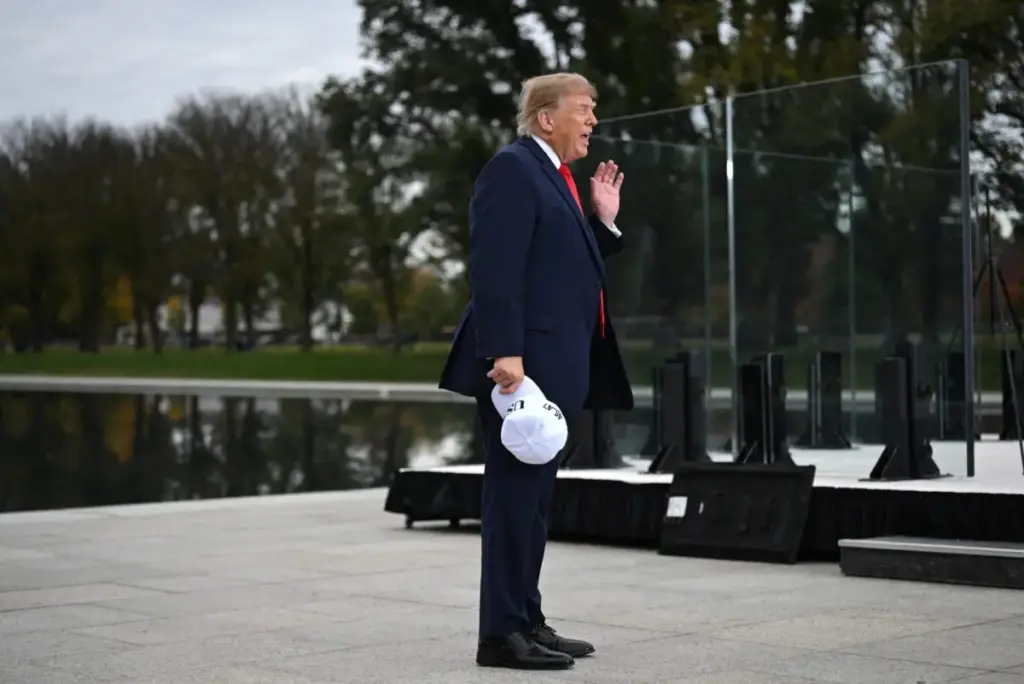
The president officially brought his whirlwind campaign tour to a close on Monday afternoon with a high-profile address at a rally in Washington, DC, staged against the backdrop of the Lincoln Memorial Reflecting Pool. The historic site has been a frequent focus of presidential attention as part of Trump’s broader initiative to renovate and reshape the nation’s capital. However, the renovation project itself has been plagued by controversy, running several months behind its original schedule and ultimately costing more than ten times its initial budget estimate. Compounding the political embarrassment, a specialized protective liner utilized for the reflecting pool—which Trump had heavily promoted during earlier phases of the project—began peeling away shortly after its installation.
Addressing the gathered crowd of supporters on Monday, Trump defended the contentious undertaking despite the widespread criticism. "It was a work of art that never worked, but now it will work," Trump declared from the podium. He dedicated a significant portion of his final campaign speech to outlining his ambitious, albeit controversial, urban planning visions for Washington, DC. Among the proposals highlighted by the president was the construction of a grand "Triumphal Arch," a project that has already run into major hurdles, including active legal challenges filed by local municipal authorities and neighboring jurisdictions.
Despite his tireless efforts on the campaign trail, the president appeared to temper expectations during his Monday remarks, seemingly acknowledging that his personal involvement might not yield the sweeping legislative victories his party desperately desires. Instead, Trump pointed to historical patterns, framing his party’s uphill battle as an inescapable political reality of American governance.
"For some reason, the sitting president doesn’t win the midterms," Trump told the rally attendees, reflecting on the historical headwinds that traditionally plague incumbent administrations. "But we gave this a very strong shot."