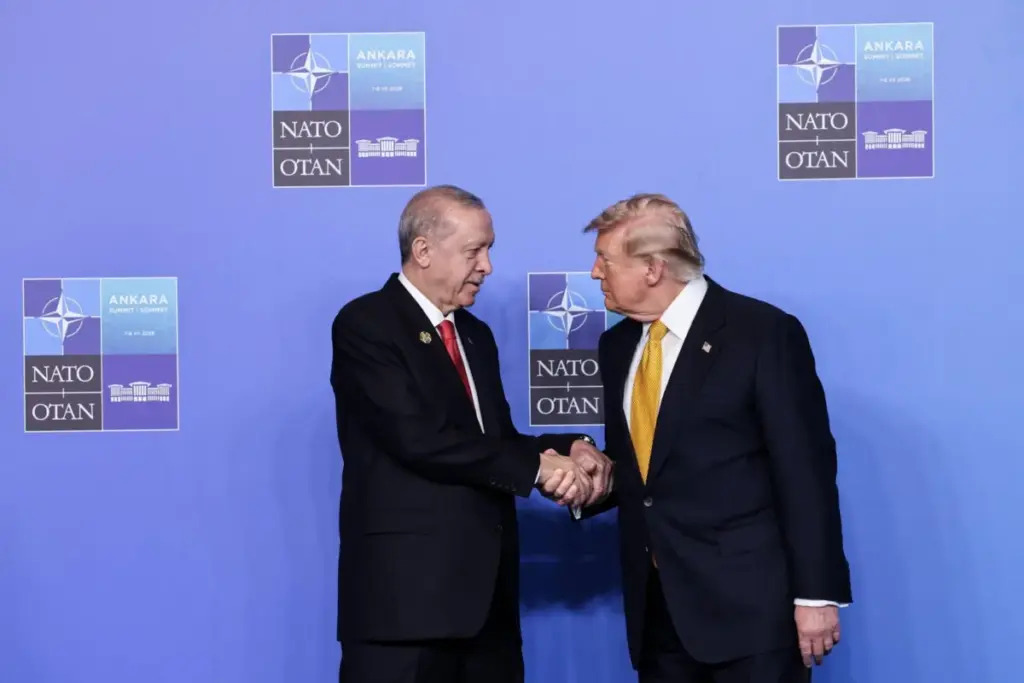
WASHINGTON — U.S. President Donald Trump voiced strong and unequivocal support for Türkiye and Turkish President Recep Tayyip Erdoğan on Friday, addressing lingering questions and delays regarding the potential lifting of Countering America’s Adversaries Through Sanctions Act (CAATSA) sanctions that previously resulted in Ankara’s removal from the multinational F-35 joint strike fighter program.
Speaking to reporters outside the White House before departing for Alabama to attend a Republican Party campaign event, President Trump emphasized his personal rapport with the Turkish leader and underscored the strategic importance of the relationship between Washington and Ankara. Addressing inquiries about why administrative and diplomatic delays have persisted in rolling back the punitive measures, Trump made it clear that his administration values its partnership with the key NATO ally.
Noting that he harbors a deep fondness for Türkiye, Trump revealed that he remains in frequent communication with President Erdoğan. Describing the Turkish president not merely as a foreign counterpart but as a personal ally, Trump offered a warm appraisal of their diplomatic relationship. "He is a friend of mine, as you know. And I’ll always make him happy," Trump told the gathered press corps as he walked toward Marine One, signaling an openness to resolving long-standing bilateral disputes that have strained diplomatic and military cooperation between the two capitals in recent years.
The remarks echo sentiments previously expressed by the U.S. leader. Earlier, during a high-profile diplomatic engagement at the NATO leaders’ summit held in Ankara in July, Trump had publicly announced that the United States intended to lift the CAATSA sanctions imposed on Türkiye. At the time, he articulated a broader policy rationale, stating explicitly that Washington did not want to impose economic or diplomatic penalties on its friends and strategic partners. However, despite that public declaration, practical steps toward fully lifting the measures have faced administrative holdups, prompting renewed media scrutiny and questions from diplomatic observers.
The origins of the current diplomatic rift date back to 2020, when the United States imposed the CAATSA sanctions against Türkiye. The punitive actions were triggered by Ankara’s acquisition of the Russian-made S-400 advanced air defense system. The decision by the Turkish government to integrate the Russian-led defense platform sparked immediate and severe pushback from Washington and other NATO allies, who argued that the S-400 system posed a direct operational security threat to Western military technology, most notably the stealth capabilities of the F-35 Lightning II fighter jet.
As a direct consequence of the S-400 procurement, the United States removed Türkiye from the F-35 fighter jet program. Ankara had previously served as both a financial partner and an industrial manufacturer for the next-generation aircraft, producing numerous critical structural and avionics components through its domestic defense aerospace industry. The abrupt removal not only disrupted Turkish defense manufacturing supply chains but also created a significant capability gap for the Turkish Air Force, which had planned to integrate dozens of the fifth-generation stealth jets into its fleet.
The acquisition of the S-400 system by Ankara, however, did not occur in a strategic vacuum. Turkish officials have repeatedly explained that the decision to turn to Moscow was a reluctant necessity rather than a deliberate pivot away from the Western alliance. For years, Ankara attempted to purchase the U.S.-made Patriot air defense system to protect its borders from mounting regional security threats emanating from neighboring conflicts. When those protracted negotiations failed to produce a viable commercial or political agreement—largely due to disagreements over pricing, technology transfer, and congressional hurdles in Washington—Türkiye looked elsewhere to address its urgent national security and air defense vulnerabilities, ultimately finalizing the deal with Russia.
Despite the turbulence that the S-400 dispute introduced into bilateral relations, both Washington and Ankara have continuously sought avenues to repair the rift, recognizing the indispensable nature of their decades-long strategic partnership within the NATO alliance. Türkiye commands the second-largest standing army in NATO and occupies a vital geopolitical crossroads connecting Europe, the Middle East, and Asia, making its alignment and cooperation critical to broader Western security architectures.
President Trump’s latest comments suggest a renewed political willingness at the highest level of the U.S. government to navigate past the diplomatic stalemate and find a mutually acceptable resolution to the lingering sanctions and defense procurement disputes. As discussions continue behind the scenes regarding the implementation of the sanctions relief previously signaled in July, defense and diplomatic analysts will be closely monitoring how the White House intends to reconcile the CAATSA statutory requirements with Trump’s stated desire to accommodate his Turkish counterpart and restore a smoother, more cooperative chapter in U.S.-Turkish relations.