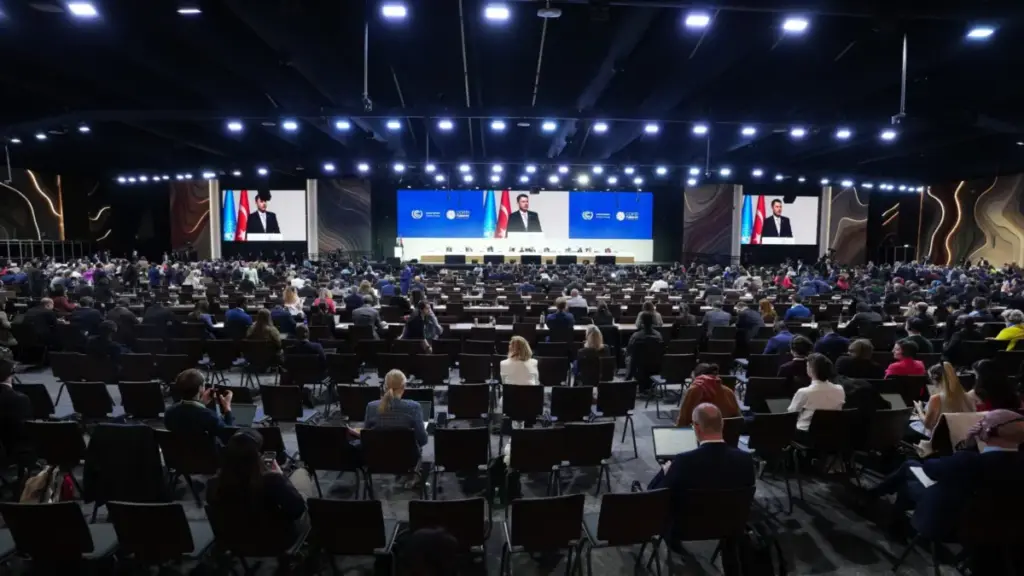
ANTALYA — Türkiye has mobilized a massive security force of 58,000 personnel across Antalya and surrounding provinces to safeguard the upcoming COP31 United Nations climate summit, Interior Minister Mustafa Çiftçi announced during a comprehensive press briefing. The extensive operation underscores the government’s commitment to ensuring a secure and seamless international gathering, even as officials broaden the conversation surrounding global environmental challenges. Speaking to reporters in the Mediterranean host city, Çiftçi outlined the intricate multi-tiered security framework designed to protect delegates, world leaders, and visitors, while issuing a broader warning that climate change itself has evolved into a critical threat to public security through extreme weather events, natural disasters, and displacement.
The logistical and operational preparations for the high-profile U.N. conference involve an unprecedented level of coordination among Türkiye’s security and emergency response agencies. At the heart of these preparations is a sophisticated three-tier security system strategically engineered to secure not only the immediate venue and host city but also the broader regional geography encompassing neighboring provinces, coastal corridors, and international borders. By establishing these concentric circles of protection, Turkish authorities aim to create an impenetrable security buffer that accounts for every potential vulnerability associated with hosting a mega-scale global summit.
Detailing the geographical scope of the deployment during his news conference in Antalya, Minister Çiftçi explained how the security rings have been demarcated to maximize operational efficiency and resource allocation. The provinces immediately surrounding Antalya have been designated as the first security ring, serving as an immediate operational buffer and support zone for the host city. Beyond this primary perimeter, a second security ring has been established across adjacent regional provinces to monitor and regulate transit corridors. Finally, the third ring encompasses Türkiye’s vital border and port provinces, ensuring comprehensive oversight of national entry points throughout the duration of the international climate conference.
"We have designated the provinces surrounding Antalya as the first security ring, those beyond them as the second, and our border and port provinces as the third," Çiftçi said during the briefing. "A total of 58,000 personnel are serving across Antalya and these security zones, working in meticulous coordination to guarantee the safety of all participants and local residents alike."
To execute this vast security architecture, the Ministry of Interior has deployed a diverse array of specialized forces across land, sea, and air. According to the minister, a substantial ground force comprising 26,000 police officers and gendarmerie personnel has been deployed to maintain public order, manage traffic flow, secure venues, and conduct routine patrols throughout the designated security zones. These frontline personnel are equipped with advanced communication and monitoring technologies to ensure rapid response capabilities in the event of any security disruption or emergency.
Simultaneously, the Turkish Coast Guard Command has been tasked with securing the nation’s coastal approaches and maritime borders adjacent to the summit zone. Operating specialized watercraft and conducting continuous aerial surveillance patrols, the Coast Guard forms a vital maritime shield designed to prevent unauthorized access and protect coastal infrastructure from potential security risks. The integration of naval and aerial assets highlights the multi-dimensional nature of the deployment, ensuring that both land-based and maritime approaches are thoroughly monitored and protected.
In tandem with law enforcement and military deployments, civil protection authorities have taken rigorous steps to mitigate potential hazards ranging from natural disasters to specialized technical emergencies. Türkiye’s Disaster and Emergency Management Authority, commonly known as AFAD, has stationed 1,000 specialized personnel directly within Antalya. This contingent is on high alert to respond swiftly to potential emergencies, including wildfires, complex search-and-rescue operations, and sophisticated chemical, biological, radiological, and nuclear threats. The presence of AFAD units reflects the multifaceted nature of modern mega-event security, where traditional law enforcement must be seamlessly integrated with advanced civil defense and disaster response capabilities.
Minister Çiftçi noted that these extensive security preparations are deeply rooted in Türkiye’s proven track record and extensive institutional experience in hosting major international gatherings. The nation has successfully managed numerous high-level global summits, state visits, and diplomatic conferences in recent years. Among these, the minister specifically highlighted the successful execution of the NATO summit held on July 7-8, pointing out that the high-stakes alliance meeting concluded entirely without security incidents. This prior operational success has provided Turkish security planners with a valuable blueprint for managing large-scale delegations, VIP movements, and international media corps under stringent security protocols.
However, the scope of the minister’s address extended far beyond the immediate logistical and tactical arrangements required for the U.N. climate conference. In a significant policy pivot, Çiftçi emphasized that climate change should no longer be categorized strictly as an environmental or ecological challenge. Instead, he argued that the compounding effects of global warming represent a profound and immediate danger to societal stability, national infrastructure, and internal security.
"We consider climate change a security problem, a potential security vulnerability and even a risk multiplier," the minister stated, stressing that state authorities are actively incorporating climate-related threats into their long-term emergency planning and strategic forecasting frameworks.
The rationale behind viewing climate change as a "risk multiplier" lies in its capacity to exacerbate existing socioeconomic tensions, trigger mass migration, and fuel resource scarcity. As extreme weather events, prolonged droughts, and severe natural disasters become more frequent and intense globally, the resulting pressures can destabilize regions, strain public infrastructure, and test the limits of emergency response systems. By framing the climate crisis through a security lens, Turkish authorities are signaling a strategic shift toward proactive adaptation and resilience-building across all levels of government.
Minister Çiftçi concluded by highlighting that Türkiye’s security institutions are actively modernizing their doctrines and operational planning to address these increasingly interconnected challenges. By bridging the traditional divide between environmental policy, disaster preparedness, and national security, the nation’s agencies are positioning themselves to navigate the complex realities of a changing global climate while ensuring that international forums like COP31 proceed safely and securely.