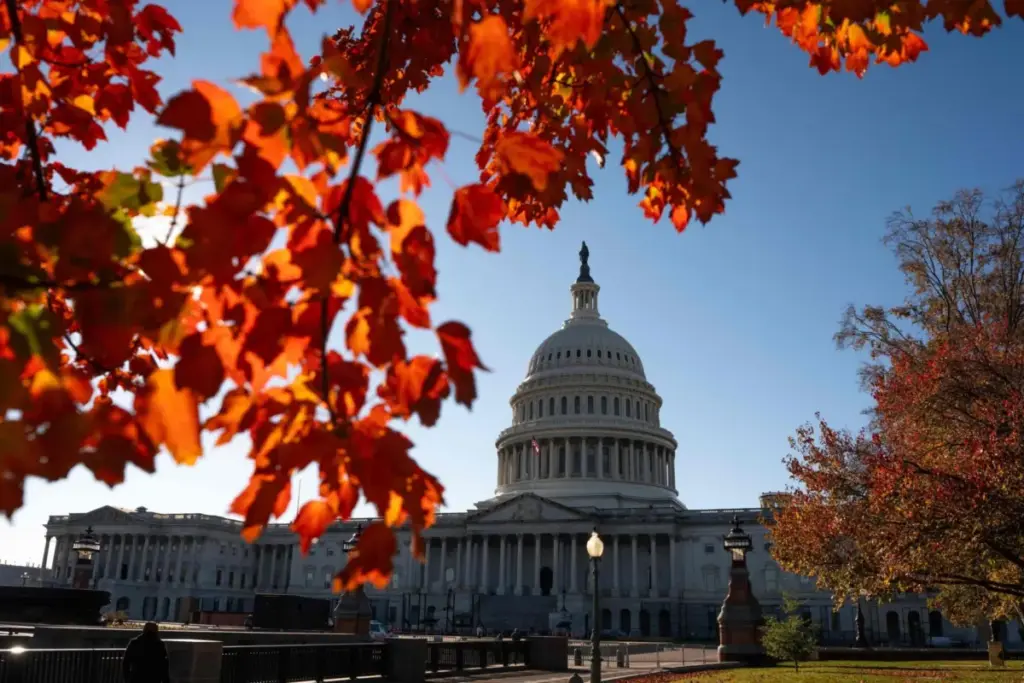
Americans headed to the polls on November 3 for a pivotal midterm election that dramatically reshaped the political landscape of Washington. In a stunning reversal of fortune following the previous presidential cycle, the Democratic Party secured a decisive majority of seats in both houses of Congress. Democrats seized control of both the Senate and the House of Representatives, locking down at least 54 seats in the upper chamber and surpassing the threshold in the House with at least 250 seats. Electoral maps and voting behavior analyses revealed a profound shift among the electorate, highlighting that a substantial block of voters who cast ballots for Republican candidates in the 2024 presidential election swung decisively toward Democratic candidates in these 2026 midterms.
The sweeping results caught many political observers, pollsters, and party strategists completely by surprise. A complex confluence of compounding socio-economic and geopolitical factors fueled this unexpected political earthquake. Chief among the domestic catalysts were worsening economic conditions marked by stubborn inflation, soaring gas prices, a deteriorating healthcare system, escalating grocery and food prices, and the mounting pressure of sweeping tariffs. Beyond these daily financial pressures, voters also expressed deep frustration with long-standing systemic issues, including persistent corruption claims, widening income inequality, and high-stakes foreign policy crises. Prominent among these international flashpoints were the devastating humanitarian crisis in Gaza and the escalating military entanglement involving the United States and Israel in a war against Iran.
In the wake of the electoral defeat, Vice President JD Vance publicly addressed the outcome, isolating four primary factors that he identified as the core drivers behind the Republican loss. Vance underscored that the American electorate had delivered a clear message, demanding that the administration bring an end to the ongoing military conflict against Iran, refocus its governing agenda squarely on the cost of living and soaring inflation, return to an unyielding "America First" posture, and fundamentally recalibrate the nation’s traditional relationship with Israel.
A deeper examination of these four factors reveals that they are inextricably linked to Israel’s profound influence on contemporary American domestic and foreign politics. The first factor highlighted by the administration—the joint U.S.-Israel military campaign against Iran—stands as a direct consequence of this dynamic. Diplomatic and defense analysts have widely noted that it was the Israeli government that actively motivated, lobbied, and persuaded the Trump administration to initiate active hostilities against Tehran. It remains transparent to international observers and domestic critics alike that no single state in the Middle East, including Iran, poses a direct, existential military threat to the United States. However, Tehran has long been perceived and framed as an ultimate security threat primarily by the Israeli government, pulling Washington into a regional conflict of choice rather than necessity.
The second factor cited by the administration, the intense public focus on deteriorating economic conditions and the crushing cost of living, is likewise largely a byproduct of the Iran war. Historically, many foreign military interventions and overseas wars waged by the United States have maintained a degree of separation from the daily routines of ordinary citizens, having relatively limited domestic economic friction. However, the conflict with Iran has fundamentally broken through that barrier, weaving itself directly into the daily lives of the American people. Whenever working families pull up to local gas stations to fill their fuel tanks, they instantly feel the economic fallout of the war at the pump, translating foreign policy decisions into immediate domestic pain.
The third factor, the imperative of putting America first, served as one of the central foundational mottos that propelled Republicans to victory in the 2024 general election. The core social contract of that campaign promised that the federal government would prioritize domestic American interests above all foreign entanglements. The ongoing subordination of these domestic priorities to the strategic concerns of Israel is now being openly questioned by voters across the political spectrum, signaling a severe erosion of public confidence in the administration. Numerous prominent American intellectuals, political commentators, and mainstream media figures have begun arguing that the foundational Make America Great Again, or MAGA, movement has effectively been subverted and replaced in practice by what critics dub "Make Israel Great Again," or MIGA.
The fourth and final factor, the urgent need to alter traditional relations with Israel, directly challenges the bedrock of historical bipartisan consensus regarding U.S. foreign policy in the Middle East. Growing opposition groups and grassroots coalitions are actively demanding that the federal government normalize and rationalize its bilateral relations with Israel. Critics from various political factions argue that Washington has essentially handed Israel a blank check, offering unconditional diplomatic and military backing, particularly as Tel Aviv pursued expansionist and aggressive policies toward neighboring regional countries.
A meticulous analytical breakdown of the midterm election results yields several profound takeaways regarding the current state of American democracy. First, the United States is officially navigating a new political reality characterized by the end of monolithic political parties. Neither of the two major mainstream parties operates as a unified bloc anymore; instead, both are fractured into distinct and often competing ideological wings. The Democratic Party remains coalition-based and divided among several distinct factions, while the Republican Party is visibly split between loyalist Trump supporters and a growing contingent seeking to distance themselves from the former president’s legacy.
Second, the election outcomes have powerfully demonstrated that U.S. domestic politics is more diversified and demographically complex than ever before. Traditional voting blocs have shifted, and communities outside the conventional political power structures—ranging from the progressive left and Black voters to rapidly growing Latino, Muslim, and Native American populations—have emerged as formidable, highly organized political actors capable of swaying national outcomes.
Third, the composition of the incoming legislative branch guarantees that the federal government will be forced to reevaluate and revise its foreign policy posture toward Israel. A significant cohort of newly elected senators and representatives captured their seats running explicitly on platforms featuring strong anti-Israeli rhetoric and demands for accountability in foreign aid.
Ultimately, political historians will likely look back on this midterm election as a definitive watershed moment in United States history. As the dust settles in Washington, the nation watches and waits to see how the new congressional majorities will translate these historic voter mandates into legislative action.
The views and opinions expressed in this article are solely those of the author. They do not necessarily reflect the editorial stance, values, or position of Daily Sabah. The newspaper provides space for diverse perspectives as part of its commitment to open and informed public discussion.