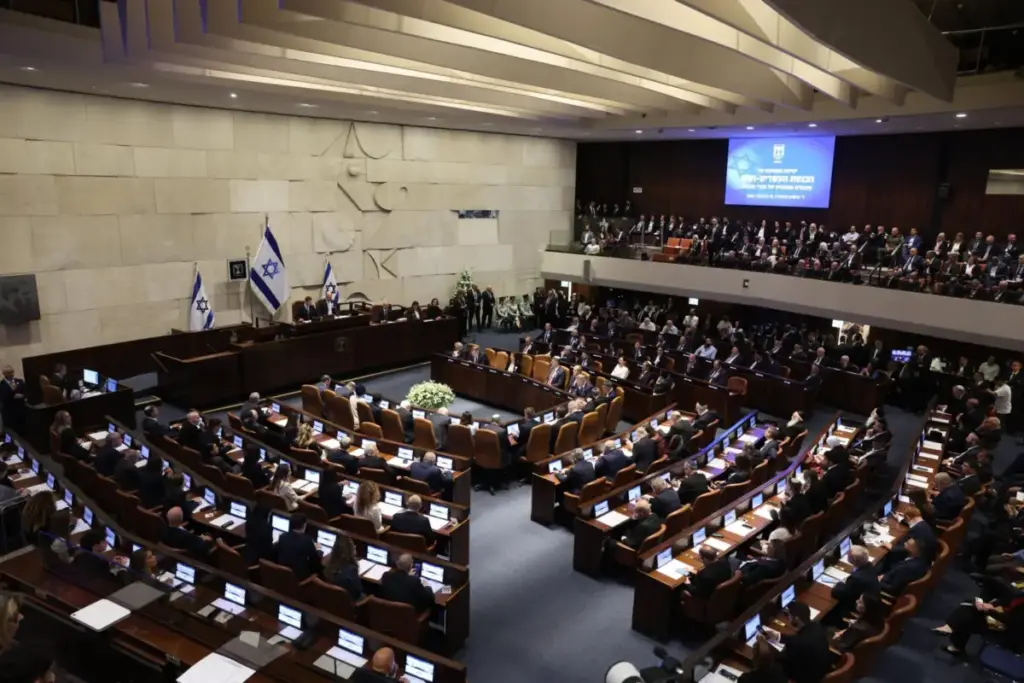
The political landscape remains deeply fractured. Neither Eisenkot nor his prospective allies command a working majority in the 120-seat parliament, and the designated prime minister has yet to successfully strike formal deals with the various political factions required to bring him to power. This intense stalemate has instantly raised the prospect that the newly sworn-in parliament could experience an extremely short lifespan. If both Eisenkot and Netanyahu ultimately fail to secure coalitions, the country could be forced into yet another unprecedented round of elections, exacerbating national exhaustion.
Presiding over the solemn swearing-in ceremony, President Isaac Herzog delivered an impassioned plea to the assembled lawmakers, urging them to prioritize national stability over partisan maneuvering.
"You must do everything to avoid a repeat election," Herzog told the plenum. "Reach out a hand for compromise, even between rivals. Look upon one another with generosity. There is much work to be done here, and it requires the ability and experience found in every part of this House."
Oct. 7 Probe
Until a new prime minister successfully navigates the complex coalition-building process and secures a parliamentary vote of confidence, Benjamin Netanyahu remains in office as caretaker prime minister. In the wake of the October vote, Netanyahu’s right-wing Likud party, alongside its traditional alliance of far-right and ultra-Orthodox factions, outperformed some pre-election projections but ultimately fell short of retaining its absolute majority. The bloc now controls 53 seats in the 120-seat Knesset.
On the other side of the political aisle, Eisenkot’s center-right Yashar party, working alongside a patchwork of partner factions, commands just 48 seats. However, Eisenkot possesses a critical block of potential outside allies: Israel’s Arab-led political parties, which hold a combined 19 seats in the Knesset. While these parties are not traditional coalition partners in Israeli politics, they share a unified stance with Eisenkot and his allies through their vehement, unyielding opposition to Netanyahu.
This numerical dynamic means that the newly sworn-in parliament could still advance key legislative objectives championed by Eisenkot during his campaign. Among the most prominent proposals is the potential establishment of a formal state commission of inquiry to investigate the catastrophic security and intelligence failures surrounding the October 7, 2023, Hamas incursion from the Gaza Strip. While an investigation is widely backed by the Arab-led parties and centrist factions, it has been largely resisted by Netanyahu and his political allies.
Furthermore, the new balance of power in the Knesset could allow Eisenkot and his supporters to replace the current Knesset speaker, who is a senior member of Likud, thereby altering the administrative control of the legislative body.
Eisenkot initially faces a deadline of December 6 to successfully assemble a government, though Israeli law permits him to request a two-week extension from the president, which would push the deadline to December 20. Eisenkot has publicly acknowledged that his path to securing power is extraordinarily complex.
His potential pathways to a government include several difficult alternatives: attempting to form a minority government backed externally by Arab parties; forging an unlikely coalition with ultra-Orthodox factions that he and his political allies have historically shunned; or negotiating a grand unity government alongside Netanyahu himself. All three of these pathways face formidable, and potentially insurmountable, political obstacles. So far, the ultra-Orthodox parties have maintained a rigid stance, stating publicly that they would refuse to join any administration led by Eisenkot.
For his part, Netanyahu has sought to challenge the legitimacy of the election results, casting doubt on the outcome by baselessly alleging voter fraud within Arab communities, which account for approximately one-fifth of Israel’s total population.
In response to these allegations, national election officials launched investigations into potential electoral misconduct. However, election authorities have consistently stated that they have uncovered no evidence of fraud or systematic irregularities that could have altered the final outcome of the vote.
Under Israel’s constitutional framework, if Eisenkot ultimately fails to form a government by his deadline, President Herzog is expected to turn to Netanyahu and give him the opportunity to try to build a coalition. If Netanyahu similarly fails, the mandate could be passed to another candidate from the Knesset. Should that individual also fail to secure a majority, the country would officially trigger a new round of national elections.
Amidst the tense political wrangling inside the Knesset plenum on Tuesday, the ceremony featured moments of stark personal and national resonance. Among those taking the oath of office was Elisha Madan, a military reservist who lost both legs during Israel’s military campaign in Gaza. Madan received a rare and emotional standing ovation from the entire parliament when he stood up to take his oath using his prosthetic legs.