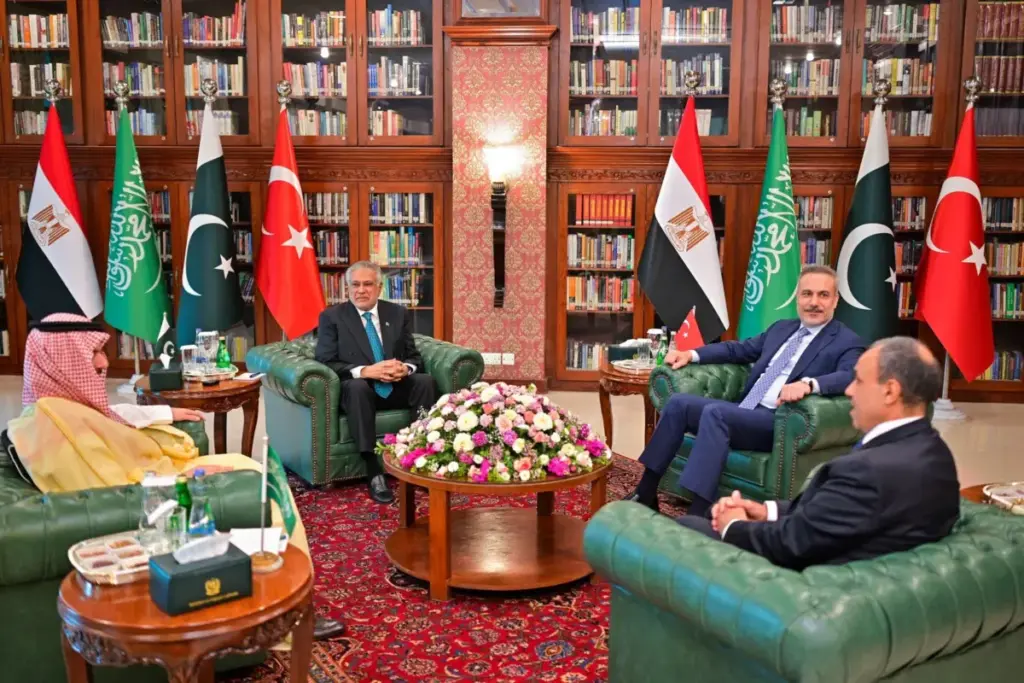
The foreign ministers of the four influential nations convened on the sidelines of high-level diplomatic engagements at the United Nations to discuss a wide array of urgent regional and international developments, according to an official joint statement released in the aftermath of the meeting. The gathering brought together key diplomatic figures to address an increasingly volatile security landscape marked by overlapping conflicts, humanitarian crises, and systemic threats to regional stability.
During their extensive discussions, the ministers stressed the critical need for closer consultation and enhanced coordination among their respective governments. They emphasized that unified diplomatic efforts are essential to promote lasting peace, security, and economic stability across the Middle East and the broader region, which has faced decades of recurring instability and geopolitical friction.
Against the backdrop of continued hostilities across multiple fronts, the ministers reiterated that dialogue and diplomacy remain the only viable and sustainable route toward a lasting settlement. They underscored the importance of upholding diplomatic frameworks, such as the Islamabad Memorandum of Understanding, as part of broader, concerted efforts to secure enduring regional peace and prevent further escalation between rival state and non-state actors.
A central component of the talks involved the security of Saudi Arabia. The four countries strongly condemned ongoing attacks targeting the kingdom, including recent Houthi strikes that have periodically threatened civilian infrastructure and energy installations. They expressed firm, unequivocal support for Saudi Arabia’s sovereignty, territorial integrity, and national security, viewing the kingdom’s stability as a pillar of wider regional order.
Furthermore, the ministers affirmed Saudi Arabia’s inherent right to defend its territory and population in accordance with international law and the United Nations Charter. In tandem with these security guarantees, they stressed the vital necessity of protecting the freedom and safety of navigation in critical regional waterways, which serve as vital arteries for global trade and energy transit.
Turning their attention to the prolonged conflict in Yemen, the ministers extended their full backing to the internationally recognized government and the Presidential Leadership Council. They called for security, stability, and development to be pursued diligently through a comprehensive political process and an inclusive dialogue among all Yemeni parties, emphasizing that a military solution is ultimately untenable for the war-torn country.
The Palestinian issue also featured prominently in the high-level talks, with the four nations describing a just and comprehensive resolution of the Israeli-Palestinian conflict as absolutely central to achieving lasting peace and stability throughout the Middle East. They warned that ongoing neglect of the Palestinian cause continues to fuel broader regional grievances and radicalization.
In this context, the ministers reaffirmed the historic and inalienable right of the Palestinian people to self-determination. They expressed strong backing for the establishment of an independent, sovereign, viable, and territorially contiguous Palestinian state along the pre-1967 borders, with East Jerusalem as its capital, in strict accordance with relevant United Nations Security Council resolutions and established international parameters.
Addressing another major flashpoint in the region, the ministers turned their focus to the devastating conflict in Sudan. They expressed steadfast support for the country’s sovereignty, unity, independence, and territorial integrity, emphasizing the utmost importance of preserving its legitimate national institutions from collapse or fragmentation.
In a strong rejection of forces threatening the Sudanese state, the ministers firmly opposed the creation of parallel governing structures that could further undermine Sudanese sovereignty and accelerate state failure. They also issued an urgent call for an end to the illicit movement of weapons, mercenaries, and foreign fighters into the conflict-hit country, warning that external interference is exacerbating civilian suffering and prolonging the civil war.
Concluding their engagements in New York, the four foreign ministers agreed to maintain regular consultations and strengthen ongoing coordination regarding evolving regional and international developments. They placed special emphasis on collective security and long-term stability, pledging to keep diplomatic channels open as they navigate the complex and interconnected crises facing the Middle East and North Africa.