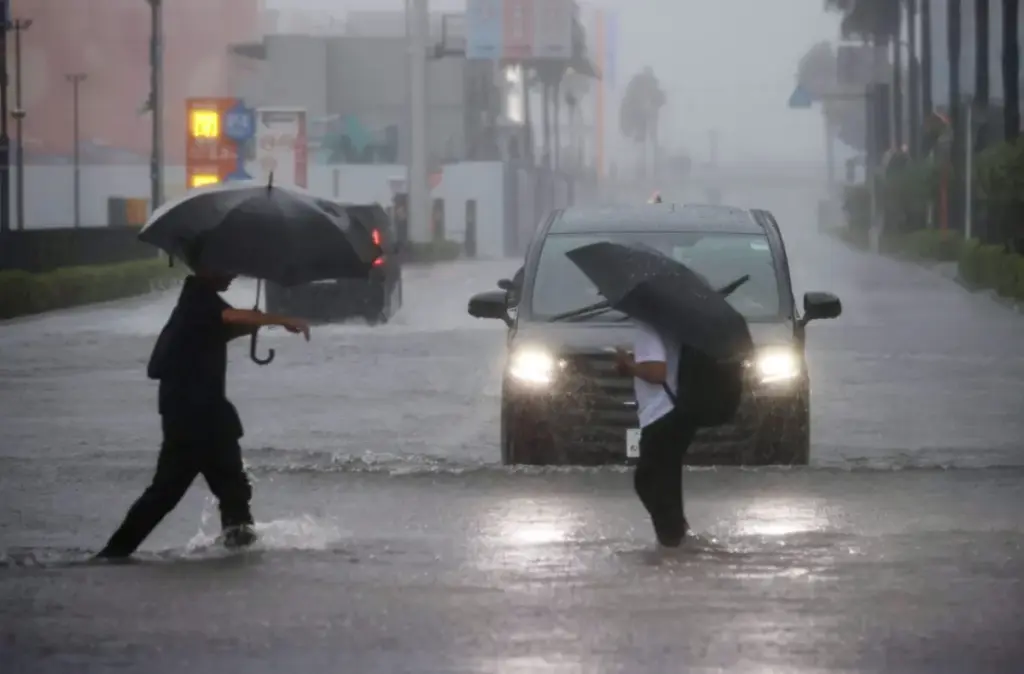
Typhoon Dujuan unleashed its fury on the Tokyo region early Tuesday, bringing torrential rainfall, howling winds, and severe disruptions that prompted evacuation advisories for more than one million residents. The powerful storm triggered dangerous flooding and life-threatening landslides across parts of Japan, resulting in at least two confirmed fatalities and widespread logistical paralysis in the country’s most densely populated metropolitan area.
According to local governments and Japanese media reports, including the Kyodo news agency, the two confirmed deaths occurred as heavy, relentless rainfall triggered sudden landslides in the Chiba and Kanagawa prefectures, located just outside of Tokyo. The treacherous weather conditions highlighted the vulnerability of the region as the storm made its presence felt across the eastern seaboard of the country.
Japan frequently experiences severe typhoons during the late summer and early autumn months, a seasonal pattern deeply familiar to its residents and infrastructure planners. However, the timing of Dujuan compounded ongoing seasonal disruptions, as other recent storms had already impacted schedules and events at the Asian Games being hosted within the country.
Meteorological tracking indicated that Dujuan was packing maximum sustained winds of approximately 144 kilometres, or 89 miles, per hour on Monday. At that time, the center of the storm was located roughly 130 kilometres south of Katsuura City, near Tokyo, moving steadily northward and threatening to unleash its full destructive potential on the capital and its surrounding prefectures.
By early Tuesday morning, however, the storm had begun to shift away from the coastline, tracking northeastward out to sea. The Japanese Meteorological Agency (JMA) reported that the typhoon was moving away with slightly diminished winds, offering a measure of relief to a region that had spent the previous twenty-four hours on high alert.
Despite the storm’s departure from the immediate coast, the transport and infrastructure sectors suffered immediate and extensive impacts. Japan Airlines took the precaution of cancelling 135 flights, while rival carrier All Nippon Airways scrapped 140 flights, leaving thousands of travelers stranded or scrambling to alter their itineraries. Additionally, more than 9,000 households in areas near Tokyo were left without electrical power as high winds and falling debris damaged local power lines and distribution networks.
The human toll and potential threat prompted swift action from municipal authorities. According to the Fire and Disaster Management Agency, more than 1.6 million residents in and around the capital were urged to evacuate their homes on Monday. While these evacuation orders and advisories were not legally mandatory, they reflected the severe nature of the threat posed by the advancing weather system.
Compounding the crisis, landslide warnings were officially issued for Tokyo itself, as well as for the surrounding prefectures of Chiba, Kanagawa, and Shizuoka. In response to the escalating hazards, major railway operators in Tokyo and neighboring regions took the precautionary step of suspending services on multiple commuter lines, cutting off key transportation arteries and further restricting movement across the metropolis.
Addressing reporters as the storm system continued to evolve, Takuya Hosomi of the Japanese Meteorological Agency emphasized the lingering dangers. In areas where official warnings had already been issued, he noted, there remained a persistent risk that heavy rainfall would continue even as the core of the typhoon tracked further north, maintaining saturated soil conditions and elevated flood risks.
The JMA had raised alarms as early as Sunday, warning the public that torrential rain and fierce winds were expected to intensify significantly even before the physical arrival of the typhoon’s center. In its pre-storm briefings, the agency issued stark projections, stating that the total cumulative rainfall through Tuesday could easily exceed the average monthly rainfall expected for the entire month of September, culminating in record-breaking heavy rain events across the affected zones.
The disruptive reach of Typhoon Dujuan extended far beyond transportation and residential areas, forcing the premature truncation of major public events and commercial exhibitions. The Tokyo Game Show, celebrated internationally as one of the world’s largest and most prominent video-game trade fairs, was forced to close its doors early on Monday, which was scheduled to be the final day of the massive exhibition.
Similarly, organizers of a major outdoor music festival and a scheduled professional baseball match, both of which were slated to take place in Chiba Prefecture, were forced to cancel the events entirely to ensure public safety in the face of the worsening weather conditions.
As the storm passed over, visual evidence of its severity quickly surfaced across social media platforms. Photographs and video footage depicted streets completely submerged in water directly in front of Kamakura station, a renowned sightseeing and tourist destination known for its historical landmarks.
The flooding in Kamakura prompted direct local government appeals. Takashi Matsuo, the Mayor of Kamakura City, issued urgent warnings on the social media platform X, formerly known as Twitter. Mayor Matsuo stated that there was severe flooding occurring in various parts of the city and explicitly warned residents and visitors that traveling by car had become dangerously hazardous.
In addition to the tourist hub of Kamakura, heavy flooding also inundated multiple residential and commercial sections of Ichikawa city, located directly east of Tokyo, as local drainage systems struggled to cope with the immense volume of water delivered by the relentless downpours.