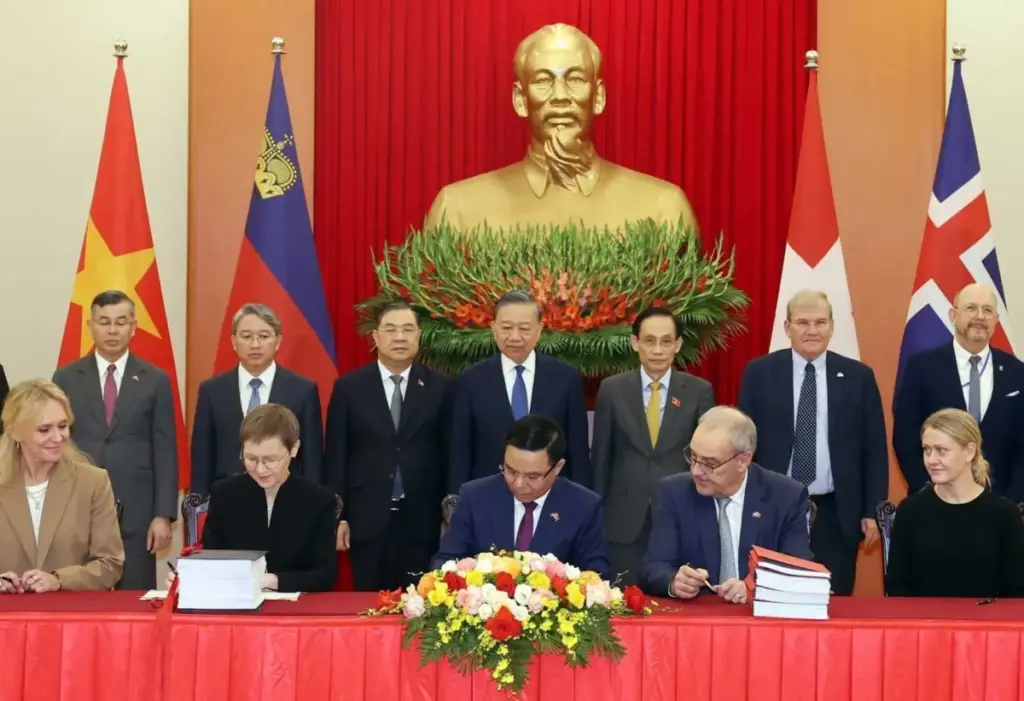
HANOI — Seeking to diversify their markets and fortify economic cooperation in the face of persistent global trade disruptions and intensifying U.S. tariff pressures, Vietnam and four European nations outside the European Union bloc inked a comprehensive free trade agreement in Hanoi on Sunday.
The strategic trade pact, concluded between Southeast Asia’s fastest-growing economy and the European Free Trade Association (EFTA)—which comprises Iceland, Liechtenstein, Norway, and Switzerland—aims to eliminate or significantly reduce customs duties across a wide array of sectors. Under the terms of the newly signed accord, tariffs will be systematically lowered or completely phased out on a broad spectrum of goods, including industrial items, fisheries, and agricultural products.
The high-stakes signing ceremony took place in the Vietnamese capital, attended by Vietnam’s top leader, To Lam, alongside senior representatives and trade officials from the respective EFTA member governments.
In a joint government statement released following the signing, Vietnam emphasized that the agreement serves as a concrete demonstration of the participating parties’ steadfast resolve to reinforce the rules-based international trading system, particularly amid a period of continued volatility and uncertainty in the global economy.
The accord is widely anticipated to provide a substantial boost to Vietnam’s broader economic objectives. Specifically, the government noted that the pact will help the nation diversify its import and export markets, mitigating risks associated with over-reliance on a small number of commercial partners, while simultaneously enabling the country to integrate more deeply into complex global value chains.
The path to Sunday’s signing ceremony was marked by protracted negotiations that spanned well over a decade. Vietnam and the EFTA officially launched their free trade talks back in 2012. After years of careful diplomatic and economic maneuvering, the negotiations experienced a prolonged stall beginning in 2018. However, momentum was successfully revived when the two sides officially relaunched discussions in September of last year, culminating in the conclusion of negotiations this past July.
The finalization of the agreement arrives in the wake of a sweeping, global trade-disrupting tariff blitz initiated by the United States under President Donald Trump. That aggressive trade policy left Vietnam contending with hefty taxes on its exports to the U.S. market, a challenge that persists amidst ongoing, complex trade negotiations between Hanoi and Washington.
International trade experts and political analysts point out that the newly minted deal reflects a shared, proactive initiative by Vietnam and the EFTA states to diversify their commercial relationships and build resilience against external economic shocks.
"As the U.S. increasingly exerts trade pressure on European countries, the agreement is a joint effort to turn economic integration into greater strategic autonomy and to develop alternative commercial relationships rather than relying exclusively on their largest partners," explained history and politics scholar Do Dinh Lam Khang in an interview with Agence France-Presse (AFP).
For Vietnam, forging closer and more formal economic ties with the advanced, highly specialized economies of the EFTA could also provide vital institutional and technological support for its national ambition to transition away from low-cost manufacturing and move upward into higher-value-added industrial and technological activities, Khang added.
Beyond the immediate tariff cuts on goods, the comprehensive agreement establishes a modern framework governing a broad spectrum of commercial interactions. According to both parties, the accord covers trade in both goods and services, robust protections for intellectual property rights, effective trade remedies, and provisions dedicated to sustainable development, labor standards, and environmental protection.
Economic ties between the EFTA nations and Vietnam have already established a solid foundation. Last year, bilateral trade between the European association and the Southeast Asian manufacturing hub was valued at approximately 4.8 billion euros, which translates to roughly $5.4 billion, according to figures provided by the EFTA.
Trade data from the previous year highlights the complementary nature of the economies involved. The primary exports from the EFTA nations to Vietnam included high-tech electrical machinery, specialized mechanical machinery, fish and seafood products, and advanced pharmaceutical goods. Conversely, Vietnam—firmly established as a major global manufacturing and assembly hub—primarily exported manufactured machinery, footwear, and apparel to the four EFTA member states.
The European Free Trade Association has a distinct historical background within the European geopolitical landscape. It was originally established decades ago as an intergovernmental trade organization and counterpart to the European Economic Community, which served as the direct precursor to the modern European Union. While Iceland, Liechtenstein, Norway, and Switzerland maintain remarkably close economic, regulatory, and political alignments with the EU bloc and participate in the wider European single market through various arrangements, they have historically chosen to remain outside of the European Union itself, preserving their independent trade policy frameworks that allow them to independently negotiate agreements such as the one finalized in Hanoi on Sunday.