For artists Ananth Ramaswamy and Devi Seetharam, the collaborative journey to create a new contemporary commission for the Victoria and Albert Museum (V&A) in London began across vast geographic divides. For months, their meticulous research into the historic Cochin Ceiling—a magnificent 19th-century carved polychromed teak coffered ceiling originating from a temple in Kerala, India—had to be conducted entirely at a distance. Relying on photographs, architectural drawings, digitized museum archives, and digital conversations, the pair laid the groundwork for a project that aims to bridge historic South Asian craftsmanship with contemporary artistic expression.
However, a pivotal milestone was reached when Devi arrived in London, marking the very first opportunity for the two creators to work together in person on the V&A Cochin Ceiling commission. This long-awaited face-to-face meeting transformed their academic and digital investigation into a tangible, deeply immersive physical experience.
Initially, their collaborative research focused heavily on studying the diverse articulations of the lotus motif within the traditional arts and architecture of Kerala. As they contemplated the complex journey and eventual recontextualization of the historic ceiling as a whole within the museum environment, their inquiry naturally expanded. They began to explore how the lotus has been conceptualized, represented, and approached across the broader expanse of the V&A’s world-class collection, spanning myriad historical periods, geographic regions, and cultural traditions. Yet, Devi’s physical presence in London allowed the duo to transcend the limitations of remote understanding, shifting their artistic perspective into something far more expansive, nuanced, and sensitive to the material realities of the objects they study.
Seeing the Ceiling in Person
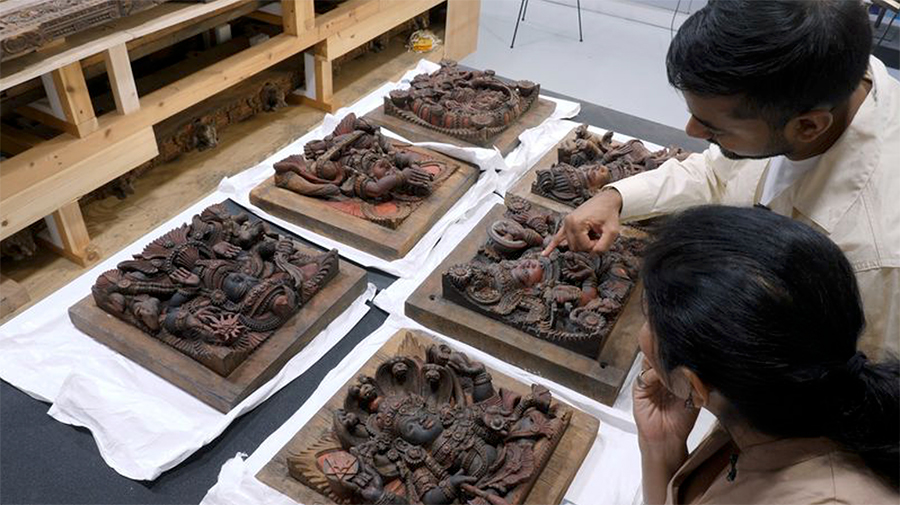
The core of their London residency began with a behind-the-scenes visit alongside the museum’s wider project team to examine the historic Cochin Ceiling while it undergoes specialized conservation. Encountering the monumental artifact in the flesh fundamentally altered their perceptions and artistic approach.
While the sheer scale of the coffered ceiling was immediately apparent, up-close observation revealed a multitude of finer, easily overlooked details. The artists noted the remarkable depth and intricacy of the woodwork, the structural intricacies of the transverse framework holding the individual carved panels together, and the subtle yet distinct variations between individual pieces. Most importantly, they were able to witness firsthand the vibrant polychrome colors gradually emerging through the meticulous cleaning processes being undertaken by the V&A’s conservation specialists.
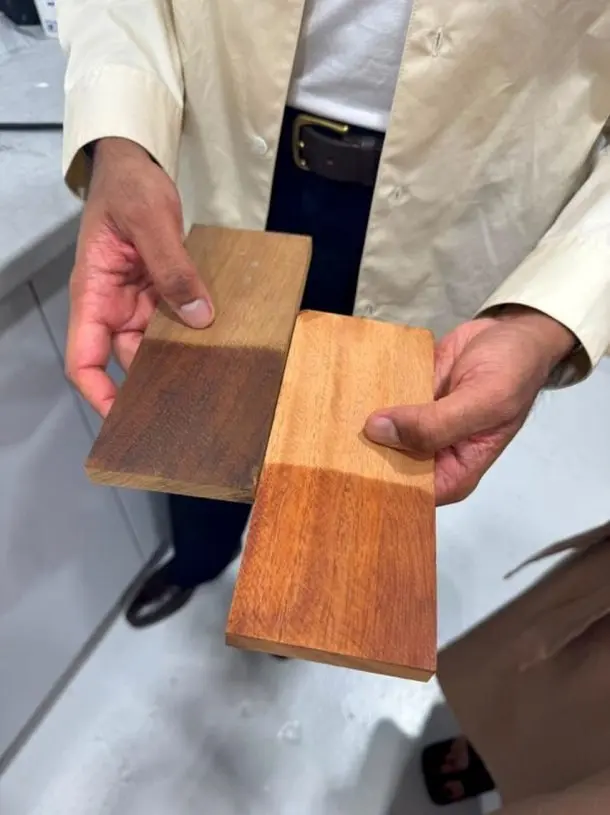
Working side by side with the conservation team also afforded the artists a rare opportunity to carefully consider how the materiality of their own contemporary intervention might harmonize with the original historic fabric. The creators came prepared with a curated selection of timber samples, including various woods commonly utilized by artisans for traditional carving in India today, alongside a range of oils and stains. By placing these material samples directly against the historic teak, they could evaluate how different finishes would sit alongside the 19th-century masterpiece.

While the historic ceiling is predominantly crafted from teak, observing the authentic polychromy in person challenged their initial assumptions about material matching. They discovered that attempting an exact timber match might not necessarily yield the most sympathetic visual response. Darker wood samples tended to recede more quietly into the background, whereas warmer timbers subtly complemented the rich palette of colors being gently revealed through the ongoing conservation work.
Exploring the Collection
The scope of the artists’ research visit extended far beyond the confines of the conservation studio and the ceiling itself. During their time at the museum, Ramaswamy and Seetharam engaged with specialists from numerous departments and areas of curatorial expertise, each contributing valuable insights that helped shape a more holistic and respectful approach to the commission.
A significant portion of their residency was spent navigating the V&A’s public galleries, behind-the-scenes archives, and secure storage facilities, where they closely examined more than a hundred distinct objects. Some of these artifacts had been intentionally pre-selected due to a recognized relationship to their ongoing research topics, while others unexpectedly revealed profound significance only upon direct, physical encounter.

The freedom to keep their investigative process remarkably open proved to be a major highlight of the residency. For instance, inspecting a glazed ceramic bowl up close might reveal a delicate surface indentation or texture that had been entirely invisible in digital photographs. Similarly, examining a small historical metal object could suggest an innovative design strategy for reducing a complex floral motif, such as a lotus petal, down to its most essential, elegant lines. Through this immersive observation, crucial artistic variables—including material translucency, subtle structural distortion, surface texture, line weight, and dramatic shifts in scale—entered organically into their ongoing creative dialogue.
Throughout these gallery and storage sessions, Devi actively sketched while historical artifacts were carefully retrieved from secure storage, allowing both artists to study craftsmanship at microscopic quarters. Objects that had appeared monumental and imposing in digital archives were occasionally revealed to be unexpectedly tiny in reality, while seemingly simple items demonstrated astonishing nuance, depth, and complexity when handled and observed in three dimensions.
A Way of Looking
Reflecting on their intense period of research, both artists emphasized the immense value of being granted the institutional time and institutional support to simply observe, question, and follow unexpected creative threads. Rather than rushing to locate a specific traditional motif and immediately translating it into a predetermined contemporary design, they were given the rare freedom to immerse themselves in prolonged, contemplative looking. Consequently, their initial encounter with the Cochin Ceiling evolved into something much deeper than a search for quick answers; it became the foundational development of a shared methodology—a specific way of looking and thinking that will profoundly inform their creative output throughout the duration of the commission.

This contemporary artistic commission forms an integral part of the ambitious, comprehensive transformation of the V&A’s renowned South Asia Gallery, which is scheduled to officially open to the public in 2028. The extensive refurbishment and reimagining of the South Asia Gallery has been made possible through generous financial support from prominent cultural funding bodies and private philanthropists, including The National Lottery Heritage Fund, the Dunard Fund, Mandakini Puri, and numerous other dedicated donors committed to preserving and sharing global heritage with the broadest possible audience.