Even as the decorations for Halloween come down and the autumn nights grow longer, the spirit of the spooky season remains alive within the archival collections of the Victoria and Albert Museum. To celebrate the enduring allure of the macabre, curators are drawing attention to a selection of terrifying treasures held within the National Art Library collections at the newly established V&A East Storehouse.
With approximately 300,000 library books housed at the Storehouse—spanning diverse subjects such as theatre and performance, local history, British topography, and historic children’s literature—there is no shortage of eccentric, rare, and wonderfully bizarre publications available for public and academic research. The seven distinct titles recently highlighted by library staff represent just a fraction of these frightful favorites, all of which are accessible to view by appointment in the Storehouse Study Centre.
Harrap’s Guide to Famous London Graves by Conrad Bailey (1975)
It stands to reason that a metropolis as ancient and vast as London would possess a rich, complex history of burial grounds and high-profile interments. Conrad Bailey’s 1975 guide navigates some of the most famous graves across the City of London and beyond, offering readers a roadmap through centuries of urban mortality.
The publication explores London’s "magnificent seven"—the expansive garden cemeteries constructed by the Victorians during the 19th century to alleviate dangerous overcrowding and unsanitary conditions in traditional parish churchyards. Ranging from these sprawling Victorian landscapes to medieval churchyards, the book charts the final resting places of historical figures from all walks of life, including monarchs, notorious criminals, esteemed artists, and poets. Among the illustrious names cataloged within its pages are political theorist Karl Marx, visionary poet and artist William Blake, novelist George Eliot, and the V&A’s very own founding figure, Henry Cole. The volume serves as a reminder of how deeply intertwined the capital’s architectural history is with the commemoration of the dead.
Sarah Bernhardt: Cuttings Albums Relating to Her Death and Funeral (2-Volume Set, 1923)
Few figures in cultural history have embraced the theatricality of mortality quite like Sarah Bernhardt. As a celebrated French tragedienne of the late 19th and early 20th centuries, she grew accustomed to staging her own demise night after night before captivated audiences. However, her fascination with death extended far beyond the footlights; she famously kept a satin-lined coffin in her bedroom, occasionally sleeping in it, resting inside while preparing for dramatic roles, and posing for photographs alongside it to cultivate her darkly romantic public persona.
When Bernhardt passed away in 1923 at the age of 78, her death prompted an immense public outpouring. An estimated crowd of 30,000 mourners gathered to witness her funeral procession across Paris to Père Lachaise Cemetery, pausing at the Sarah Bernhardt Theatre along the route. The National Art Library holds a two-volume scrapbook compiled by an anonymous admirer, meticulously collecting contemporary obituaries, press clippings, and articles that documented both her extraordinary theatrical career and her elaborate funeral procession. The scrapbooks capture the grandeur of the final send-off, which featured extravagant floral arrangements, plumed black horses pulling the funeral cortege, and a massive entourage of grieving fans and colleagues.
Emblems of Mortality: Representing, in Upwards of Fifty Cuts, Death Seizing All Ranks and Degrees of People by John Bewick after Hans Holbein (1795)
For researchers delving into the history of graphic arts and allegorical imagery, a pocket-sized 1795 volume offers a striking encounter with historical representations of mortality. Jam-packed with skeletal figures, Emblems of Mortality features wood-engraved reproductions of Hans Holbein’s famous Dance of Death series, which was first published in 1538.
The Dance of Death, or Danse Macabre, was a prominent allegorical genre during the late Middle Ages. In these works, a personification of Death—universally depicted as a skeleton—invites representatives from every tier of society, from lowly peasants to powerful emperors, into a relentless dance leading toward the grave. Produced as physical reminders of human mortality, or memento mori, these images carried a democratic message: regardless of one’s wealth, status, or position in society, death acts as the ultimate equalizer.
The wood engravings in this 18th-century edition were executed by John Bewick, an engraver whose brother, Thomas Bewick, is widely celebrated as a pioneer of the medium. Thomas gained widespread acclaim for the fine lines and naturalism of his animal illustrations in works such as A History of British birds. John Bewick completed an apprenticeship under his brother before establishing an independent career focused primarily on illustrating children’s literature. Tragically, John passed away at the age of 35, cutting short an artistic career that was only beginning to earn independent renown.
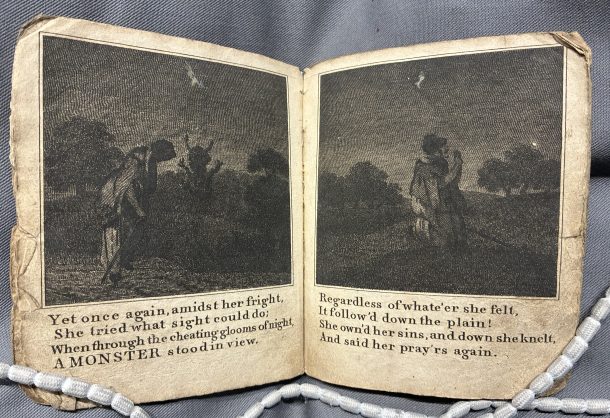
The Fakenham Ghost: A True Tale by Robert Bloomfield (1806)
Exploring the psychological tricks played by darkness and isolation, Robert Bloomfield’s The Fakenham Ghost recounts an eerie narrative set in the Norfolk countryside. The poem follows a nighttime journey home through rural landscapes, shadowed by an unseen and seemingly threatening presence. Though the encounter initially terrifies the protagonist, Bloomfield’s verse skillfully balances mounting tension with subtle humor, a duality reflected in the accompanying unsigned illustrations that play with contrasts of light and shadow. While atmospheric and spooky, the prints offer subtle visual clues early on regarding the true identity of the "ghost"—hinting that the haunting apparition may simply be a harmless stray donkey.
Robert Bloomfield was a self-taught poet and former shoemaker from Suffolk whose pastoral poetry garnered significant critical praise during his lifetime. The Fakenham Ghost was originally published in 1802 as part of his broader collection, Rural Tales. The 1806 edition held in the National Art Library was published by William Darton, a prominent London publisher who specialized in literature for children, bridging the gap between adult poetry and youthful accessibility.
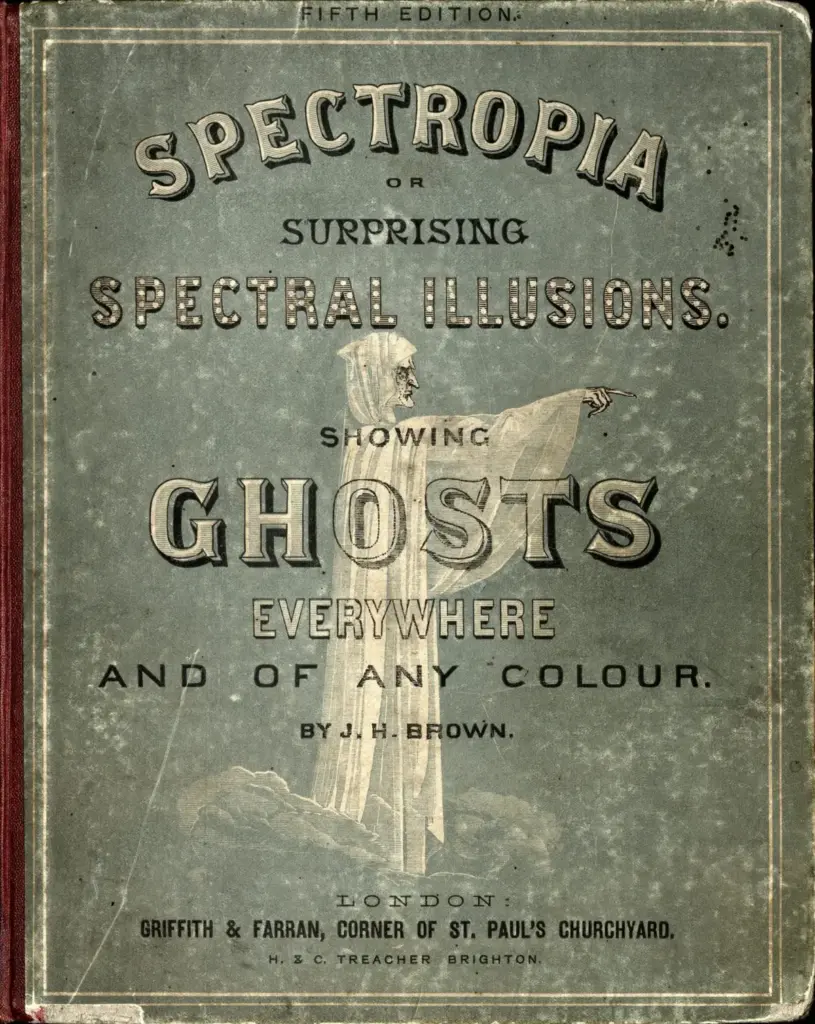
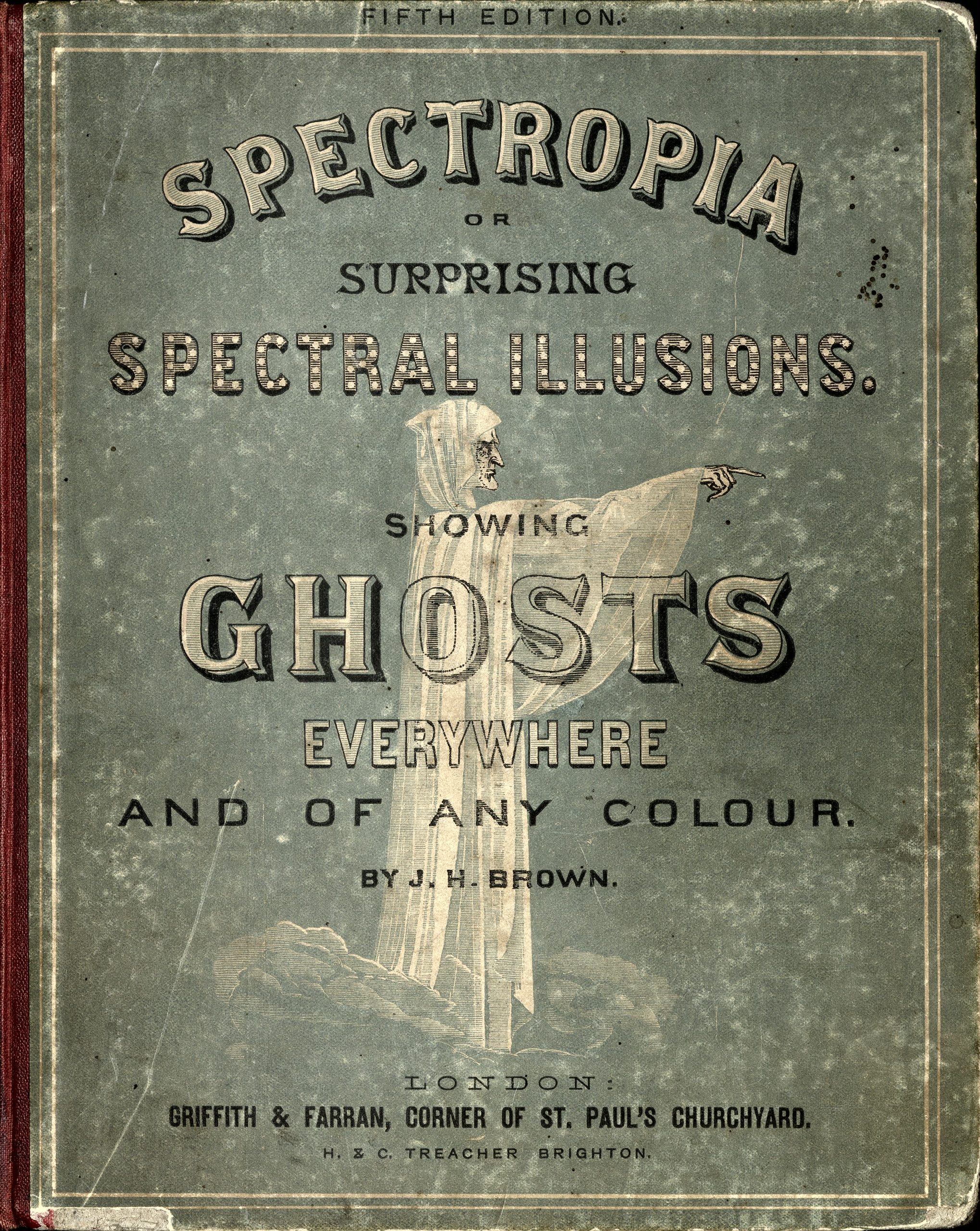
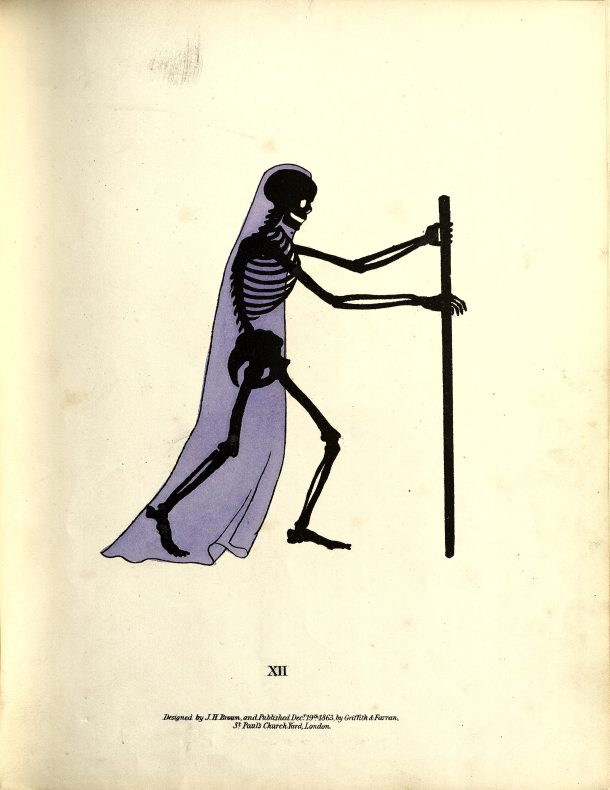
Spectropia, or, Surprising Spectral Illusions: Showing Ghosts Everywhere, and of Any Colour by J. H. Brown (1864)
The 19th century witnessed a significant cultural surge in Spiritualism—the religious and philosophical belief that the living could communicate with the departed, typically mediated through seances and spiritual practitioners. J. H. Brown, author of the 1864 publication Spectropia, viewed this trend with deep skepticism and set out to demonstrate that reported ghost sightings were nothing more than easily explained optical illusions.
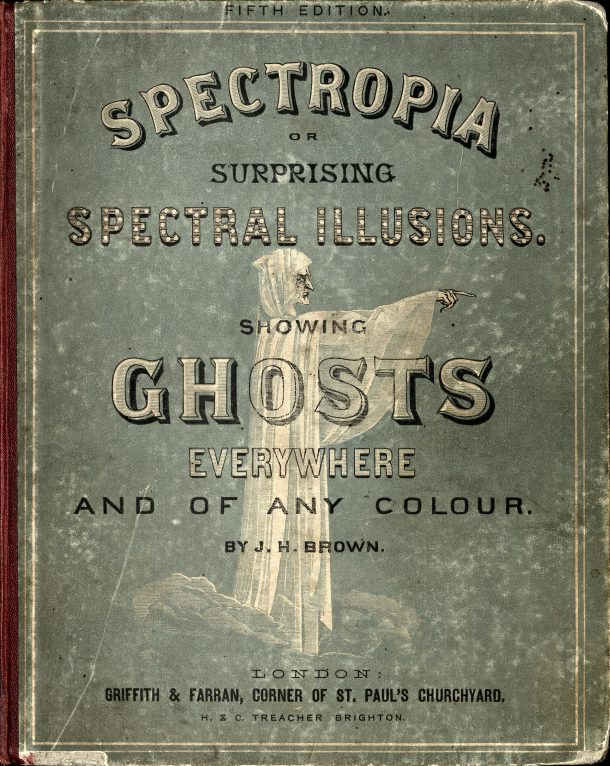
Following a sharp introductory critique condemning the "absurd follies" of the Spiritualist movement, the book presents 16 lithographed plates, 13 of which are hand-colored, specifically engineered to produce vivid afterimage illusions. Readers were instructed to stare fixedly at a marked point on an illustration under strong illumination for approximately 20 seconds. Upon shifting their gaze to a blank wall or ceiling, an eerie "ghost" would appear in inverted colors due to the physiological afterimage effect, a phenomenon where visual perception persists after the initial light stimulus ceases.
By providing a scientific breakdown of optics, color theory, and human eye anatomy, Brown hoped to eradicate superstitious beliefs regarding supernatural apparitions. Nevertheless, the volume was frequently marketed as a novelty toy book or parlor game for children. Today, copies reside securely within the Children’s Books collection at the National Art Library, leaving modern visitors to ponder whether spectral encounters are genuine manifestations or merely tricks of the visual system.
The Haunted Library: A Novocastrian Reminiscence by John F. Layson (1880)
Libraries are, by their very nature, repositories of voices from the past, echoing whenever a historic volume is retrieved from the shelf. This concept forms the foundation of John F. Layson’s 1880 publication, The Haunted Library. Written in verse and set within the shadowy stacks and hallowed reading rooms of the Newcastle City Library, the narrative follows a perplexed doctor who unexpectedly stumbles upon a ghostly assembly of literary history’s most celebrated figures.
Eerie, enigmatic line-block illustrations accompany the text as legendary authors such as Geoffrey Chaucer and William Shakespeare materialize for an otherworldly debate concerning the evolution of literature and the enduring power of libraries. Adding a layer of archival mystery to the V&A’s specific copy, a handwritten letter of correspondence is tipped into the volume. Dated December 28, 1880, and addressed to an anonymous "Dear Doctor," the letter is signed by W. J. Haggerston, the Chief Librarian at Newcastle Library, prompting researchers to wonder whether Layson’s spectral tale was rooted in actual local lore.
Haunted House by Jan Pieńkowski (1971)
Moving from haunted public institutions to domestic terrors, Jan Pieńkowski’s Haunted House demonstrates an extraordinary feat of paper engineering. Through complex layered illustrations and mechanical folds, the book guides readers through a physical landscape of pop-up horrors.
Recognized as one of the best-selling movable books in publishing history, Haunted House earned its creator the prestigious Greenaway Medal in 1979. The traditional pop-up mechanisms are paired with Pieńkowski’s signature graphic art style, creating a tactile and immersive reading experience. While perhaps best remembered today for his beloved children’s picture book series Meg & Mog, Pieńkowski was a prolific illustrator, writer, and designer of interactive books, many of which are preserved across the library’s holdings.
Researchers, students, and curious members of the public wishing to examine these works can access them at the V&A East Storehouse Study Centre. The facility is open to National Art Library readers from Monday to Wednesday by appointment. Those interested in arranging a visit or browsing the wider catalog can contact the library team directly to explore the collections for academic study, creative projects, or personal research.