When an archivist begins a new professional chapter immersed in historical records, unexpected personal connections often emerge. For the V&A Wedgwood Collection’s newest Archives Cataloguer, who stepped into the role in April 2026, that connection walked straight out of childhood memories on the Yorkshire Coast. Hours spent scouring beaches for interesting rocks, polished sea-glass, and unique marine specimens laid the groundwork for a delightful professional revelation: seashells are a deeply recurring, foundational theme across centuries of Wedgwood production.
This lifelong fascination with the treasures of the shore mirrors the passions of the company’s legendary founder. Established in 1759, the Wedgwood company was built on the vision of Josiah Wedgwood I (1730–1795), a potter widely celebrated for his master craftsmanship and relentless experimentation. Yet, beyond his immense contributions to ceramic history, Josiah possessed a polymathic curiosity that stretched across chemistry, botany, drawing, and design. He held a profound fascination for the natural world, which naturally channeled into specialized interests in conchology—the study and collection of shells—and palaeontology.

The 18th-Century Craze for "Shell Fancying"
During the 18th and 19th centuries, conchology was far from a niche scientific pursuit; it was a cultural phenomenon among the wealthy elite. Often referred to affectionately by Josiah Wedgwood as "shell fancying," enthusiasts would avidly collect, trade, and display elaborate arrangements of marine specimens, occasionally even incorporating them directly into decorative artworks.
This widespread enthusiasm provided fertile ground for commercial design. Josiah’s personal passion for conchology directly inspired a multitude of early Wedgwood wares. Surviving documents, such as the late 18th-century Wedgwood Shape Books, preserve a diverse inventory of shell-inspired forms. This period coincided with a soaring public demand for Rococo styles, which favored organic motifs, asymmetrical lines, and "rocaille" decorations—a French term derived from the irregular shapes of rocks and broken seashells.

Among these archival records is a shape sheet presenting sketched designs for the Wreathed Shell Dessert Set, accompanied by a list of the technical names of the shells that served as the primary inspiration. Sketches and surviving artifacts from this era demonstrate that the Argonauta Argo shell, universally known as the "Paper Nautilus," captured the imagination of designers and consumers alike, remaining in production well into the 20th century.
Royal Patrons and Exquisite Tableware
The versatility of shell-inspired ceramics expanded rapidly as Wedgwood’s manufacturing techniques evolved. Another remarkable example from this formative period is a hand-painted Queen’s ware dish, part of the comprehensive Husk Service manufactured in 1770. This complete dinner and dessert service was commissioned by Empress Catherine II of Russia (1729–1796), a prominent royal figure who shared a passionate appreciation for conchology.

As production capabilities grew, Wedgwood ventured into new mediums. Beginning in 1776, the Staffordshire factories began producing plain, printed, enamelled, and painted tiles. The natural world heavily influenced these architectural and decorative elements, with shell motifs appearing repeatedly in the company’s tile pattern books. Tile manufacturing at the historic Etruria factory—which served as Wedgwood’s operational heart from 1769 to 1950—continued until 1902, when a broad industry-wide decline forced the closure of the tile department.
Despite the eventual shuttering of the tile division, successful decorative patterns transcended their original mediums. Certain shell tile designs found new life when translated onto functional tableware, such as intricate, scallop shell-shaped plates crafted from fine bone china during the late 19th century.

Innovation in Jasperware and Majolica
Shell motifs also found an iconic home within Wedgwood’s signature jasperware. Developed by Josiah Wedgwood I during the 1770s and perfected by 1775, jasperware is a fine-grained, unglazed white stoneware that can be permanently dyed in various pastel and bold shades through the addition of metal oxides. The creation of jasperware was the triumphant result of thousands of meticulous experiments, ultimately yielding a material celebrated for its smooth, matte finish and suitability for applied white relief ornamentation.
Among the early applications of this innovative material were colourful jasperware tea caddy spoons produced around 1768. During an era when tea drinking had become an absolute craze among the burgeoning middle classes, the demand for specialized tea-related wares skyrocketed. Wedgwood met this commercial appetite by molding delicate tea caddy spoons directly in the form of Pecten (scallop) shells.

As the Victorian era progressed, the fascination with conchology evolved into what contemporaries dubbed "conchylomania." To capture this insatiable market, the Wedgwood company continually refreshed its product lines. By 1879, artisans at Etruria were producing vibrant majolica-glazed creamware, including teapots and sugar bowls richly decorated with tactile seashell and coral motifs.
Archival Protection and 20th-Century Revivals
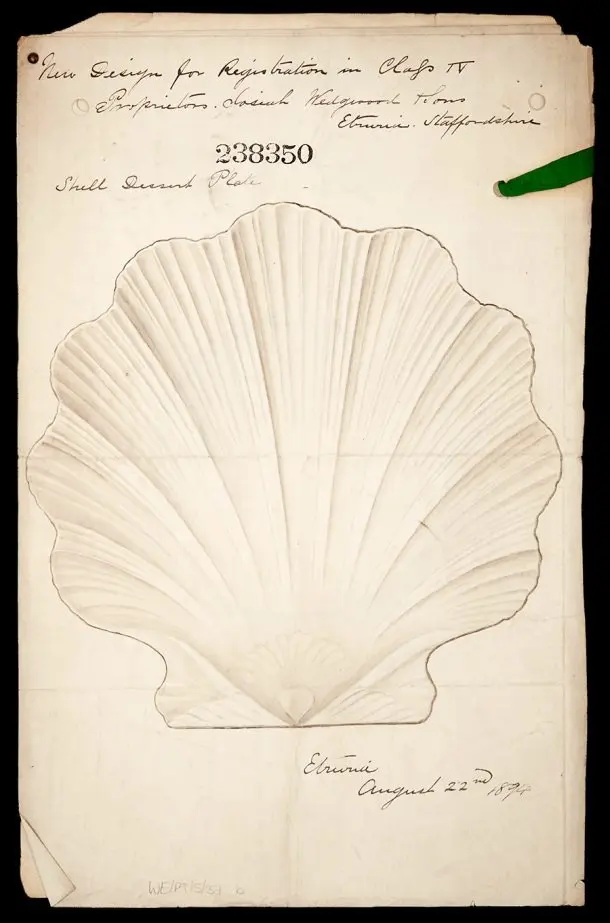
Safeguarding these innovative commercial designs was paramount for the firm. The V&A Wedgwood Collection Archive preserves numerous original design patent certificates, which granted the company exclusive legal control over specific artistic configurations. For instance, a patent record featuring a detailed illustration of a shell dessert plate, registered in August 1894 under patent number 238350, highlights the enduring commercial viability of marine-inspired tableware toward the close of the 19th century.

This reliance on historical motifs was not merely a historical footnote; it became a core design strategy. Well into the 20th century, Wedgwood designers continually revisited their own archives to breathe new life into classic forms. In 1982, manufacturing operations at Barlaston produced jasperware bowls and jugs embellished with crisp, white applied relief Pecten shells—the very same biological forms that had inspired Josiah Wedgwood’s earliest experiments two centuries prior.
Throughout the 20th century, the company maintained an active program of experimentation with new ceramic bodies and glaze formulations. Modern reproductions of 18th-century shapes, particularly the iconic Nautilus design, were perpetually reinterpreted to align with contemporary aesthetic movements.

During the mid-20th century, pastel colorways dominated interior design trends. In response, Wedgwood introduced lines like the Alpine Pink dessert service, transforming traditional shell-shaped molds through soft, contemporary color palettes. To appeal to an even wider demographic, Nautilus shell centrepieces were elevated using iridescent lustre glazes. This shimmering surface effect was achieved by brushing a specialized metallic solution across the ceramic body prior to its final kiln firing, creating a pearlescent finish reminiscent of an actual shell’s interior.
Although shell-shaped wares are no longer actively manufactured by Wedgwood today, these historic pieces remain intensely sought after by private collectors and museum curators alike. The profound dialogue between ceramic art and marine biology continues to resonate globally, as contemporary artists and designers frequently turn to natural forms to explore and promote the beauty and preservation of the natural world. In this way, the modern appreciation for shell-inspired design echoes the deep intellectual passions of 18th-century conchologists, whose historic cabinets of curiosity live on within institutional archives as an everlasting source of creative inspiration.