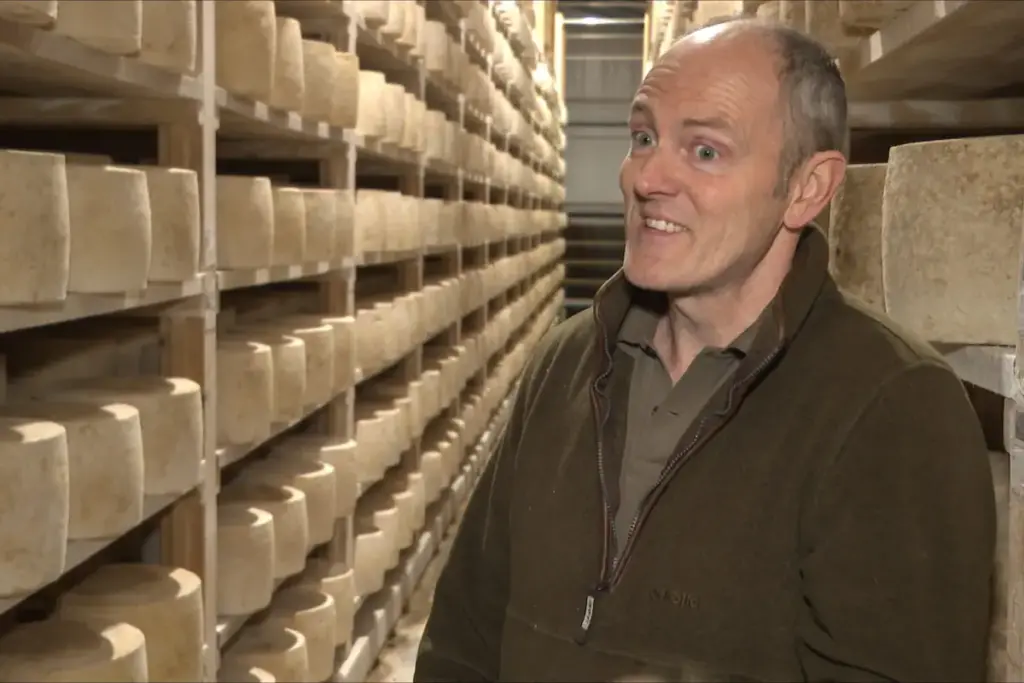
Lincolnshire, United Kingdom — A decade is a remarkably short time in the deliberate, unhurried craft of cheesemaking. In the English Midlands, massive barrels of Tim Jones’s renowned "Lincolnshire Poachers" cheese rest quietly on their wooden racks for months and, in some cases, years. Aside from the occasional mechanical intervention of Florence, the automated robot cheese turner designed to gently rotate the heavy cylinders, the wheels are left largely undisturbed. In this environment, true complexity, depth, and flavor are forged entirely through patience.
By that same chronological measure, it was only a couple of production cycles ago that 52 percent of the British public headed to the polls to vote for what remains the country’s most tumultuous constitutional revolt in living memory.
Tim Jones was one of those who cast a ballot to leave the European Union. Yet, a decade down the line, he is under no illusions about how the monumental political shift actually panned out—particularly for his agricultural exports.
“It suddenly made life much harder. We lost certain customers, and it became more expensive to get the cheese there. It definitely harmed our business,” Jones told Al Jazeera from his Lincolnshire dairy.
Ten years after the historic referendum fundamentally altered the trajectory of the United Kingdom, few segments of society appear genuinely happy with the ultimate reality of what was delivered. Remainers remain heartbroken that a majority of the country did not look upon continental integration with approval. Meanwhile, Leavers, by and large, feel aggrieved that many of the core economic and political benefits promised during the heated campaign were never actually delivered.
“I did vote to leave,” Jones reflected. “But I didn’t vote to leave in the way that we did.”
This sentiment of profound disconnect is no longer an isolated outlier; it is increasingly mirrored across the nation. Recent polling tells a remarkably consistent story about a populace undergoing a steady, measurable shift in perspective: a solid majority of Britons now view Brexit as a historical misstep.
In a YouGov survey conducted in September, 55 percent of respondents stated that leaving the European Union was fundamentally the wrong turn for the UK. In contrast, only 21 percent maintained that it was the right decision. Furthermore, public backing for reversing the process has climbed noticeably, with 59 percent of Britons now expressing support for eventually rejoining the European Union.
Where does Burnham stand?
The shifting political winds have not gone unnoticed at the highest levels of government. The relatively new Prime Minister, Andy Burnham, has clearly recognized the profound transformation in the public mood. Demonstrating a far less cautious approach than his predecessor, Keir Starmer, Burnham dramatically reignited the dormant Brexit debate shortly after stepping into office in July.
Burnham has carefully ruled out introducing major changes to the United Kingdom’s fundamental relationship with the European Union prior to the next general election. However, he has made no secret of his long-term personal ambition: he would ideally like to see the country safely back inside the European bloc within his own lifetime, and he has explicitly suggested that a future Labour Party manifesto could well promise a brand-new public referendum on membership.
The evolving political mood is only one facet of the complex logic driving this strategic recalculation. A government desperately searching for sustainable economic growth will naturally prioritize what remains its single largest trade partner. Geopolitics matter deeply as well, particularly at a time when the UK’s traditional, historic bond with the United States has arguably become less reliable and more unpredictable than it once was.
Unsurprisingly, renewed talk of Brexit has swiftly swept through media outlets across Britain and, to a lesser extent, throughout continental Europe. Burnham has repeatedly insisted that he will not get too far ahead of the public on this sensitive issue. His immediate, pragmatic concern, he emphasizes, is steadily improving the current, often strained day-to-day relationship between the UK and the European Union.

As part of this diplomatic push, Burnham traveled to Brussels for the second UK-EU Summit—a high-level vehicle originally established under Starmer’s administration to deepen post-Brexit cooperation across key sectors. Among the delicate deals currently being worked on behind closed doors are a targeted youth mobility scheme, a collaborative emissions trading agreement, and a comprehensive food and drink trade deal aimed at easing friction at the borders.
For producers like Tim Jones, these diplomatic maneuvers offer a glimmer of cautious hope.
“If he can reduce the red tape and the cost of sending cheese to Europe—and for us that means across the world—that would be a huge positive for us,” Jones said.
At the same time, the Lincolnshire cheesemaker remains distinctly hesitant when asked which way he would cast his ballot if given the chance to vote in another referendum today.
“Gosh, I genuinely don’t know. I think it would depend entirely on a critical view on the arguments that were presented at the time. A much more critical view than I had the first time around.”
It is a psychological hurdle intimately familiar to anyone who has lived through the exhausting, protracted negotiations of the Brexit years: the fine print and the exact terms matter immensely.
During the height of the political chaos, former Prime Minister Theresa May famously relied on the absolute shorthand motto, “Brexit means Brexit.” Yet, the slogan was entirely vague by design. What kind of Brexit was the country actually choosing? Hard? Soft? Norway Plus? Canada Plus?
There were dozens of potential Brexits on the table—just as there might be numerous, vastly different ways for the United Kingdom to eventually rejoin the fold. And predictably, some of those theoretical pathways are vastly more popular with the electorate than others.
A comprehensive new YouGov survey recently offered citizens a detailed menu of 18 distinct options regarding future relations. In the most popular scenario presented to respondents, 58 percent said they would vote to rejoin the EU if the UK successfully stayed out of the euro currency, joined the border-free Schengen Zone, and managed to retain its previous substantial budget rebate from the European Union.
Conversely, the political math shifted dramatically under less favorable conditions. If the UK were forced to permanently lose its historic budget rebate, remain outside the Schengen Zone, and adopt the mandatory euro currency, public enthusiasm cratered, with only 35 percent of people expressing any interest in pursuing membership under those terms.
Anticipating the bitter political battles that lie ahead as the national conversation shifts once again, pro-Brexit campaign groups are already mobilizing, relaunching themselves under fresh names such as Stay Out and Enough Official to prepare for a new ideological clash.
Prime Minister Burnham has indicated that he will formally begin exploratory talks with European Union officials concerning options for the long-term, post-summit relationship. For a nation that spent years bitterly divided over its place in Europe, the political horizon suggests one clear reality: the Brexit wars may well be starting all over again.