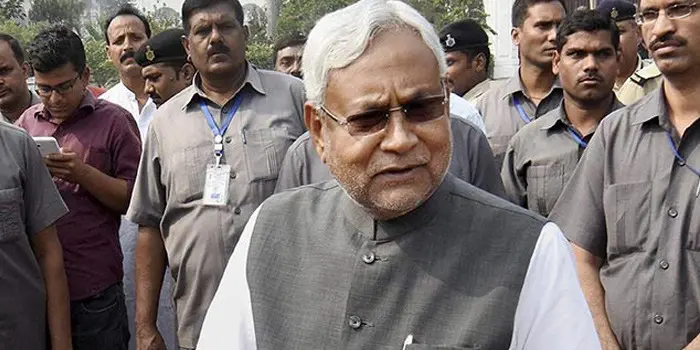
PATNA: As the political landscape of Bihar braces for high-stakes assembly elections, Chief Minister Nitish Kumar finds himself navigating a complex and precarious political tightrope. Despite his long-standing partnership and facilitation of the Bharatiya Janata Party (BJP), the veteran leader continues to aggressively court the Muslim electorate. While his supporters credit him with containing the more aggressive, divisive policies of the BJP, a profound sense of alienation grips the minority community. Across the state, Muslim voters and community leaders are confronting the administration with a singular, pointed question: Why did Nitish Kumar compromise on the Waqf law?
This deep-seated frustration highlights the widening chasm between the Janata Dal (United) leader and a critical voting bloc as Bihar heads toward upcoming polls scheduled across multiple phases, with counting culminating later in November. For a leader who once prided himself on being a secular alternative and the architect of "Sushasan" (good governance), the current political reality is fraught with contradiction.
Muslim Discontent and Broken Trust
The disillusionment among the Muslim community did not happen overnight. For years, critics and former supporters have pointed to a pattern of political somersaults and policy alignments with the BJP’s core Hindutva agenda. From supporting the Triple Talaq legislation and the Citizenship Amendment Act (CAA) to maintaining a conspicuous silence over provocative rhetoric—such as Prime Minister Narendra Modi and Home Minister Amit Shah’s "infiltrators" remarks aimed at Muslims in the Seemanchal region—Kumar’s secular credentials have faced relentless erosion.
Young voices have increasingly taken to public platforms to articulate this widespread betrayal. Reflecting the sentiment of many within his generation, young journalist Salman Ghani addressed the Chief Minister online, challenging claims of inclusive governance. Ghani captured the emotional core of the community’s grievance, noting that despite heavy hearts, many Muslims had previously accommodated Kumar’s pragmatic friendships with the BJP, only to feel utterly let down by subsequent policy decisions extending from the CAA to controversial amendments regarding Waqf properties.
Between Approval and Anger
Political analysts note that Kumar, despite operating amidst frail health, remains acutely aware of the numerical weight of Bihar’s roughly 40 Muslim-dominated assembly seats. In a tightly contested political environment where his Janata Dal (United) faces a razor-thin margin against the formidable opposition Mahagathbandhan—comprising the Rashtriya Janata Dal (RJD), the Congress, and Left parties—every vote carries magnified importance.
Yet, critics argue that Kumar is attempting an impossible political balancing act, trying to "hold with the hare and run with the hounds." For every nod of approval his welfare schemes might attract, there is a furrowed brow across the state. From the handloom weavers of Bhagalpur to the traders and laborers of Seemanchal, grievances run deep.
The sharpest blow to his minority outreach came in March 2025, when prominent Islamic organizations, including the influential Imarat Shariah, publicly boycotted the Chief Minister’s traditional Iftar gathering. The boycott was a direct protest against his government’s tacit support for the BJP’s Waqf (Amendment) Bill, which minority bodies view as an existential assault on religious endowments and properties. In an open letter echoing widespread anger, leaders reminded Kumar that he had risen to power promising secularism, only to side with political forces perceived as diluting fundamental minority rights.
This confrontation stands in stark contrast to Kumar’s assertions that Muslims have historically voted not just for him, but even for his NDA partners due to his personal goodwill—a reservoir of trust that critics argue has now been all but exhausted.
The electoral math reflects this diplomatic chill. The JD(U) has fielded only four Muslim candidates for the upcoming election, a steep decline from the eleven candidates put forward in the 2020 assembly polls. Across the broader National Democratic Alliance, the total number of Muslim candidates stands at a meager five, with zero representation coming from the BJP itself and only one ticket allotted to Chirag Paswan’s party.
While some within the JD(U) defend this drop as a pragmatic response to the reality that all eleven of their Muslim candidates lost in the previous election, other party insiders have made openly hostile statements. Suggestions from certain quarters that the community does not vote for the alliance and therefore deserves no electoral representation have further poisoned the well, irrevocably damaging whatever remaining goodwill Kumar once enjoyed.
The Sushasan Babu at a Crossroads
At 74 years of age, the leader often celebrated as "Sushasan Babu" after nearly two decades at the helm of Bihar finds himself at a defining historical crossroads. His frequent political realignments have earned him the cynical moniker "Paltu Ram" among detractors, while rising anti-incumbency whispers grow louder following a decade of NDA rule marked by persistent economic stagnation and unfulfilled employment promises.
Nonetheless, in a state where Muslims constitute approximately 17.7 percent of the population, Kumar refuses to write off the minority vote entirely, doubling down on targeted outreach efforts.
The Transactional Pitch
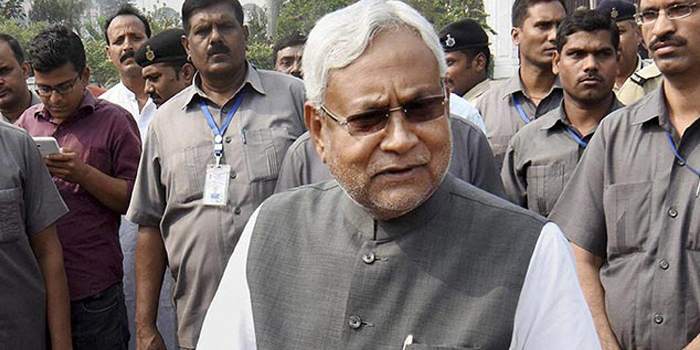
Facing skepticism, Kumar’s campaign pitch has become unapologetically transactional, grounded in a narrative of tangible administrative delivery rather than ideological alignment. Addressing a recent election rally in Purnea, the Chief Minister framed his tenure as a historical correction for a neglected demographic.
"Before 2005, Muslims were just a vote bank paraded during elections, forgotten afterward. My government changed that," Kumar declared, proceeding to list various welfare initiatives aimed specifically at Pasmanda (backward) Muslims, who form the vast majority of the state’s minority underclass.
State figures show that the minority welfare budget has expanded significantly since 2005, climbing from a modest ₹2 crore to over ₹600 crore. These funds have been channeled into scholarships, residential hostels, and skill-development training centers designed for Muslim youth.
However, critics remain unimpressed. They point out that despite the nominal budget expansion, the proportional share allocated to minority welfare continues to lag behind that of other marginalized social groups and neighboring states.
Symbolism and Shortfalls
Kumar frequently points to infrastructure projects as proof of his commitment to communal harmony, highlighting the construction of boundary walls around some eight thousand Qabristans (graveyards) to prevent land encroachment and minimize local tensions. Opponents, however, dismiss this as basic governance rather than a special favor, noting that the administration has simultaneously constructed crematoriums for the Hindu majority.
Similarly, while government initiatives regarding Madrasa modernization and improved salary structures for teachers are acknowledged, community representatives argue that these reforms remain incomplete. Salaries for Madrasa educators still fall short of parity with mainstream schoolteachers, and the Urdu language continues to face institutional neglect within state administration.
Why Nitish Still Seeks Muslim Votes
Given the accumulated friction, political observers frequently question why Kumar continues expending political capital to court a constituency that appears largely alienated.
A senior JD(U) leader, speaking on condition of anonymity, offered a candid explanation regarding the cold political calculus involved. The core social base of the JD(U) rests upon Kurmis and Extremely Backward Classes (EBCs). However, to counter the formidable 14 percent Yadav block that traditionally anchors the RJD, the party desperately requires a portion of Muslim votes. Without this buffer, analysts warn of a potential RJD-led Muslim-Yadav electoral sweep that could collapse the NDA’s share of seats.
"The BJP can afford to ignore Muslim votes; Nitish cannot," the insider noted.
Senior journalist Abdul Qadir elaborates on the psychological dimension, explaining that a specific faction within the JD(U) continues to seek minority support out of deference to Kumar’s historical political identity. Throughout his career, Kumar has carefully cultivated an image as an upholder of liberal values and cross-community respect. His pro-Mandal allies remain deeply invested in ensuring that his legacy is not permanently defined by religious majoritarianism.
The Survival Pitch
Beyond vote-bank math, internal party insiders point to a deep-seated wariness regarding the long-term designs of alliance partners such as the BJP and Chirag Paswan. While prominent national BJP figures, including Home Minister Amit Shah, publicly acknowledge Kumar as the NDA’s chief ministerial face in Bihar, they routinely avoid confirming whether he will retain the top post should the alliance win a majority. Such ambiguities risk dampening vote transfers from traditional upper-caste BJP voters and Paswan’s Dalit support base.
These underlying tensions bring sharp memories of the 2005 and 2020 elections, when Paswan—then styling himself as "Modi’s Hanuman"—ran candidates specifically to undermine JD(U) nominees, resulting in the defeat of dozens of Kumar’s party members under tacit opposition pressure. Anticipating similar vulnerabilities, Kumar views minority outreach not as a matter of ideological affection, but as an indispensable survival mechanism.
Ultimately, political analysts summarize Kumar’s strategy in starkly pragmatic terms: it is neither love nor ideology driving the outreach, but pure arithmetic. He requires just enough Muslim votes to disrupt the RJD’s consolidation, while simultaneously projecting a soft Hindutva posture to prevent his EBC support base from drifting permanently into the BJP’s expanding orbit.