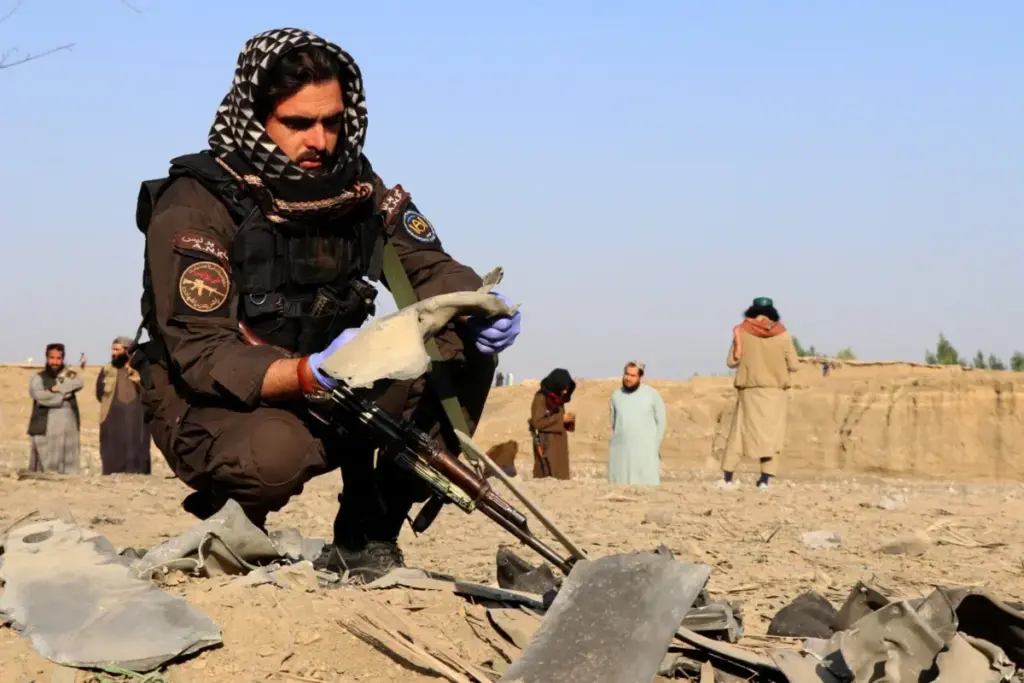
Fresh fighting erupted between Pakistan and Afghanistan on October 17, marked by heavy exchanges of gunfire across the volatile Upper Kurram-Paktia frontier. According to Pakistani security sources, the latest round of hostilities began after Afghan Taliban forces opened fire to facilitate militants attempting to cross the border into Pakistani territory.
These recurring border skirmishes underscore deep-seated and unresolved differences that continue to strain relations between the two neighboring countries. The latest outbreak of violence threatens to undo delicate diplomatic efforts aimed at establishing stability along the frontier and addressing mutual security concerns.
Only a month prior to the October clashes, a high-level diplomatic initiative had sought to ease escalating tensions. On September 16, Türkiye’s intelligence chief, Ibrahim Kalın, accompanied by a Qatari security delegation, met with senior Taliban officials in Kabul. Kalın also traveled to Kandahar before proceeding to Islamabad on September 17, where he held discussions with Field Marshal Asim Munir, intelligence chief Asim Malik, and Prime Minister Shahbaz Sharif.
However, the diplomatic momentum was short-lived. The very next day, a major terrorist attack struck Khyber Pakhtunkhwa, Pakistan’s province bordering Afghanistan. The incident involved a coordinated suicide bombing and armed assault targeting a police compound during Friday prayers, killing security personnel and civilians gathered at the mosque. In response, Pakistan carried out military strikes against several sites inside Afghanistan. This retaliation triggered renewed border clashes, effectively bringing diplomatic efforts to ease tensions back to square one.
Cost of TTP violence
Whatever the broader geopolitical causes of the diplomatic rupture between Islamabad and Kabul, Pakistan’s acute concern over terrorist violence is grounded in a dramatic and sustained surge in attacks over recent years. Across the country, terrorist incidents climbed steadily from 294 in 2021—the year the Taliban returned to power in Afghanistan—to 380 in 2022, 645 in 2023, 908 in 2024, and 1,066 in 2025.
The human cost for Pakistan’s security forces has been severe. By late September 2026, more than 1,000 Pakistani security personnel had lost their lives in terrorist violence. Pakistan had last suffered casualties on that scale in 2025, when 1,229 personnel were killed, a level of bloodshed not seen since 2009, when 1,012 security personnel died.
International observers have repeatedly highlighted the cross-border dimensions of this violence. A United Nations monitoring report identified approximately 6,000 fighters belonging to the Tehreek-e-Taliban Pakistan (TTP) operating within Afghanistan, noting that Afghan Taliban authorities continued to provide the group with operational space and support. A subsequent U.N. report stated that the TTP had been granted greater liberty and support, resulting in a direct increase in attacks against Pakistan.
Kabul consistently denies harboring militant groups that launch attacks against its neighbor. This fundamental disagreement is precisely the issue that any meaningful negotiations must address. Pakistan requires credible protection against cross-border terrorism, while both nations urgently need a viable pathway out of the escalating cycle of attacks and military retaliation.
The geopolitical friction along the frontier carries a heavy human toll, cutting directly through Pashtun tribal lands and dividing families and communities on both sides of the border. Pakistan has generously hosted millions of Afghan refugees for more than four decades. However, its accelerated return policy is now uprooting families for whom Pakistan is the only home they have ever known. While Pakistan’s security concerns are entirely real, there is a profound and tragic irony in seeing individuals who grew up under its protection now displaced as diplomatic relations deteriorate.
The breakdown in relations has severely impacted daily life and economic exchange. Afghan families who historically relied on medical treatment in Pakistani hospitals now find it increasingly difficult to cross the border, while the studies of students in both countries have been repeatedly interrupted.
Bilateral trade tells a parallel story of disruption. Afghan fruit growers have struggled to reach prospective buyers in Pakistan, while Pakistani potato farmers have lost a major export market in Afghanistan. Furthermore, the cross-border movement of vital commodities such as coal, medicines, cement, and machinery has faced continuous delays and blockages.
As Pakistan confronts mounting terrorist violence and communities on both sides bear the economic and social costs of strained relations, a separate set of security complications is emerging inside Afghanistan itself. Armed opposition groups have visibly increased their activity across parts of northern and northeastern Afghanistan, while recent clashes in Badakhshan have exposed internal factions and tensions within the Taliban’s own ranks. Despite these internal challenges, Kabul has accused Pakistan of sheltering its armed opponents and supporting unrest in Badakhshan—allegations that Islamabad categorically denies.
Conversely, the Taliban authorities reject Pakistan’s persistent concerns regarding TTP safe havens in Afghanistan, arguing that the violence confronting Pakistan is fundamentally an internal security issue. By the same logical extension, maintaining peace and internal security within Afghanistan remains the primary responsibility of those who govern the country.
The Afghan people deserve peace above all else, having endured decades of continuous war, destruction, and displacement since the geopolitical upheavals of the late 1970s. Another major conflict, whether fought across the international border or contained within Afghanistan, would only deepen a humanitarian suffering that has already lasted far too long.
Need for security, stability
When the Taliban assumed power, the prevailing international hope was that the movement, having endured a protracted insurgency, would successfully transition from military resistance to the far more complex and demanding work of governance. This transition involves repairing fractured state institutions, restoring local livelihoods, and providing exhausted families with a measure of ordinary, stable life.
Nearly a third of Afghans currently face acute food insecurity. According to UNICEF reports, approximately 3.7 million young children suffer from acute malnutrition, including around 1 million who require urgent treatment for life-threatening severe acute malnutrition. Furthermore, millions of Afghan girls remain barred from attending secondary school. Although the national economy has experienced some modest growth, overall living standards continue to decline, and the poorest households face the constant, looming danger of starvation.
These humanitarian and governance priorities should take precedence over enduring confrontations regarding the historic Durand Line. At the same time, Pakistan’s legitimate security concerns regarding militant attacks originating from Afghan territory require a serious and constructive response. Regardless of the TTP’s stated political grievances, violent extremism does not grant any group the right to impose its radical agenda on Pakistani society.
Any viable political process must begin with an immediate cessation of attacks. The Afghan Taliban should distance themselves unequivocally from TTP violence and cooperate constructively with Pakistan to prevent cross-border incursions.
Simultaneously, securing sustainable peace within Afghanistan demands equal care and inclusive governance. Women remain largely excluded from public life, and the country’s diverse minority communities must be guaranteed a meaningful place in its political future. A government that permits political and social exclusion to deepen risks generating the very internal unrest it seeks to contain.
The Taliban risk failing the Afghan population whose welfare must take precedence over narrow tribal loyalties or rigid claims of ideological purity. After decades characterized by death, forced flight, and widespread destruction, the people of Afghanistan deserve the most fundamental promise of any responsible government: a genuine chance to live without fear.