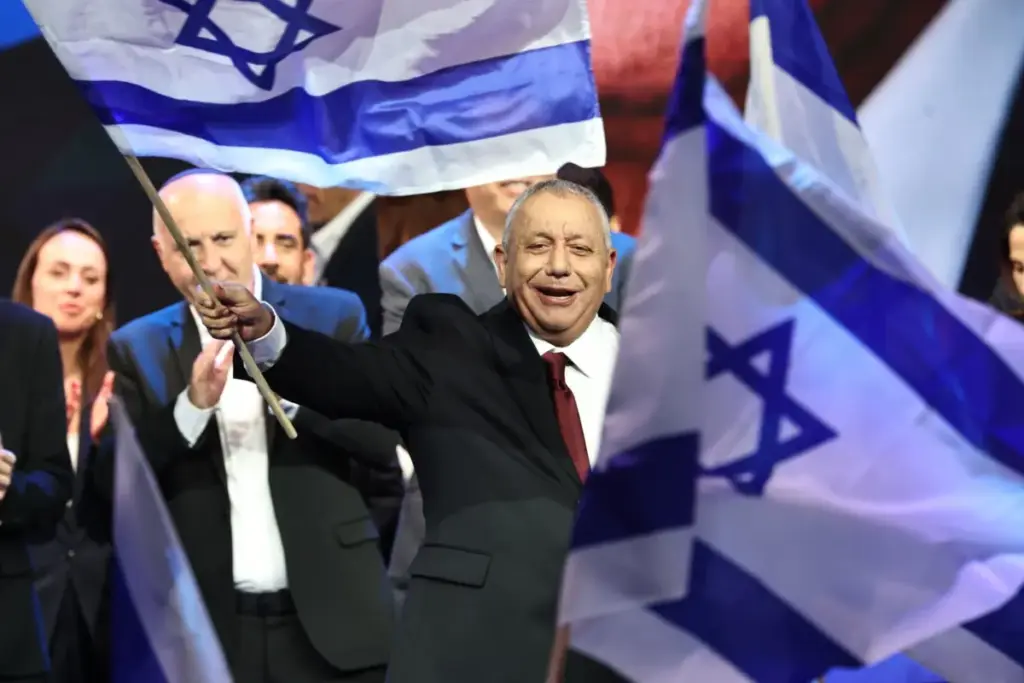
JERUSALEM — Israeli opposition leader Gadi Eisenkot announced on Friday that ongoing political negotiations aimed at establishing a broad national emergency government have advanced significantly, expressing strong optimism that he could secure an official mandate to form a new administration early next week.
In a formal statement published on the U.S.-based social media platform X, formerly known as Twitter, the leader of the Yashar party painted a stark picture of the current national landscape. Eisenkot stated that Israel was facing what he described as a "real, tangible and dangerous emergency," utilizing the gravity of the situation to urgently call for a swift and orderly transfer of political power. His primary political objective, as outlined in the statement, is to prevent outgoing Prime Minister Benjamin Netanyahu from remaining in office under caretaker status or assembling a new governing coalition.
To substantiate his claims of a shifting parliamentary landscape, Eisenkot pointed to the current mathematical reality within the Israeli legislature. He noted that a decisive majority—specifically 74 members of the 120-seat Knesset—had formally or informally expressed a lack of confidence in Netanyahu’s continued leadership. By contrast, he highlighted that only 46 lawmakers continue to support the outgoing prime minister, illustrating a deep legislative divide and a growing momentum behind alternative leadership.
Eisenkot detailed that his negotiating teams had dedicated dozens of hours to intensive, closed-door discussions with various opposition factions. These arduous talks, he maintained, had yielded "significant progress and breakthroughs" that brought the prospective national emergency coalition closer to reality than at any previous point in the current political cycle.
As part of his vision for the prospective administration, Eisenkot proposed founding the new government on four core, non-negotiable principles. First, the coalition must officially recognize Israel as a Jewish and democratic state. Second, it must steadfastly uphold the foundational values enshrined in the nation’s Declaration of Independence. Third, the administration must implement a standardized requirement for military, national, or civilian service applicable to all segments of society. Finally, the government platform must explicitly recognize Hamas as a terrorist organization while making an unwavering commitment to completely dismantling both its military apparatus and its governing capabilities in the Gaza Strip.
Building upon these foundational tenets, Eisenkot stated that he intends to extend an official invitation to all parliamentary factions and individual lawmakers who are genuinely willing to accept and abide by these principles, encouraging them to join the proposed emergency government regardless of their previous partisan alignments.
Addressing the broader risks of political paralysis, Eisenkot issued a stern warning that dragging the country into yet another round of elections would only prolong the existing domestic and security uncertainty. Such a delay, he cautioned, would inadvertently benefit Netanyahu by allowing him to remain in power indefinitely as the head of a caretaker government without securing a legitimate, majority-backed mandate from the Knesset.
Eisenkot’s public remarks arrived precisely one day after Israeli President Isaac Herzog made a landmark announcement regarding the country’s executive leadership. President Herzog stated publicly that he would formally announce his decision on Sunday regarding which specific lawmaker he intends to task with the critical mission of forming the next government.
The presidential timeline follows an extensive series of formal consultations held at the President’s Residence in Jerusalem, where Herzog met with representatives from all newly elected political parties represented in the parliament. Following these consultations, President Herzog’s office reported that factions representing a combined total of 67 lawmakers had officially recommended Eisenkot to lead the next administration. Conversely, only 46 lawmakers had backed Netanyahu during the consultation process, signaling a clear numerical preference among the majority of the legislature for a change in executive leadership.
The current political scramble is the direct fallout of Israel’s closely contested parliamentary elections held on October 27. Those elections produced a heavily fragmented and polarized parliament, complicating the arithmetic of government formation. In the wake of the vote, Netanyahu’s traditional right-wing and religious bloc secured 53 seats, while the opposing Jewish opposition bloc captured 48 seats. Meanwhile, Arab-led parties secured a pivotal 19 seats in the legislature. This complex distribution left every traditional political bloc well short of the 61 seats required to command a stable majority in the 120-seat Knesset, thereby triggering the intense negotiations, legislative maneuvering, and presidential consultations that are now reaching a critical juncture.