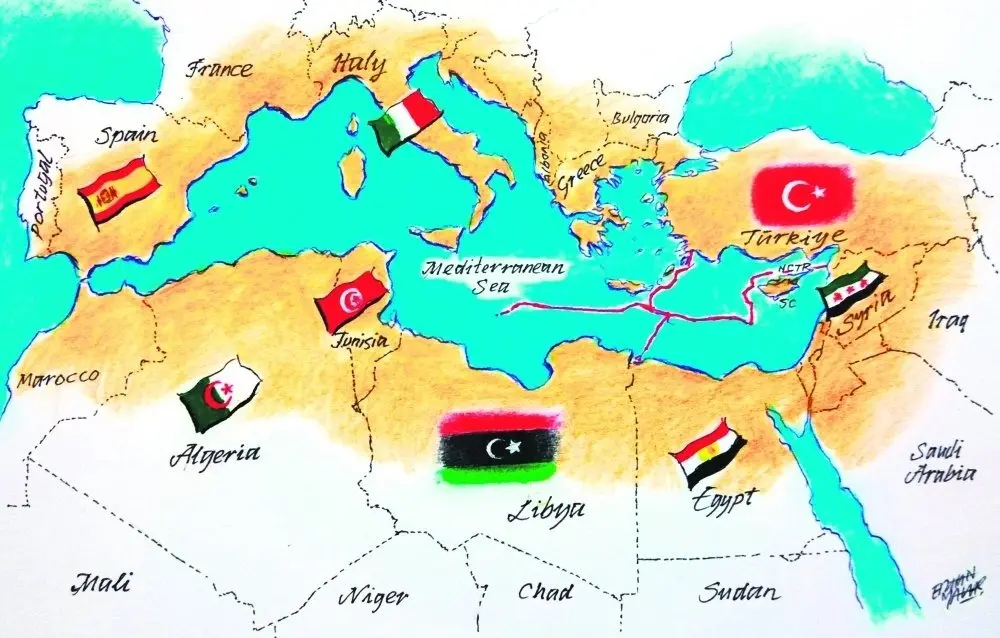
The regional order across the Middle East and the Mediterranean is undergoing a profound and rapid transformation. Amid shifting geopolitical alliances and escalating global uncertainties, disputes over maritime jurisdiction and the allocation of vital energy resources have rapidly climbed to the top of the diplomatic agenda for Mediterranean littoral states. At the center of this evolving landscape is the maritime jurisdiction agreement signed between Türkiye and Libya, a pact that has drawn intense international scrutiny because it creates viable opportunities for entirely new forms of regional cooperation.
In the wake of this foundational agreement, diplomatic and strategic discussions have increasingly emerged regarding the possibility of extending this legal framework to incorporate a broader roster of Mediterranean nations, including Algeria, Tunisia, Egypt, Syria, and Spain. Proponents of this wider diplomatic architecture argue that such an expansion could pave the way for a novel, law-based regional partnership. Ultimately, it could foster the development of a comprehensive energy, economic, and security corridor stretching across the entire length of the Mediterranean basin.
Expansion of EEZs and the Rise of a New Maritime Corridor
Achieving greater economic and strategic integration across the Mediterranean, firmly supported by mutually recognized agreements on exclusive economic zones (EEZs), offers considerable potential. Such cooperation could significantly reduce ongoing disputes over maritime jurisdiction, encouraging countries to develop their offshore energy resources through collaborative frameworks rather than counterproductive conflict. By adopting a win-win approach, participating nations could generate widespread prosperity for their own populations while simultaneously injecting much-needed stability into global energy markets.
The proposed expansion of this maritime corridor would effectively create a strategic security, economic, and energy network stretching uninterrupted from Spain in the Western Mediterranean to Türkiye in the far east, tightly bound together via North Africa. At a historical juncture when critical maritime choke points face severe operational challenges—exemplified by the closure of the Strait of Hormuz, the serious risk of closure threatening the Bab el-Mandeb Strait, and parallel vulnerabilities plaguing the Black Sea—the Mediterranean basin emerges as an indispensable alternative route. It offers a reliable and uninterrupted channel for European energy supplies originating from North Africa, a prospect made especially vital by the substantial natural gas reserves harbored by Algeria and Libya. As scenarios involving large-scale geopolitical conflicts and systemic global instability are increasingly debated in policy circles, this proposed Mediterranean corridor represents a project of immense strategic value.
The bilateral maritime jurisdiction agreement concluded between Türkiye and Libya rests on solid legal and legitimate foundations. International jurisprudence provides clear and relevant precedents for such arrangements, most notably the 2009 International Court of Justice ruling in the case concerning maritime delimitation in the Black Sea between Romania and Ukraine regarding Snake Island, as well as the series of maritime boundary agreements concluded between Tunisia and Italy between 1971 and 1979.
Furthermore, the Türkiye-Libya accord was formulated with direct reference to the sovereign rights concerning the continental shelf and exclusive economic zones established under the United Nations Convention on the Law of the Sea (UNCLOS). In full compliance with international protocols, the agreement was subsequently formally registered with the United Nations Secretariat pursuant to Article 102 of the U.N. Charter.
Expanding the scope of the original Türkiye-Libya framework to encompass Algeria, Tunisia, Egypt, Syria, and Spain could exert a decisive influence on regional power balances. Unlike the isolated, narrow energy agreements that these individual countries currently maintain with various external states, a broader, multilateral partnership encompassing defense coordination, economic integration, and long-term strategic planning could provide a far more comprehensive and secure foundation for regional stability. While Mediterranean countries currently hold deeply differing positions on maritime delimitation, addressing these disputes through direct bilateral and multilateral negotiations could change the regional dynamic. Developing shared approaches to offshore energy development and strengthening mutual cooperation in defense could encourage hesitant countries to participate. Over time, perpetual competition in the Mediterranean could give way to a broader, more resilient framework of regional unity.
The EU and Greek Perspective on Regional Dynamics
The persistent support shown by the European Union for Greece’s maximalist maritime jurisdiction claims—which Türkiye regards as entirely unjust and fundamentally contrary to international law—remains a central factor in regional friction. The underlying strategic motivations driving Brussels and Athens in this calculus are multifaceted.
First, energy security is destined to remain a permanent fixture on the international political agenda. In this context, ensuring that Mediterranean energy reserves and transport corridors remain firmly within the exclusive sphere of influence of EU member states, specifically Greece and the Greek Cypriot administration, would grant the European Union a tighter grip over its internal energy security architecture.
Second, the national borders of Greece function concurrently as the external border framework of the European Union. Consequently, any unilateral or expansive interpretation of Greece’s maritime jurisdiction carries direct administrative and strategic implications for the wider domain of European geopolitical influence.
Third, the dispute possesses a profound ideological and political dimension. Certain political circles harbor the ambition of systematically undermining Türkiye’s legitimate legal rights in the Mediterranean in favor of an exclusive arrangement designed to bolster Israel’s strategic footprint in the region. A series of gas supply agreements, proposed electricity interconnectors, defense arrangements, and related initiatives involving Israel, Greece, and the Greek Cypriot administration are viewed by analysts as components of a broader, concerted effort to project unilateral influence across the Levant and the Eastern Mediterranean.
Through its contentious interpretation of the maritime generation effects attributed to isolated islands such as Crete and Rhodes, Greece claims expansive maritime jurisdiction over areas of the Mediterranean that Libya independently considers its sovereign domain. The conclusion of the maritime agreement with Türkiye has provided Libya with the necessary legal and diplomatic leverage to robustly defend its sovereign positions against Greek claims overlapping a contested maritime zone spanning some 16,700 square kilometers.
Given that the Eastern Mediterranean represents a globally critical basin rich in offshore oil and natural gas reserves, technological capabilities are paramount. Türkiye’s advanced technological infrastructure, state-of-the-art seismic research vessels, and deep-water drilling expertise could prove instrumental in helping Libya successfully explore and develop its dormant offshore energy wealth. Within this framework, active cooperation between the Turkish Petroleum Corporation (TPAO) and Libya’s National Oil Corporation (NOC) assumes critical importance for both nations.
Synergies with Algeria and Tunisia
Forging a more comprehensive level of cooperation among Türkiye, Libya, Algeria, and Tunisia would uniquely combine Türkiye’s cutting-edge seismic exploration and deep-drilling technologies, Libya’s vast hydrocarbon deposits, Tunisia’s highly strategic geographical location at the center of the Mediterranean basin, and Algeria’s decades of deep institutional experience in the global energy sector.
The continental shelf represents a major strategic and economic asset throughout the Mediterranean. The formal participation of Tunisia and Algeria in a wider cooperative framework built around the foundational architecture of the Türkiye-Libya agreement could substantially strengthen their respective negotiating positions in international maritime forums. It would also assist them in safeguarding the maritime zones to which they claim rightful legal entitlement.
Libya consistently ranks among the world’s leading holders of proven oil and natural gas reserves. With approximately 48.36 billion barrels of proven oil reserves, the country ranks tenth globally, while its estimated 53 trillion cubic feet of proven natural gas reserves place it 22nd worldwide. It holds the largest proven crude oil reserves on the African continent and maintains some of the most significant natural gas deposits in the region. Algeria, similarly, occupies a formidable position in global energy markets, ranking 15th worldwide in proven oil reserves with approximately 12.2 billion barrels, and 10th globally in proven natural gas reserves with an estimated 159 trillion cubic feet.
When paired with Türkiye’s proven track record in rapidly expanding offshore drilling projects and Tunisia’s pivotal geographical positioning, the collective influence of this partnership becomes undeniable. Such an institutionalized alignment could significantly reinforce trade volumes and security ties while generating substantial economic dividends through lucrative energy transit corridors crossing the territories of all participating states.
The systematic exploration and development of the Mediterranean’s substantial hydrocarbon deposits could unlock sweeping opportunities for multilateral collaboration spanning energy production, pipeline transportation, logistics, and broader regional economic integration. Furthermore, to effectively protect these vital infrastructure networks and actively promote enduring regional stability, the proposed framework could seamlessly incorporate joint defense, intelligence sharing, and security mechanisms, drawing extensively upon Türkiye’s advanced defense industrial capabilities.
Egypt’s Geopolitical Constraints and Strategic Calculus
Meanwhile, Egypt commands its own formidable resource base, ranking 24th globally in oil reserves with approximately 3.3 billion barrels, and 18th in natural gas reserves with roughly 63 trillion cubic feet. Beyond its subterranean wealth, Egypt stands out on the global stage due to its exceptionally advantageous geopolitical position, anchored by the strategic lifeline of the Suez Canal.
However, Egypt remains one of the nations directly affected by regional power realignments and external pressures, particularly given historical flashpoints such as Israel’s past occupation of the Sinai Peninsula. Persistent domestic economic difficulties and ongoing risks of internal financial instability have compelled Cairo in recent years to cooperate pragmatically with Israel and Greece, even when such alignment has resulted in a net loss of sovereign maritime jurisdiction. This cautious stance has largely stemmed from Cairo’s reluctance to act independently due to pressing economic vulnerabilities, structural geopolitical constraints, and a heavy institutional reliance on substantial financial assistance from the United Arab Emirates to sustain its macroeconomic stability. Furthermore, the diplomatic momentum generated by the Abraham Accords between the UAE and Israel has placed additional political pressure on Egyptian decision-makers to maintain active cooperation with Athens and Tel Aviv in the Eastern Mediterranean.
Despite these complex and lingering challenges, Cairo has periodically signaled an underlying willingness to explore the possibility of moving toward an equitable EEZ delimitation agreement with Türkiye. Successfully concluding such an accord would help Cairo secure well over 15,000 additional square kilometers of sovereign maritime jurisdiction. Crucially, it would also grant Egypt access to highly valuable tracts designated for natural gas and oil exploration that, according to legal experts supporting this perspective, Greece has previously claimed in violation of the core principles of UNCLOS.
Concurrently, Israel maintains close and active cooperation with Greece and the Greek Cypriot administration concerning the development of its offshore natural gas discoveries, including the massive Leviathan and Tamar fields, as well as its long-term commercial ambitions to pipe gas directly into European markets. The long-discussed EastMed pipeline project remains a central pillar of Israel’s broader strategic and economic objectives in the Eastern Mediterranean. Consequently, the Türkiye-Libya maritime agreement and the prospect of a parallel Egyptian EEZ framework directly challenge these unilateral designs.
Spain’s Potential Role as a Transcontinental Bridge
Endowed with substantial energy import infrastructure, Libya and Algeria remain indispensable suppliers of natural gas to the European continent. By actively strengthening energy cooperation with these North African producers, Spain is uniquely positioned to cement its status as a major European logistics hub for transporting regional energy resources directly into broader European markets. Its favorable geographical location and existing terminal infrastructure make it exceptionally well-suited to bridging the energy gap between North Africa and Europe.
In parallel, green hydrogen has emerged as a promising frontier for future industrial cooperation. Transporting green hydrogen—produced at scale via abundant solar energy in North Africa—to energy-hungry European markets will necessitate entirely new transmission infrastructure and robust logistical networks. Spain could easily assume a central role in the physical transportation and distribution of these next-generation energy commodities.
Notably, Algeria’s formal declaration of its own exclusive economic zone in 2018 previously generated diplomatic friction and maritime jurisdiction disputes concerning the waters surrounding Spain’s Balearic Islands. Bringing Spain into a broader, multilateral Mediterranean cooperation framework could transform these points of contention into constructive economic opportunities. It would enable Madrid and its southern partners to pursue mutually beneficial arrangements and focus on joint offshore resource development rather than remaining permanently locked in bilateral maritime boundary disputes.
At a time when closer regional security cooperation can significantly enhance the capacity of Mediterranean states to coordinate on critical operational challenges such as migration management and maritime security in the Western Mediterranean, such a strategic pivot could also visibly influence Spain’s diplomatic posture within the European Union.
Spain’s strategic geographical location physically connects two continents, while its control over the Strait of Gibraltar endows the country with outsized importance in both global economic commerce and military strategy. Yet, the domestic political landscape in Madrid remains dynamic. Prime Minister Pedro Sanchez’s government has adopted a sharply critical stance toward Israeli military actions in the Middle East, a policy that has severely strained bilateral ties with Tel Aviv and prompted Israeli Prime Minister Benjamin Netanyahu to declare Sanchez persona non grata. Incidents involving diplomatic friction between Israeli leadership and Madrid have frequently drawn intense international attention.
Under these intricate circumstances, Spain’s political cycles and national elections remain vital barometers for its foreign policy direction. Continued leadership under Sanchez or shifts in government policy could directly impact whether Spain decides to engage more deeply with the proposed Mediterranean EEZ partnership. As geopolitical and economic balances shift globally, ongoing conflicts intensify, and recurring energy crises threaten European stability, Spain’s evolving foreign policy decisions will heavily influence its own national trajectory, its Mediterranean energy and defense strategies, and the broader diplomatic course of Middle Eastern conflicts.
Syria, Italy, and the Future Architecture of Mediterranean Security
Looking further across the geopolitical landscape, Syria’s Mediterranean coastline, historic strategic ports, and potential future offshore energy projects render it an important prospective partner in any comprehensive regional cooperation framework. Policy analysts suggest that the eventual stabilization of the Syrian state could open the door for a future maritime jurisdiction agreement with Türkiye, thereby solidifying a formidable geostrategic bloc in the Eastern Mediterranean basin.
Following the stabilization phases of the Syrian state, the country has frequently faced ongoing efforts aimed at destabilization through localized uprisings, foreign airstrikes, and the persistent activities of radical terrorist organizations, processes in which external actors, including Israel, have played disruptive roles. The ongoing Israeli occupation of the Syrian Golan Heights remains another major unresolved hurdle to comprehensive regional normalization. Nevertheless, Syria’s eventual integration into a cooperative regional bloc could help reinforce its long-term security, political stability, and economic recovery, facilitating national reconstruction and knitting the country back into vital regional economic networks.
Should a comprehensive Mediterranean EEZ alliance successfully materialize, it is expected to attract the keen strategic interest of Italy, potentially encouraging Rome to evaluate the tangible benefits of joining the partnership. Through the diplomatic and economic opportunities afforded by a structured Mediterranean EEZ framework, Italy could seek to formulate a more constructive and autonomous response to a global environment increasingly defined by compounding crises and overlapping conflicts. Deepened multilateral cooperation spanning energy supplies, maritime security, regulated migration management, and commercial trade could support a much more stable developmental path anchored in shared regional security.
Ultimately, the proposed Mediterranean EEZ framework is designed to function as an integrated corridor for fundamental energy security, green energy transition, commercial trade, logistical efficiency, and shared prosperity built firmly upon the principles of mutual benefit and sustained economic development. Such comprehensive cooperation could actively promote a fairer, more equitable win-win development model, offering a compelling alternative to the traditional efforts of external global powers seeking to project unilateral political and economic influence across Europe, Asia, and Africa.